How does AI safety via debate work, in short
How does AI safety via debate work? Two copies of a capable model argue opposite answers to the same question, and a judge who knows less than either of them picks the winner. The models are trained to win that contest. The bet is that, against an opponent who can point at the exact step that is wrong, telling the truth is the easier way to win.
The idea is one answer to a wider question: how people can keep supervising AI systems that know more than they do. Learn AI Alignment Theory places that question among the open research problems in its Advanced courses, where each proposal is set out next to the arguments for and against it.
The problem debate tries to solve
Many training methods for AI systems depend on a person looking at what the system did and saying whether it was good. That works when the person can check the answer. It works less well as the answers get harder.
The paper that proposed debate, AI safety via debate by Geoffrey Irving, Paul Christiano and Dario Amodei in 2018, starts from exactly that gap. Asking humans to judge which behaviors are safe and useful can fail when the task is too complicated for a human to judge directly. A long proof, a large codebase or a plan with many moving parts can look fine to a reader who has no way to check it line by line.
If the judge cannot tell a correct answer from a convincing one, training on the judge's approval rewards whatever convinces. That is the opening for answers that only seem right.
The rules of the debate game
The 2018 paper describes the setup as a zero sum game played between two agents through self play. The rules fit in a few lines:
- A question or a proposed action is put to both agents.
- They take turns making short statements, up to a fixed limit.
- A human judge reads the exchange and decides which agent gave the most true and useful information.
- One agent wins and the other loses, so any point one gains is a point the other gives up.
Zero sum is the important part. Each debater has every reason to find and expose a flaw in the other's case. The judge does not have to search the whole answer for mistakes, because one of the debaters earns its training reward by doing that search.
Self play means both sides are copies of the same model, improving by playing against each other. As the model gets stronger, so does the opponent that is trying to catch it.
A worked example with one claim to check
Take a question a judge might find slow to answer alone: is 391 a prime number? Checking that from scratch means trying divisors one after another.
Debater A argues that 391 is not prime, because it equals 17 times 23. Debater B argues that it is prime. B now has a problem. To win, B has to show that A's claim is false, and A's whole case rests on a single step: 17 times 23. The judge multiplies the two numbers, gets 391, and A wins.
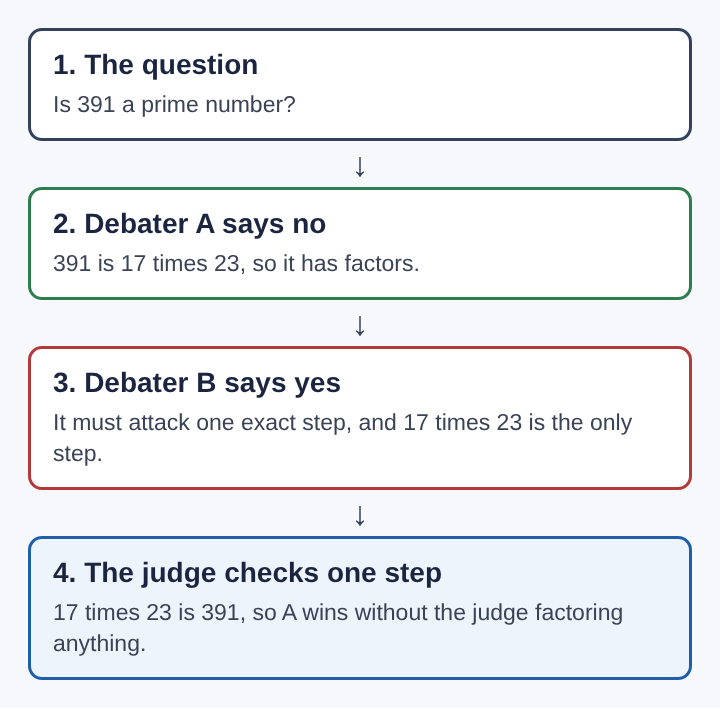
Notice what the judge did not do. The judge did not search for factors and did not need to know any number theory. The honest debater did the hard work, and the debate reduced the question to one step a non-expert could verify.
Now flip it. If 391 really were prime, A would have no true factorization to offer, and any false one would fall apart the moment B asked the judge to check it. That asymmetry is what the method depends on.
Why a lie should be harder to defend
The 2018 paper makes the case with a result from complexity theory. A judge who can only check short things directly can answer a class of problems called NP. With debate under optimal play, the paper shows that a judge with the same limited, polynomial time budget can answer any question in a much larger class, PSPACE.
In plain terms, each round of argument narrows the dispute. The liar has to commit to claims, the honest side picks the weakest one, and the fight moves down to a smaller and smaller piece until it reaches something the judge can check in one look. A long chain of reasoning becomes one short step.
That is a statement about perfect play, though. The same paper says plainly that whether debate works in practice depends on empirical questions about humans and the tasks people want AI to do, and on deeper questions about what alignment means.
What experiments have found so far
The first experiment, in the same 2018 paper, used the MNIST set of handwritten digits. The judge was a sparse classifier that could see only a few pixels of each image, and the two agents chose which pixels to reveal. Debate lifted the judge's accuracy from 59.4% to 88.9% when 6 pixels were shown, and from 48.2% to 85.2% with 4.
Later work moved to people and language. In Debate Helps Supervise Unreliable Experts, Julian Michael and colleagues collected human debates on hard reading comprehension questions. The judge never saw the passage, only the arguments and short quotes the debaters chose to reveal. Debate reached 84% judge accuracy, against 74% for consultancy, a baseline where one expert argues for a single answer that is correct half the time. Debates were also shorter, at 68% of the length.
The same study looked at where errors came from. In human debate, 46% of the errors traced to mistakes by the honest debater, which should shrink as debaters get better. In consultancy, 52% came from the expert hiding the relevant evidence, which should grow with skill. Stronger human debaters raised debate's accuracy and lowered consultancy's.
With language models as debaters, Debating with More Persuasive LLMs Leads to More Truthful Answers by Akbir Khan and colleagues found that debate helped both weaker models and humans pick the right answer: 76% and 88% accuracy, against baselines of 48% and 60%. Training the debaters to be more persuasive, with no access to the correct answers, made the judges better at finding the truth, not worse.
Where debate can go wrong
The results are encouraging, but every one of them comes from a controlled setting. Several open questions remain.
- Judges have biases. A human judge can prefer the answer that sounds confident or agrees with what they already believe. If one side can exploit that, persuasion and truth come apart.
- Some claims cannot be broken down. The method assumes a dispute can be narrowed to a step the judge can check. Questions of taste, prediction or values may have no such step.
- Both debaters might share a blind spot. Two copies of one model can make the same mistake, and then nobody in the room points it out.
- Scale. The 2018 paper itself names potential weaknesses as models grow, and the studies so far used reading questions and digit images, far from the hardest tasks people want help with.
Frequently asked questions
Who proposed AI safety via debate?
Geoffrey Irving, Paul Christiano and Dario Amodei proposed it in a 2018 paper titled AI safety via debate. It described the debate game, the complexity argument and a first experiment on handwritten digits.
Does the judge in a debate need to be an expert?
No. The point is that a judge who knows less than the debaters can still pick the true answer, because the debaters reduce the dispute to a step the judge can check.
How is debate different from asking one model to explain itself?
A single model explaining itself can leave out evidence that hurts its case, and nobody is there to raise it. In debate, the opponent is rewarded for raising exactly that evidence, which is why debate beat single-expert consultancy in human studies.
Has debate been shown to work on real AI systems?
It has helped in controlled experiments with language models on reading questions, raising judge accuracy well above simple baselines. Whether it holds up on much harder tasks and much stronger models is still an open question.
Debate and the future of AI oversight
Debate turns a hard question about trust into a narrower one about checking. Instead of asking whether a judge can understand everything a stronger model says, it asks whether the judge can follow a fight between two strong models down to one step and see who is right about that step.
If that holds, oversight could keep pace with capability, since each gain in the model also strengthens the opponent looking for its mistakes. If judges can be fooled in ways the honest side cannot correct, the same training would reward persuasion over truth. The experiments so far lean toward the first outcome, under conditions far simpler than the ones that will matter most.
Learn AI Alignment Theory
AI alignment, from first principles to open research. Visit learnaialignment.vlvd.net