What is apatheia, in plain words
If you are asking what is apatheia, the short answer is that it is the Stoic name for a mind no longer pushed around by its passions. The Greek word is built from a- (without) and pathos (suffering or passion), and the Wikipedia page on apatheia notes that equanimity is a better English word for it than indifference. It did not mean feeling nothing.
That last point is where most people go wrong. The word looks close to apathy, and apathy means not caring. The Stoics meant something close to the opposite: a person who still cares, still acts and still feels, but whose feelings follow a sound view of what matters instead of a panicked one.
The short lessons and daily practice at How to Find Your Meaning start from the same Stoic ground, with the four virtues in the morning and Seneca's three questions at night. Apatheia is the state those habits point toward.
Passions as judgments you agree to
To see why the Stoics thought freedom from passion was possible at all, start with what they meant by a passion. The Stanford Encyclopedia of Philosophy entry on Stoicism reports their definition: a passion is an impulse that is excessive and does not obey reason. It also explains that each passion can be described as a judgment.
In the usual case that judgment holds two mistakes. The first is that something outside you is truly good or truly bad. The second is that a certain reaction is the fitting one: rage, dread, grasping or gloating.
The Internet Encyclopedia of Philosophy article on Stoicism makes the same point from another side. Passions, on the Stoic view, are not automatic reflexes you are stuck with. They come from giving assent to an impression, that is, from agreeing that the way things look is the way things are. The live article on assent in Stoic philosophy covers that step in detail.
If a passion rests on a judgment, then a different judgment can undo it. That is the whole hope behind apatheia.
The four passions and what they aim at
The Stanford entry sorts the passions into four kinds, each defined by what it is about and when:
- Distress: a bad thing you believe is present now.
- Fear: a bad thing you believe is coming.
- Appetite: a good thing you believe is coming and want.
- Delight or pleasure: a good thing you believe is present now.
Notice the word "believe" in each line. A lost promotion, a rude remark or a win at cards gets its force from the opinion that it is a real good or a real harm to you. The Stoics held that only virtue is truly good and only vice truly bad, which the live piece on eudaimonia in Stoic philosophy sets out. Everything else is an indifferent. So each of the four passions, in its usual form, overstates the stakes.
Apatheia is what is left when those overstatements stop. The Internet Encyclopedia calls it freedom from passion and a part of the flourishing life, and it adds that the plainest way to read it is as equanimity in the face of whatever the world brings.
The good feelings that remain
Here is the part that surprises many readers. A Stoic free of the passions is not empty. The Stanford entry says the ideal wise person, the Sage, is not an unfeeling robot, and that the Sage has good feelings that answer to genuine goods: virtue, virtuous actions and virtuous friends.
The Internet Encyclopedia names three of these healthy feelings:
- Discretion: a reasoned turning away from vice and from what does real harm. It takes the place of fear.
- Willing: a reasoned desire for virtue. It takes the place of appetite.
- Delight: a reasoned lift of the spirit over virtue. It takes the place of the passion of pleasure.
Distress has no healthy partner on this list.
The encyclopedia also records the idea of pre-emotions, the involuntary jolts that come before you have agreed to anything. A racing heart at a loud noise, a flush of heat at an insult: these happen even to the Sage. They become a passion only if you then agree that something terrible has happened and that a violent response is called for.
Why apatheia is not apathy
The modern word apathy carries a plainly negative sense of being inert and unmoved, as the Wikipedia page notes. Apatheia is a considered calm, not a lack of care. The Internet Encyclopedia goes further and says it is a serious error to claim the Stoics wanted a passionless life in the sense of crushing their emotions.
The difference shows in behavior. An apathetic person does not answer the email, does not visit the sick friend and does not care how the project ends. A person with apatheia answers the email with a clear head, visits the friend out of real affection and works hard on the project, while refusing to let the outcome decide whether their day is ruined.
The Wikipedia page also sets the Stoics against Aristotle here. Aristotle held that virtue sits in a middle point between too much feeling and too little. The Stoics held that a virtuous life frees you from the passions altogether, because a passion is a mistake in judgment and a mistake does not have a right amount. The same page notes that Seneca used apatheia and ataraxia, the word for an untroubled mind, as near equals.
A worked example: one sharp comment in a meeting
Take a single case. In a Tuesday team meeting, a colleague says in front of everyone that your plan for the new schedule "was not thought through." Here is how the Stoic account of apatheia sorts what happens next.
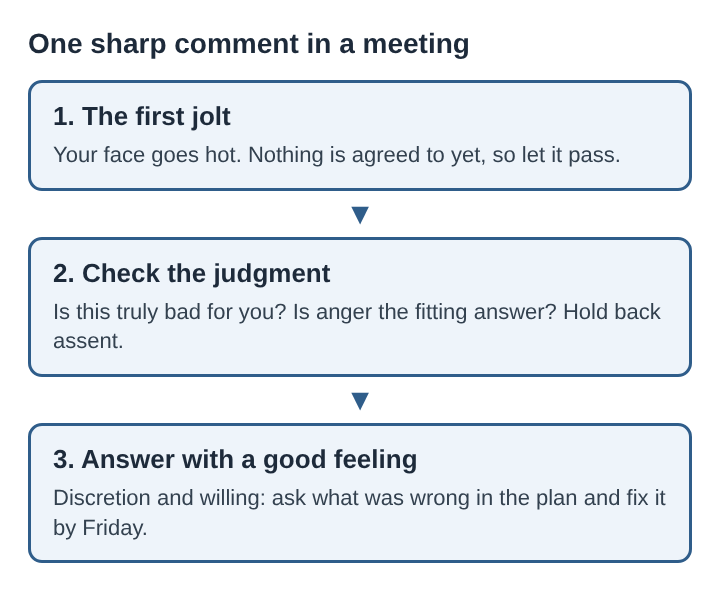
Step one, the first jolt. Your face goes hot and your jaw tightens. On the Stoic view this is a pre-emotion. You have not agreed to anything yet, so there is nothing to blame yourself for. Let the jolt pass without acting on it.
Step two, check the judgment. The impression arriving with the jolt says two things: that this comment is a real harm to you, and that anger is the fitting answer. Ask each one in turn. Your reputation in the room is an indifferent; it can be preferred, but it is not your good. Your own honesty and care in the work are your good, and the comment cannot touch them. Anger, then, would be a response to a harm that is not there. Hold back your assent.
Step three, answer with a good feeling. What remains is not blankness. Discretion turns you away from the one real harm in reach, which would be a defensive reply that is less than honest. Willing turns you toward the one real good in reach, which is getting the schedule right. So you ask the colleague which part was weak, write down the two gaps they name and send a revised plan by Friday.
Nothing about the comment changed. What changed is the judgment you agreed to, and with it the feeling and the action that followed.
Frequently asked questions
Does apatheia mean having no emotions?
No. It means freedom from the passions, which the Stoics saw as feelings built on false judgments. Healthy feelings such as discretion, willing and delight remain, and involuntary first reactions still happen.
What is the difference between apatheia and ataraxia?
Ataraxia means an untroubled mind and was a central aim for the Epicureans. Seneca used the two words almost interchangeably, but the Stoic term stresses freedom from passion reached through correct judgment.
Is apatheia a realistic goal for an ordinary person?
The Stoics tied full apatheia to the Sage, their ideal of the wise and virtuous person. For everyone else it works as a direction: each time you hold back assent from an overstated judgment, you move a little closer.
How is apatheia related to what is up to you?
Both rest on the same split between what is up to you and what is not. The live piece on what is up to you in Stoic philosophy covers that split; apatheia is the calm that follows when you stop treating what is not up to you as your good or your harm.
Apatheia as steady feeling
Apatheia asks for less than it seems to and more than it seems to. Less, because nobody is told to stop caring or to feel nothing. The first jolt is allowed, and the healthy feelings of discretion, willing and delight are welcome. More, because it asks you to look hard at each judgment that would turn a jolt into a passion: is this truly good or bad for you, and is this reaction truly fitting? A mind that keeps asking those two questions does not go cold. It goes steady, and a steady mind can feel deeply about virtue, good action and good friends.
How to Find Your Meaning
Find what your life is for. Visit findyourmeaning.vlvd.net