The founders of modern chemistry turned a craft of secret recipes into a science of measurement. Four names come up again and again: Robert Boyle, Antoine Lavoisier, John Dalton and Dmitri Mendeleev. Each one solved a different problem, and each built on the work before. Their story is part of the wider sweep of people who changed how the world works, the kind of history taught in short lessons at Learn 100 Influential People.
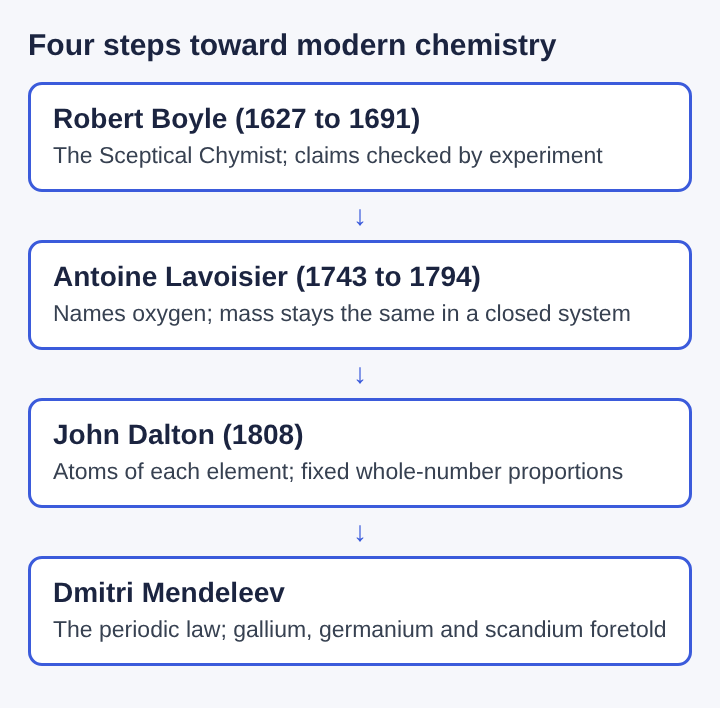
Each name carries one big idea. Boyle made chemistry rest on experiment. Lavoisier made it rest on the balance. Dalton gave it atoms with weights. Mendeleev gave it a map of the elements that could foretell what was still missing.
Why chemistry needed founders at all
For centuries, people who worked with metals, salts and acids followed the methods of alchemy. They could make dyes, medicines and alloys, but they did not share one account of what matter is made of. Recipes were often private, and claims were rarely checked by anyone else.
Modern chemistry began when that changed. Three things had to arrive. First, the habit of checking a claim by experiment and writing up the result. Second, careful weighing, so a change could be measured, not only described. Third, a theory of matter that explained why substances combine in the amounts they do. The four founders supplied these pieces in turn.
Robert Boyle and the experimental method
Robert Boyle (1627 to 1691) was an Anglo-Irish chemist, physicist, inventor and theologian. He is widely regarded today as the first modern chemist and one of the pioneers of the modern experimental method. He also worked as an alchemist, which shows how close the old craft and the new science still were in his lifetime.
His book The Sceptical Chymist is seen as a cornerstone of the field. Its title says a lot: Boyle asked chemists to doubt inherited claims and to trust results that could be repeated. He is best known for Boyle's law, which says that if you keep a gas at a fixed temperature in a closed space, its pressure and volume move in opposite directions. Halve the volume and the pressure doubles.
Boyle's law matters for more than gases. It was a rule written as a relation between two measured numbers. That is the shape most of chemistry would later take.
Antoine Lavoisier and the founders of modern chemistry
If one person sits at the centre of the founders of modern chemistry, it is Antoine Lavoisier (1743 to 1794). He was a French nobleman at the heart of the 18th-century chemical revolution, and his great step was to make chemistry quantitative, not only qualitative.
Before him, many chemists explained burning with the phlogiston theory: a burning thing was said to give off a substance called phlogiston. Lavoisier found the role that oxygen plays in combustion instead, as his biography sets out. He named oxygen in 1778 and recognised hydrogen as an element in 1783.
His sharpest tool was the balance. Using more precise measurements than earlier workers, he confirmed that in a closed system matter may change its form, but its total mass stays the same. This is now called the law of conservation of mass, and it led to the balanced reaction equations that chemistry students still write today.
Lavoisier did more. He helped build the metric system, wrote the first extensive list of elements, in which he predicted that silicon existed, and helped reform the names chemists gave to substances, so that a name could tell you what a compound contains. His wife, Marie-Anne Paulze Lavoisier, worked as his laboratory assistant and became a respected chemist in her own right. His life ended during the French Revolution: as an administrator of the hated tax-collecting body, the Ferme générale, he was executed by guillotine in 1794.
A sealed flask, worked step by step
Conservation of mass is easiest to see with numbers. The figures here are an invented example, chosen to make the arithmetic clear.
- Put 10 grams of a metal into a glass flask, seal it, and weigh the whole thing: flask, metal and air together come to 210 grams.
- Heat the flask until the metal turns into a dull powder. Do not open it.
- Weigh the sealed flask again. It still reads 210 grams. Nothing entered or left.
- Now open the flask and weigh only the powder. Say it reads 12 grams. The solid has gained 2 grams.
- Those 2 grams came from the air inside the flask. The gas lost exactly what the solid gained, so the total never moved.
Under the phlogiston theory, a burning or heated metal was supposed to lose something. The balance says the opposite: the solid gains weight by taking part of the air. Once you weigh everything in a closed vessel, the books always balance. That single habit is what turned reactions into equations.
John Dalton gives atoms a weight
Mass, then, is kept. John Dalton, an English chemist, physicist and meteorologist, explained why substances combine in the amounts they do. From precise measurements of combining ratios, he proposed that each element is made of identical atoms with a characteristic weight, and that compounds form when atoms of different elements combine in fixed whole-number proportions.
His book A New System of Chemical Philosophy (1808) set out this atomic model, gave relative atomic weights and offered symbols to write compounds. It laid the foundations of modern atomic theory and of stoichiometry, the part of chemistry that works out how much of each substance a reaction uses and makes. Later physicists would show that atoms have parts inside them, a story told in who discovered the structure of the atom, but Dalton's whole-number rule still holds for everyday chemistry.
Dmitri Mendeleev and the periodic table
By the middle of the 19th century chemists knew dozens of elements and their atomic weights, but not how they fitted together. Dmitri Mendeleev, a Russian chemist, formulated the periodic law: when elements are arranged by atomic weight, their properties repeat in a regular pattern.
What set his table apart was its boldness. Mendeleev used the pattern to correct accepted values for some known elements, such as the valence and atomic weight of uranium. He also left gaps and predicted the properties of three elements nobody had found yet. They were later discovered and named gallium, germanium and scandium. A table that could predict became far more than a list.
He published it in a Russian-language journal, and only months later Meyer published a nearly identical table. Two people reaching the same pattern at almost the same time shows how ready the field was for it. Mendeleev was also one of the founders of the Russian Chemical Society in 1868, and the synthetic element mendelevium carries his name.
Frequently asked questions
Who is called the first modern chemist?
Robert Boyle is largely regarded as the first modern chemist, for his stress on experiment. Antoine Lavoisier is the central figure of the chemical revolution that followed, because he made chemistry a science of measurement.
What did Lavoisier prove about burning?
Lavoisier found that oxygen plays the key role in combustion, against the older phlogiston theory. Careful weighing showed that a burning or heated substance combines with part of the air.
What was new about Dalton's atomic theory?
Dalton gave each element atoms of a characteristic weight and said compounds form in fixed whole-number ratios. That made it possible to calculate how much of each substance a reaction needs.
Why did Mendeleev leave gaps in his table?
The repeating pattern told him some elements were still undiscovered. He predicted the properties of three of them, later found as gallium, germanium and scandium.
How the founders of modern chemistry built one science
Each founder handed the next one a tool. Boyle asked for experiments anyone could repeat. Lavoisier weighed everything and found that mass is never lost, which turned reactions into equations. Dalton explained those equations with atoms that combine in whole numbers. Mendeleev arranged the atoms' elements into a pattern strong enough to name what was missing. Read in order, the four lives show chemistry growing from doubt, to measurement, to theory, to prediction, the same path most sciences take on their way to becoming exact.
Learn 100 Influential People
100 people who shaped history, from Moses to the web. Visit influentialpeople.vlvd.net