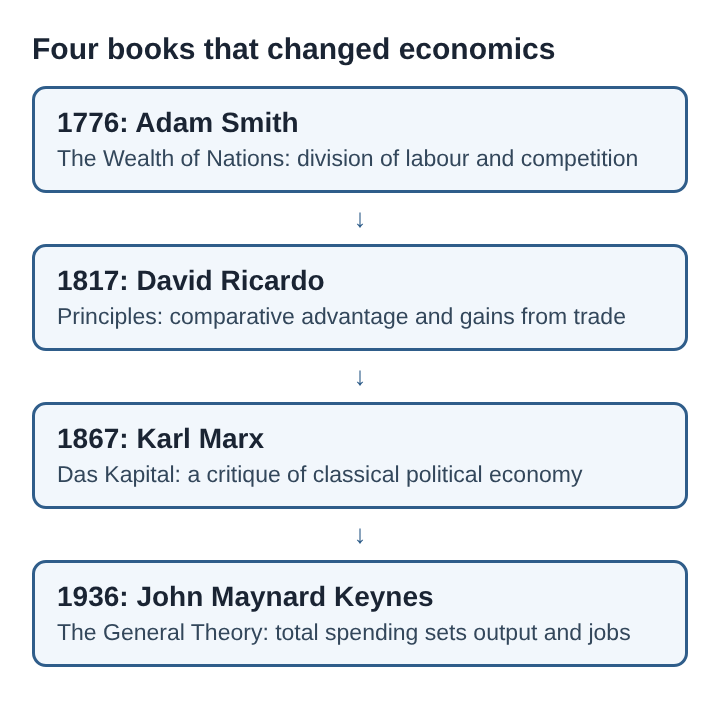
The most important economists in history were people who wrote one book that changed how governments, traders and workers saw the world. Four names come up again and again: Adam Smith, David Ricardo, Karl Marx and John Maynard Keynes. Each answered a different question. Where does wealth come from? Why should countries trade? Who gains from capitalism? And why do whole economies sometimes stall for years?
Why these are the most important economists
Economics is young as a subject of its own, so a short list of thinkers set most of its first questions. Learn 100 Influential People treats economy as one of the fields where single people shaped history, next to war, religion and science, and its course on the thinkers of the economy sits in the part about how ideas and markets spread. The four names here are not the only candidates. They are the ones whose arguments still sit inside the debates you hear about trade deals, wages and recessions.
Reading them in order shows a pattern. Each one answered the problem of his own time, and each answer opened a new question for the next.
Adam Smith and the wealth of nations
Adam Smith was a Scottish philosopher of the eighteenth century and a central figure of the Scottish Enlightenment. Many call him the father of economics. His first major book, The Theory of Moral Sentiments, came out in 1759 and dealt with ethics. His second, The Wealth of Nations, is the one that made his name.
Two ideas carry most of its weight. The first is the division of labour: when work is split into small, repeated tasks, the same number of people make far more. The second is that rational self-interest and competition, inside a market, can lead to general prosperity without anyone planning it.
Smith was a moral philosopher before he was an economist, and The Wealth of Nations is a long book. It also covers schooling and the duties of the state, and in its fifth part he compares the teaching at English and Scottish universities. Readers who quote only the market passages miss much of what he wrote.
David Ricardo and the case for trade
David Ricardo was born in London in 1772, the son of a stockbroker. He made a fortune financing government borrowing, then retired, wrote economics and bought a seat in Parliament as a reformer. He is counted among the most influential classical economists, beside Smith and Thomas Malthus.
His lasting gift is comparative advantage, set out in his Principles of Political Economy and Taxation in 1817. The idea is that two countries can both gain from trade even when one of them is better at making everything. What matters is not who is best at a thing, but who gives up the least to make it.
Working through Ricardo's wine and cloth
Ricardo's own example still makes the idea click. Take two countries and two goods, counted in hours of work.
- England needs 100 hours to make one unit of cloth and 120 hours to make one unit of wine.
- Portugal needs 90 hours for one unit of cloth and 80 hours for one unit of wine.
Portugal is faster at both. So why trade? Follow the hours.
- Without trade, England spends 100 plus 120, so 220 hours, to have one cloth and one wine. Portugal spends 90 plus 80, so 170 hours.
- Now let each country spend the same hours on the good it gives up least to make. England puts all 220 hours into cloth. At 100 hours a unit, that makes 2.2 units.
- Portugal puts all 170 hours into wine. At 80 hours a unit, that makes 2.125 units.
- Between them, the two countries now hold 2.2 cloth and 2.125 wine, where before they held 2 of each. After a swap, each can have a full unit of both, with something left over.
Nobody worked harder and no new machine was built. The extra came only from each side doing what it was relatively better at. That is why the idea still sits under almost every argument for open trade, and why critics who attack trade deals usually attack its assumptions, such as workers moving easily between jobs, rather than its arithmetic.
Karl Marx and the critique of capital
Karl Marx read Smith and Ricardo closely and turned their tools against the system they described. A German philosopher and revolutionary socialist, he built a theory of history called historical materialism, which explains social change through class struggle. He wrote The Communist Manifesto with Friedrich Engels in 1848, and his major work, Das Kapital, appeared from 1867, with later volumes published up to 1894.
Where Smith saw self-interest and competition spreading prosperity, Marx asked who owned the workshops and who did the work. He argued that capitalism set owners and workers against each other and would in the end give way to a new system. His forecasts are fiercely disputed, and many did not come true in the form he expected. Yet his ideas inspired revolutionary movements in many countries, and few thinkers of any kind have changed more governments.
John Maynard Keynes and the problem of slumps
John Maynard Keynes was an English economist who first trained in mathematics. He wrote his major book in the 1930s, a decade of mass unemployment, when the older classical theory said a free market should soon put the jobless back to work.
His answer, in The General Theory of Employment, Interest and Money in 1936, was that total spending in an economy, which he called aggregate demand, sets how much gets made and how many people get hired. If spending falls and wages do not drop easily, an economy can sit with high unemployment for years. In such times, as his biography sums up the book, the economy must depend on the state rather than the market.
Keynes is often called the father of macroeconomics. Late in life he worked on the financial order agreed at the Bretton Woods Conference after the Second World War. When governments today cut taxes or spend more to fight a recession, they are using his reasoning, whether or not they name him.
Frequently asked questions
Who is called the father of economics?
Adam Smith is the name most often given that title. The Wealth of Nations is widely seen as a forerunner of economics as a subject of its own.
What is the difference between absolute and comparative advantage?
Absolute advantage means making a good with less work than anyone else. Comparative advantage means giving up less of other goods to make it, and that is what lets both sides gain from trade.
Was Karl Marx an economist or a philosopher?
Both. He trained in philosophy, and Das Kapital is a critique of the political economy of Smith and Ricardo, so he is read in both fields.
Why does Keynes still matter?
His idea that total spending drives jobs and output is the basis of how most governments respond to recessions, through spending, tax changes and interest rates.
What the four economists share
Smith, Ricardo, Marx and Keynes disagreed about almost everything, yet each began from a real problem in front of him: a growing trading nation, the question of what to import and what to make at home, factory towns full of poor workers, and a world stuck in a depression. Each turned that problem into a simple idea that others could carry. The division of labour, comparative advantage, class struggle and aggregate demand are still four of the first ideas anyone meets when they ask how an economy works, and the arguments between them are still running in parliaments today.
Learn 100 Influential People
100 people who shaped history, from Moses to the web. Visit influentialpeople.vlvd.net