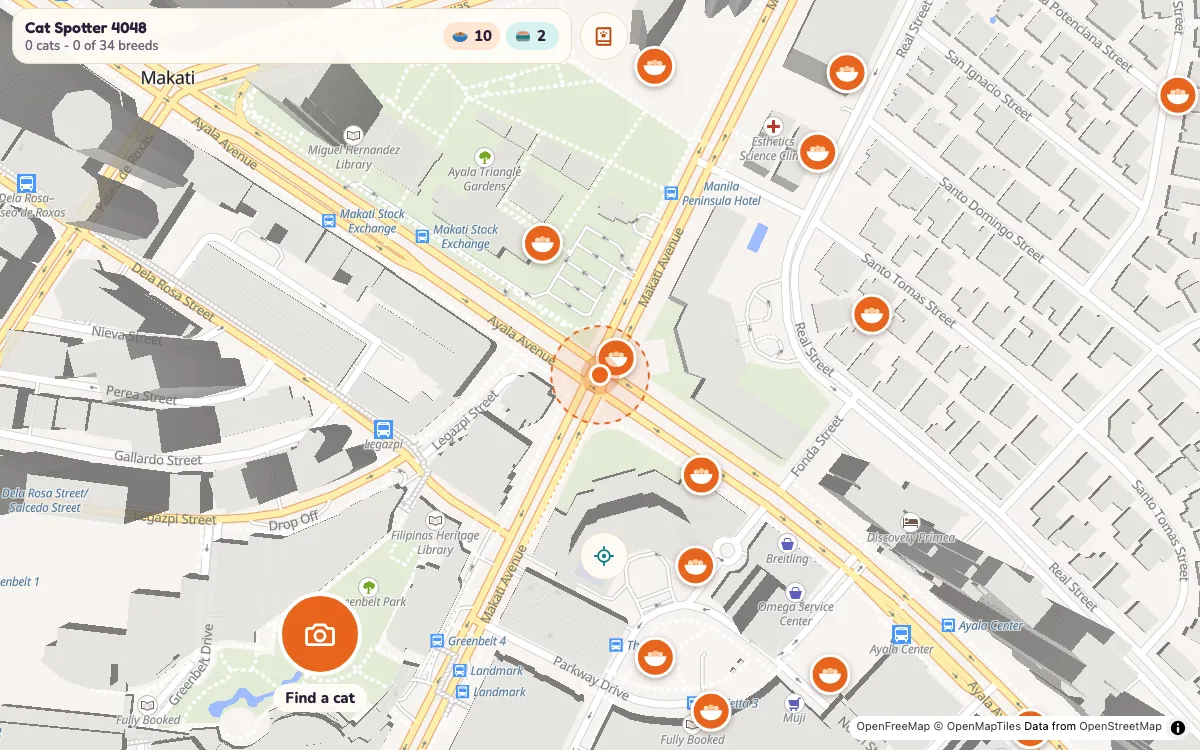
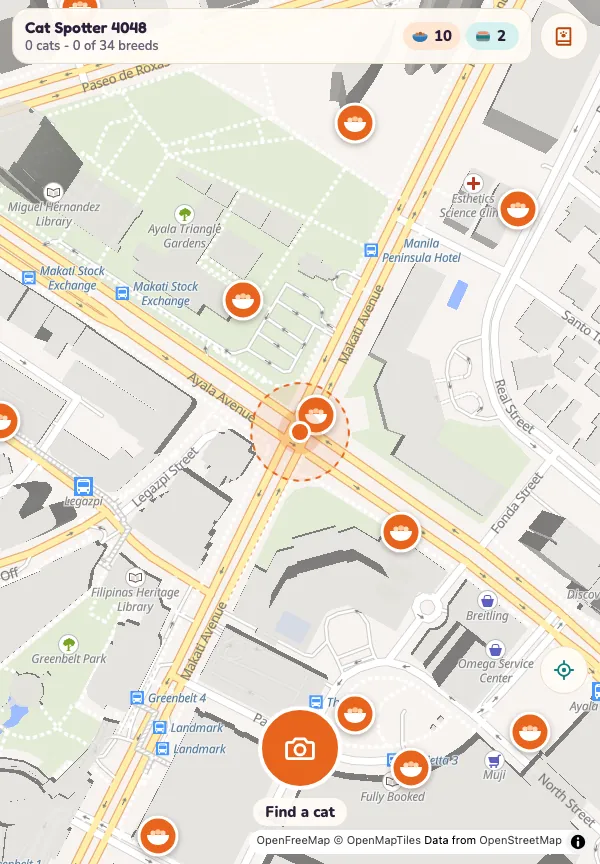
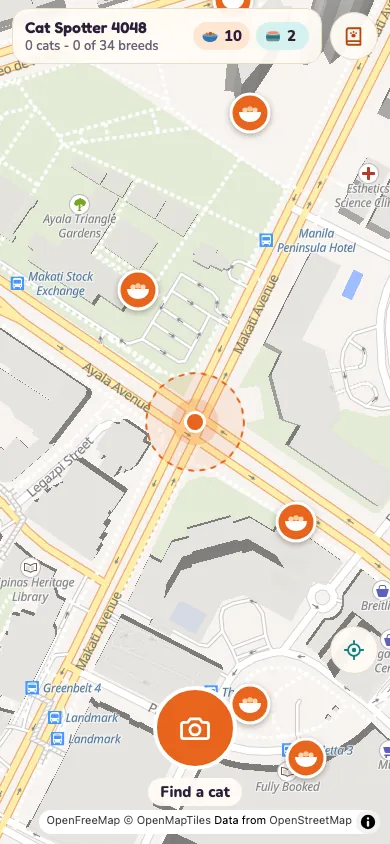
What is a Turkish Van cat? It is a large, semi-longhaired breed whose colour sits only on its head and its tail, while the rest of the body is white. That layout is so tied to the breed that it carries the breed's name: the Van pattern. The Turkish Van is also rare, and in the walking game Cat Go it sits in the very rare group of the Catdex, next to the Chartreux, the Korat and the Singapura, far from the common Domestic Shorthair and Domestic Longhair. A white cat with a red tail on a garden wall is worth a second glance, but the pattern alone does not make a pedigree.
What is a Turkish Van cat, in plain terms
A breed is a cat with a registered family line, kept to a written description by cat registries. According to the Turkish Van page on Wikipedia, the Turkish Van was developed in the United Kingdom during the 1950s from cats brought back from several cities in Turkey. It is one of the larger breeds, and what sets it apart is the Van pattern: colour restricted to the head and the tail, with everything else white. That pattern comes from the white spotting gene, a form of partial leucism that leaves most of the coat without colour.
The eyes add a second clue. A Turkish Van can have blue eyes, copper-orange eyes, or one of each, which is called being odd-eyed. Put together, the white body, the coloured head and tail, the silky coat and those eyes give the breed a look that is easy to remember and also easy to mistake.
Four cats from four Turkish cities
The breed's story starts in 1955. Two British photographers, Laura Lushington and Sonia Halliday, were working in Turkey for the Turkish Ministry of Tourism when they were given two unrelated cats. Lushington took them home to England and let them mate. The kittens came out the same as their parents, chalk white with dark markings on the head and tail, so she set out to build a recognised breed.
The founding cats came from all over the country. Van Iskenderun Guzelli, a female, came from Hatay Province in 1955, and Stambul Byzantium, a male, was a gift from a hotel manager in Istanbul the same year. Two more were added in 1959: Antalya Anatolia, from the city of Antalya, and Burdur, from the city of Burdur. None of them came from the Van area, and Lushington did not visit the city of Van before 1963. Why the breed ended up named after Van is still unclear.
Registration followed slowly. The Governing Council of the Cat Fancy, the main UK registry, gave the breed full pedigree status in 1969 under the plain name Turkish cat. It was renamed Turkish Van in 1979 in the UK and in 1985 in the US, to keep it apart from the Turkish Angora. The International Cat Association gave it championship status in 1985, and the Cat Fanciers' Association moved it from the miscellaneous class in 1988 to championship status in 1994. It has stayed scarce: in 2024 only 49 Turkish Van kittens were registered with FIFe, a large international registry, ranking the breed 40th of 54.
The Van pattern: colour on the head and tail
The pattern is the first thing to read, and registries are strict about it. The classic Turkish Van is red tabby and white, but the colour on the head and tail can be red, cream, black or blue, alone or with tabby or tortoiseshell markings. A few random spots on the body are allowed, as long as colour covers no more than about 20% of the cat and it does not start to read as a bicolour, a cat with large patches of colour across the back.
Two things fall outside the breed. Colourpoints, the darker face, ears, legs and tail of a colorpoint cat, are not allowed. And a fully white cat is a hard case: the CFA and FIFe recognise only Van-patterned cats, while the World Cat Federation and the GCCF treat solid white ones as a separate breed under names such as Turkish Van Kedisi. Solid white cats of this line are prone to deafness, as many white animals are, and some registries require a clean hearing check before registration.
Coat, tail, build and eyes
Once the pattern fits, the rest of the cat should fit too. The breed's description covers it in some detail:
- Coat: semi-long, with no obvious undercoat, so it feels soft and smooth to the touch and repels water. It is thick and long in winter and sheds to a shorter, lighter coat in summer.
- Tail: a full brush tail, often with rings of colour, that stays long and full all year.
- Ears and paws: ears feathered with fur inside, and tufts of fur between the toes.
- Build: large and muscular, with broad shoulders, a short neck and a body that carries its weight forward. The back legs are slightly longer than the front ones.
- Size: males weigh roughly 4.5 to 9 kg and females roughly 3 to 5.5 kg, and some reach about 1 m from nose to tail tip.
- Eyes: blue, copper-orange or odd-eyed, set in a face with high cheekbones and a long, straight nose.
Age changes all of this. A Turkish Van takes three to five years to reach full maturity, and its coat grows in over the same span. Kittens and young cats can seem short-haired, with thin tails, and only later fill out across the chest and grow the full brush tail. A lean young cat with a thin coloured tail can still be a Turkish Van in the making.
Naming a white cat with a coloured tail: a worked example
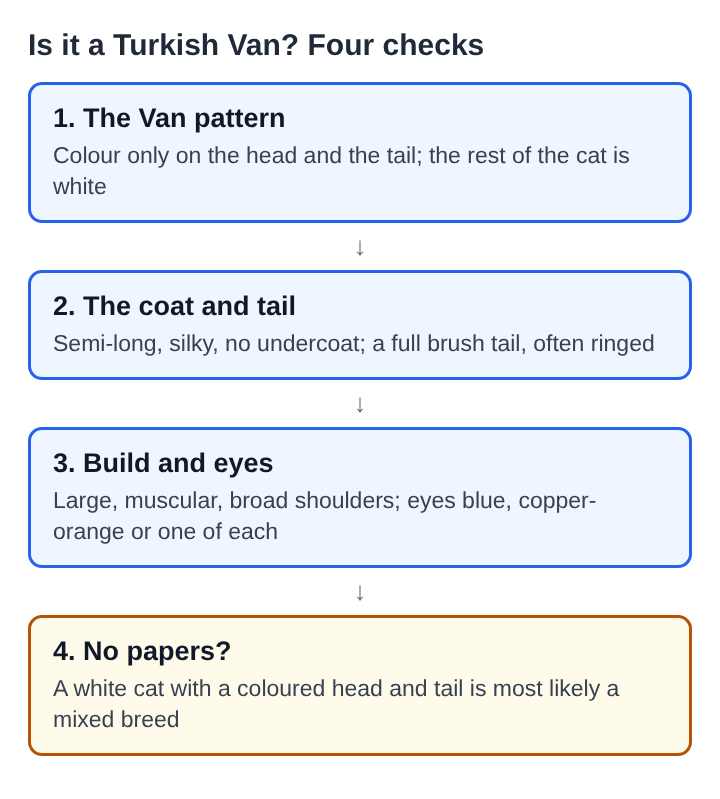
Say a white cat crosses a courtyard ahead of you. Its head has a red patch between the ears and its tail is red with faint rings. You want to name it. Stay where you are, let the cat go about its business, and work through four checks.
First, the pattern. Is the colour limited to the head and the tail, with the body white? A cat with a red saddle across its back, or big patches on its sides, is a bicolour, not a Van-patterned cat.
Second, the coat and tail. Is the coat medium-long and silky, with a full, brushy tail? A short, tight coat and a thin tail on an adult cat point away from the breed.
Third, build and eyes. A big, strong cat with broad shoulders fits. If it turns your way, blue, copper or mismatched eyes fit too. Green eyes or a small, fine build do not.
Fourth, the honest limit. The white spotting gene behind the Van pattern turns up in ordinary cats everywhere, so a random-bred cat can carry colour on just its head and tail. With a breed this rare and no papers to check, the likely answer is a mixed breed with a Van pattern. In the game, a photo is checked for a cat and its coat is read, then it asks "Which breed is it?" and you choose from a list. Its own advice suits this cat well: "Most cats you meet are mixed breed. Rarer breeds are warier." When nothing settles the question, "Mixed breed is always a safe pick."
The Van cat of Lake Van is a different animal
The name causes a common mix-up. Around Lake Van in eastern Turkey lives a local cat called the Van cat, or Van kedisi in Turkish. According to the Van cat page on Wikipedia, it is a landrace, a natural local type, rather than a registered breed. Van cats are usually solid white, sometimes with amber markings, and have blue or amber eyes or one of each. They are known as the swimming cat and have been seen swimming in the lake.
The Turkish Van is often said to descend from these cats, but its founder's own records place every foundation cat far from Van. The local cats have also grown scarce: a 1992 survey found only 92 pure Van cats in their home area, and a breeding programme for the solid white type has run at the Van Cat Research Centre of Van Yuzuncu Yil University since 1995. So a solid white, odd-eyed cat in Turkey and a red-tailed Turkish Van at a British show share a name and a story, not a family line.
Frequently asked questions
Do Turkish Van cats like water?
The breed's coat repels water, and the related Van cat of Lake Van has been seen swimming, which is where the swimming cat name comes from. How much any single cat enjoys water varies.
Is a Turkish Van the same as a Turkish Angora?
No. They are separate breeds, and the Turkish Van was renamed from Turkish cat in 1979 partly to keep the two apart.
Can a Turkish Van be all white?
Some registries, such as the GCCF and the World Cat Federation, register solid white cats of the line under a separate name, while the CFA and FIFe recognise only Van-patterned cats.
How rare is the Turkish Van?
Quite rare. In 2024 FIFe registered only 49 Turkish Van kittens, placing the breed 40th of 54.
What the Van pattern tells you about a cat
The Van pattern is one of the easiest coats to spot: colour on the head and the tail, white everywhere else. On a large, silky cat with a full brush tail and blue, copper or odd eyes, it makes the Turkish Van a fair guess. But the gene behind the pattern is common, the breed is scarce, and the white cats of Lake Van share the name without sharing the pedigree. Read the pattern first, the coat and build second, and remember that a white cat with a coloured tail is far more often a mixed breed than a Turkish Van.
Cat Go
Walk anywhere, find a real cat, and catch it. Visit catgo.vlvd.net