What is a Scottish Fold cat? It is a breed whose ears fold forward and down, so they lie flat against the head like a small cap and give the face a round, owl like look. Those ears come from a single gene, and the same gene changes how cartilage grows in the rest of the body, which is why the breed is both famous and refused by some registries. In the walking game Cat Go, the Scottish Fold sits in the rare group of the Catdex, far from the common Domestic Shorthair and Domestic Longhair. That ranking matches the street: a cat with folded ears is an uncommon sight.
What is a Scottish Fold cat, in plain terms
A breed is a cat with a registered family line, bred to look a certain way. Most breeds are defined by many traits at once. The Scottish Fold is defined by one. According to the Scottish Fold page on Wikipedia, its folded ears are caused by a naturally occurring dominant mutation linked to a condition called feline osteochondrodysplasia, shortened to FOCD. FOCD affects how cartilage and bone form throughout the body. In the ears, it makes the cartilage fold.
That has two consequences for anyone trying to name a cat. First, the ear fold is the one sign that counts most, because it is the trait the whole breed was built around. Second, a cat can carry Scottish Fold ancestry and still have ordinary, upright ears, which matters later.
Susie, the barn cat from Coupar Angus
Every Scottish Fold goes back to one cat. In 1961 a white barn cat named Susie was found on a farm near Coupar Angus, in Tayside, Scotland. Her ears had an odd fold in the middle. When Susie had kittens, two of them were born with folded ears. One went to William and Molly Ross, neighbouring farmers who kept and showed cats, and they started breeding from it.
The breed was first called Lop-ears, or Lops, after the lop eared rabbit. The name changed to Scottish Fold in 1966. In 1970 the first kittens went to the United States through Neil Todd, a researcher in Massachusetts who was studying the mutation, and breeders there continued the line with American Shorthairs and British Shorthairs. The Cat Fanciers' Association gave the breed championship status in 1978. A longhaired version followed, recognised by The International Cat Association in the 1987 to 1988 show season and by the CFA in 1993 to 1994. Depending on the registry, the longhair is called the Highland Fold, Scottish Fold Longhair, Longhair Fold or Coupari.
The folded ears and the round face
The ears are the first thing to look at, and the breed's own description is precise about them. Small, tightly folded ears set close to the head like a cap are preferred over a loose fold and a larger ear. From the front, the folded ears barely break the outline of the skull, so the head reads as a circle.
The rest of the cat repeats that circle:
- Head: round and domed at the top, with full cheeks and rounded whisker pads.
- Eyes: large, round and set wide apart, which gives the breed what its fans call a sweet expression.
- Nose and neck: a short nose with a gentle curve, and a very short neck.
- Body: medium to large, well rounded with a padded look, on medium to short legs.
- Size: males typically weigh 4 to 6 kg and females 2.7 to 4 kg.
- Coat: short and thick and soft, or long with tufts at the extremities, in almost any colour or pattern, white and calico included.
The folded ears still work as ears. A Scottish Fold swivels them to listen, lays them back when it is angry and lifts them when something interesting happens. So a fold that flicks and turns is not a sign of a different cat; it is how the breed behaves.
Scottish Straights: the same family with upright ears
Not every kitten from a Scottish Fold litter has folded ears. The ones that do not are called Scottish Straights. When a fold eared cat that carries one copy of the gene is bred to a straight eared cat, roughly half the kittens fold and half do not. Some kittens even fold at first and then straighten as they grow.
This matters for identification. A Scottish Straight has the same round head, round eyes and padded body as its folded litter mates, but nothing on its ears to point to the breed. Seen on a wall or a doorstep, a Scottish Straight is just a round faced shorthair to the eye, and since the breed was built partly from British Shorthairs, it can easily pass for a British Shorthair. Without papers, nobody can tell them apart by eye.
Naming a fold eared cat: a worked example
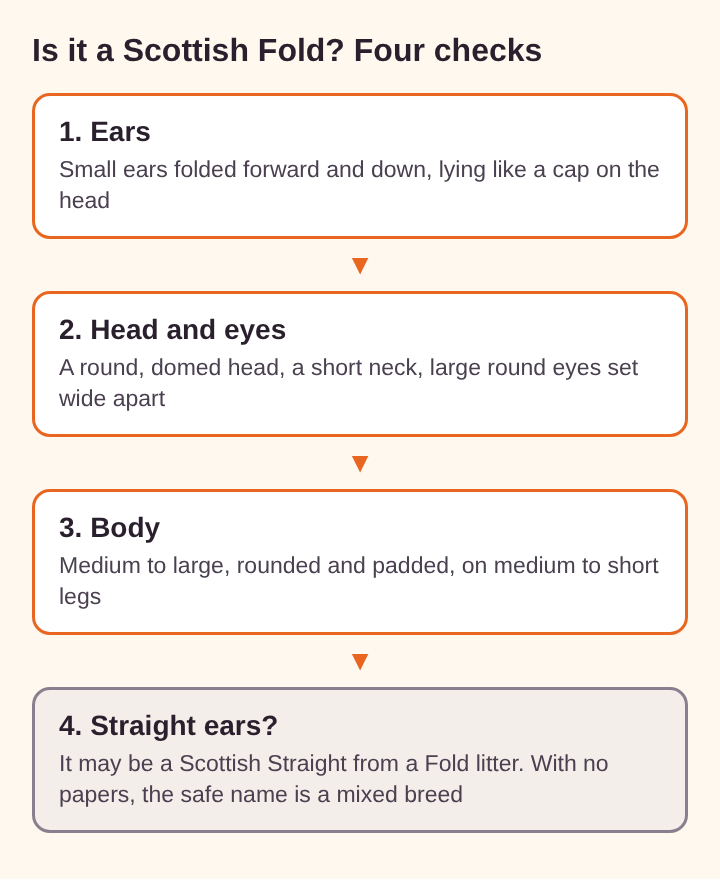
Say you see a cat in a neighbour's window with ears that seem to sit flat on its head. You want to know what it is. Work through four checks from a calm distance.
First, the ears. Are both ears folded forward and down, lying close like a cap? Ears pressed back or out to the sides are not the same thing. The fold of a Scottish Fold points forward, toward the face, so the tips sit over the front of the head.
Second, the head and eyes. Look for a round, domed head with full cheeks, a short neck and big, round eyes set wide apart. A wedge shaped head with tall, upright ears is a different kind of cat.
Third, the body. A rounded, padded body on legs that look medium to short fits the breed. A long, lean, long legged cat does not.
Fourth, the honest limit. Even a cat that passes all three checks is only a likely Scottish Fold, not a proven one. A cat with no papers can carry the gene from a fold eared parent and be a mixed breed, and a straight eared cat could be a Scottish Straight you would never spot. In Cat Go, the game checks your photo for a cat and reads its coat, then asks "Which breed is it?" and you choose from a list. Its own advice is the sensible one here: "Most cats you meet are mixed breed. Rarer breeds are warier." When nothing fits clearly, "Mixed breed is always a safe pick."
Why some registries and countries refuse the breed
The gene that folds the ears does not stop at the ears. Research summarised on the Wikipedia page found that all Scottish Folds are affected by FOCD to some degree. The same mutation can cause a short, stiff tail, and cats with one copy of the gene develop a progressive form of arthritis whose severity varies a great deal from cat to cat. Cats with two copies, from breeding one Fold to another, are prone to severe problems, which is why that pairing is considered highly unethical. In 2016 the mutation was traced to a gene called TRPV4.
Registries and lawmakers have reacted. The Governing Council of the Cat Fancy, the main UK registry, withdrew registrations in 1971, and neither it nor FIFe, a large international registry, accepts the breed today. The Netherlands banned breeding fold eared cats in 2014, Austria in 2020, Flanders in Belgium in 2021, and the state of Victoria in Australia has a ban too. Some researchers argue for ending Fold breeding altogether, while CFA breeders say that pairing Folds only with straight eared cats has removed the worst tail and bone problems. Either way, a cat's folded ears are a sign of a gene with effects well beyond its looks.
Frequently asked questions
Are Scottish Folds born with folded ears?
Kittens from a Fold litter are born with straight ears, and only some of them go on to fold. Those that keep upright ears are called Scottish Straights.
Is a cat with curled back ears a Scottish Fold?
No. Ears that curl back toward the rear of the skull belong to a different breed, the American Curl, which began with a stray in Lakewood, California, in 1981. A Scottish Fold's ears fold forward and down.
What colours do Scottish Folds come in?
Almost any colour or pattern, including white, tabby and calico. The breed comes in both a shorthaired and a longhaired form.
Why is the Scottish Fold banned in some countries?
The gene behind the fold also affects cartilage and bone throughout the body and is linked to arthritis. Several countries and regions, including the Netherlands, Austria, Flanders and Victoria, have banned breeding fold eared cats for that reason.
What a folded ear tells you about a cat
The Scottish Fold is unusual because a single visible trait carries most of the identification. Ears folded forward and down like a cap, on a round head with big round eyes and a padded body, make the breed a strong guess. But the same family produces straight eared kittens with nothing to set them apart from any round faced shorthair, and a fold eared cat without papers may be a mixed breed with one Fold parent. Read the ears first, the head and body second, and keep in mind that the fold is the sign of a gene that shapes far more than the ears.
Cat Go
Walk anywhere, find a real cat, and catch it. Visit catgo.vlvd.net