What is a British Shorthair cat? It is the pedigree form of the old house cat of Britain: a stocky, round headed cat with a short, very dense coat that feels plush under the hand. Most people picture the British Blue, a solid grey blue cat with copper eyes, but the breed comes in many colours and patterns. You can meet one on a doorstep, and you can also meet a dozen round grey cats that are not one at all. The walking game Cat Go files the British Shorthair as an uncommon breed in its Catdex, one step up from the Domestic Shorthair, which says a lot about the odds.
What is a British Shorthair cat, in plain terms
A breed is a cat with a registered family line, bred to a written description of how it should look. The British Shorthair is one of the oldest of them. The British Shorthair page on Wikipedia describes it as the pedigree version of the British domestic cat landrace, a local type that grew up on the islands long before anyone kept pedigrees.
That history is the whole reason identification is hard. The breed was drawn out of the ordinary cat population, so ordinary cats in Britain and elsewhere still share much of its look. A pedigree British Shorthair is that look, fixed and exaggerated: a heavier body, a rounder head and a denser coat than the average street cat.
It is also popular. About half of all kittens registered each year with the Governing Council of the Cat Fancy, the main UK registry, are British Shorthairs. It ranked sixth in the United States in 2023, and second of 54 breeds in the 2024 figures of FIFe, a large international registry, with 16.9% of the kittens registered there.
Where the breed came from
Nobody knows exactly how cats first reached the British Isles, but they seem to have arrived before the Roman invasion. Those cats bred with the local European wildcat, and over the centuries their isolated descendants became large, sturdy animals with a short, thick coat suited to a damp climate.
Selective breeding started in the nineteenth century. The British Shorthair was shown at the first organised cat show, run by Harrison Weir at the Crystal Palace in London in 1871. Breeders were especially keen on the blue grey colour, which became known as the British Blue.
The breed then nearly disappeared. Longhaired imports such as the Persian took over the fashion, and by the First World War breeding stock was critically rare. Breeders crossed in Persians, Russian Blues, Burmese and the French Chartreux to keep the lines going, then spent decades pulling the type back. By the late 1970s the British Shorthair had full recognition from all three major registries: the CFA, FIFe and TICA.
The round head and the stocky body
Shape is the best clue, because colour can be copied by any cat. A British Shorthair is built heavy and compact:
- Body: large and powerful looking, with a broad chest, thick legs that are medium to short, and round paws.
- Head: large and distinctly round, with full cheeks, a short muzzle and a short nose. The neck blends into the cheeks, so there seems to be little or no neck at all.
- Ears: small to medium, broad at the base and set wide apart, which keeps the top of the head looking flat and round.
- Eyes: large, round and level. Breeders count the shape as more important than the colour.
- Tail: medium length, thick at the base, tapering to a rounded tip, about two thirds the length of the body.
Size helps too, with one catch. Males average 4 to 8 kg and females 3 to 5 kg, a clear gap between the sexes that is unusual in domestic cats. But the breed matures slowly and is not fully grown until about three years old, so a young British Shorthair can look slighter than the picture in your head.
A plush coat in more colours than blue
The coat is the other defining feature. It is very dense, straight and even in length, plush rather than woolly or fluffy, with a firm pile that visibly breaks open over the body as the cat moves. Many short coated street cats have a sleek, flat coat that lies close to the skin; the British coat stands up from it.
Blue is the famous colour, not the only one. White, black, blue, red, cream, cinnamon and fawn are accepted by every major registry. The GCCF, FIFe and TICA also allow chocolate and lilac; the CFA does not. Any of these can be solid or one of the four tabby patterns, classic, mackerel, spotted and ticked, and there are silver, golden, colourpoint, bicolour and tortoiseshell versions as well. A longhaired form exists too: the British Longhair, identical apart from its longer, denser coat, which some registries treat as its own breed.
Telling one apart from a grey street cat: a worked example
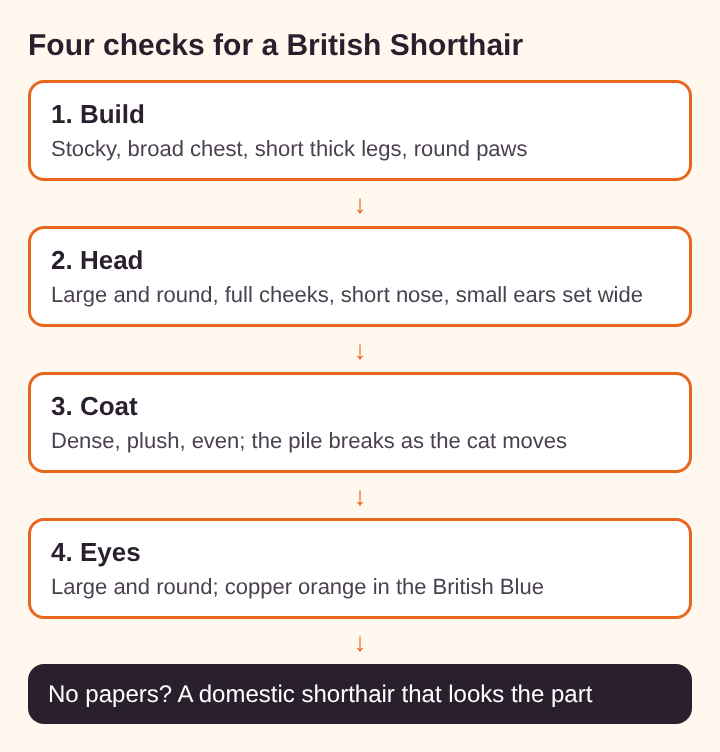
Say a solid grey cat sits on a garden wall near you, and you want to name it. Work through the checks in order.
Build first. Is the chest broad and the body thick, on legs that look short for its size? A long, lean cat with a narrow chest fails here, whatever its colour.
Then the head. Look for a big, round face with heavy cheeks, a short nose and small ears set far apart. A wedge shaped face or tall ears close together point away from the breed.
Then the coat. When the cat turns, does the fur part in a plush pile, or does it stay flat and smooth? A thick, standing coat is a good sign.
Then the eyes. A grey British Blue has large, round, copper orange eyes. Green or yellow eyes in a grey cat do not prove anything on their own, but together with a slim build they make the breed unlikely.
Now the honest answer. Even if the cat passes all four, you cannot know it is a pedigree without papers. A sturdy grey domestic shorthair can show every one of these traits, because the breed was drawn from cats like it. In Cat Go the game checks your photo for a cat and reads its coat, then asks "Which breed is it?" and you pick from a list. Its own hint is the right one: "Most cats you meet are mixed breed. Rarer breeds are warier." When you are unsure, the game says, "Mixed breed is always a safe pick."
The Chartreux and other grey lookalikes
A round, grey cat with copper eyes could also be a Chartreux, a rare French breed. It is genetically unrelated to the British Blue but very similar in appearance, which is partly why breeders once used it in British lines. The Chartreux is large and muscular on short, fine boned limbs, with a water resistant blue double coat and orange or copper eyes. Its tapered muzzle gives it a look of smiling, while the British Shorthair has a shorter muzzle and fuller cheeks.
The Russian Blue is the other grey cat people mix up with it. In the early days the heavier British type was called the "English type" to set it apart from the more fine boned "Russian type". If the grey cat on the wall is slim and elegant rather than round and solid, the British Shorthair is the weaker guess.
Frequently asked questions
Is every grey cat a British Shorthair?
No. Grey, or blue, is a common colour in mixed breed cats. A British Shorthair is defined by its stocky build, round head and dense plush coat, and by a registered family line.
Do British Shorthairs only come in blue?
No. Blue is the best known colour, but the breed is accepted in white, black, red, cream, cinnamon, fawn and more, solid or tabby, plus colourpoint, bicolour and tortoiseshell versions.
How big does a British Shorthair get?
Males average 4 to 8 kg and females 3 to 5 kg. The breed grows slowly and reaches its full size at around three years old.
Is the British Shorthair the Cheshire Cat?
The breed is often named as the inspiration for John Tenniel's drawing of the Cheshire Cat in Alice in Wonderland. That is a story about the drawing, not a trait you can check on a living cat.
Naming a round grey cat on the street
The British Shorthair grew out of the ordinary British cat, so its look still turns up in cats with no pedigree at all. That makes it one of the easiest breeds to suspect and one of the hardest to confirm. Read the shape before the colour: a broad chest, short thick legs, a big round head with full cheeks, small ears set wide and a coat that breaks open in a plush pile. A cat with all of those may be a British Shorthair. Without papers, the safer name is still a domestic shorthair with a British look, and knowing why is what makes the guess worth something.
Cat Go
Walk anywhere, find a real cat, and catch it. Visit catgo.vlvd.net