What is a Bengal cat? It is a pedigree breed first bred by crossing a small wild cat, the Asian leopard cat, with domestic cats. Its tabby coat carries spots that often form rosettes, clusters with a darker edge around a lighter middle, or a swirled pattern called marbling. It is a medium to large cat with long back legs and a tail held low. Most spotted cats on a street are not Bengals, and Cat Go, a walking game where players photograph real cats and keep each catch with its breed and the place it was found, puts the Bengal among its eight uncommon breeds, one step above the ordinary domestic shorthair and longhair.
What is a Bengal cat: a breed with a wild grandparent
The Wikipedia page on the Bengal cat describes it as a hybrid breed, made by crossing the Asian leopard cat with domestic cats, above all the spotted Egyptian Mau, with the Abyssinian and others in the early mix. The name has nothing to do with where the cats live today. It comes from the leopard cat's scientific name, Prionailurus bengalensis, which means "of Bengal", the region of South Asia.
The wild side of the family is a real animal you would never meet on a doorstep. The leopard cat lives in the forests of South, Southeast and East Asia. It is about the size of a house cat, but more slender, with longer legs and black spots on a tawny body. Those spots are what breeders set out to keep.
The modern breed starts with Jean Mill of California, who made the first known deliberate cross of a leopard cat with a black domestic tomcat in 1963. People had written about such crosses long before. Harrison Weir mentioned them in 1889. Serious breeding came later, and the registries followed one by one:
- The International Cat Association (TICA) accepted the Bengal as a new breed in 1986 and gave it championship status in 1991.
- The Governing Council of the Cat Fancy in Britain accepted it in 1997, and FIFe in 1999.
- The Cat Fanciers' Association accepted it in 2016, only for cats six or more generations away from the leopard cat.
How much wild cat is left in a Bengal
Less than the name suggests. The first three generations bred from a leopard cat, called F1, F2 and F3, are known as foundation Bengals, and the early males are often unable to father kittens. Breeders therefore pair early females with later, fully domestic Bengal males. A genome study of 947 Bengals in 2024, cited on the Bengal page's genetics section, found an average of only 3.48% leopard cat DNA, spread thinly across the whole genome.
So the Bengal on a neighbour's windowsill is many generations removed from anything wild. What it kept is mostly a look: the spots, the stance and a coat unlike most house cats.
Rosettes and marbling: the Bengal coat
Every Bengal is a tabby. Domestic cats come in four heritable tabby patterns: ticked, mackerel, blotched and spotted, and the tabby article on stripes, swirls and spots walks through each one. A Bengal takes the spotted or the blotched kind and pushes it further.
- Spotted. The spots range from plain domestic dots to arrowheads and rosettes. The Wikipedia page calls the Bengal the only domestic breed with rosette markings.
- Marbled. Instead of spots, the coat carries long sideways swirls, the Bengal's version of the blotched tabby.
Colour comes on top of the pattern. A Bengal can be black, which breeders also call brown, seal or sable, or blue. Either can come with or without silver and with or without charcoal, a darker shading. There are also three pale "snow" coats, point, sepia and mink, which are the same colour restriction found in pointed breeds; the colorpoint article explains how that gene darkens only the cooler parts of the body. Long haired Bengals exist too. They come from a recessive gene carried over from the domestic side, and TICA has accepted the Bengal Longhair, sometimes called the Cashmere Bengal, for competition since 2017.
A long body on long back legs
The coat gets the attention, but the outline helps as well. The Bengal is a medium to large breed. Its back legs are longer than its front legs, so the hips can sit a little higher than the shoulders, and it carries its tail low as it walks.
Telling a Bengal from a spotted tabby
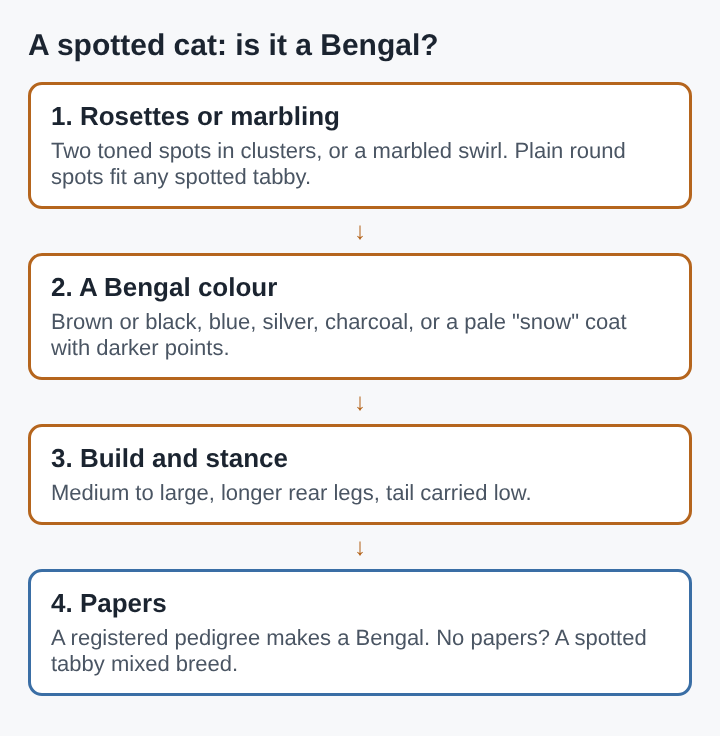
Plenty of ordinary cats have spots. A spotted tabby with no pedigree is far more common than a Bengal, and the article on what a mixed breed cat is called explains why such a cat is a domestic shorthair, not a breed. Four questions sort most cases:
- Are the spots rosettes or marbling? Two toned clusters, arrowheads or long swirls point toward a Bengal. Small, plain, evenly dark spots are what any spotted tabby has.
- Is the colour one a Bengal comes in? Brown or black, blue, silver, charcoal, or a pale snow coat with darker points. Ginger is not in the Bengal list.
- Does the build match? A longer, medium to large body, higher hips and a tail carried low.
- Are there papers? A breed is a matter of registered ancestry. Without a pedigree, even a cat with good rosettes is a spotted tabby of mixed breed.
The fourth question is the one you can almost never answer on a street, which is why the first three only ever give a likely answer.
A worked example: the spotted cat on the wall
You are walking past a garden wall and a spotted cat is sitting on it, watching you. You stay where you are and look from a distance.
- Pattern. The spots on its sides are dark brown with a black edge and a lighter middle, grouped in clusters. That is a rosette, a point for a Bengal.
- Colour. The ground colour is a warm golden brown. Black, also called brown, is a Bengal colour. Another point.
- Build. When it stands and walks along the wall, its hips ride higher than its shoulders and its tail hangs low. A third point.
- Papers. You have no way to see them, and the cat is not yours to ask about.
In Cat Go the game checks the photo for a cat and reads its coat, then asks "Which breed is it?" and leaves the choice to the player. It also says "Most cats you meet are mixed breed. Rarer breeds are warier." A cat with all three signs here is a reasonable Bengal pick. If the spots had been plain dots on a grey coat, the game's own advice applies: "Mixed breed is always a safe pick."
Frequently asked questions
Is a Bengal cat part wild?
Only distantly. The breed began with crosses to the Asian leopard cat, but a 2024 study of 947 Bengals put their leopard cat DNA at an average of 3.48%, and most registries accept only cats several generations removed.
Are Bengal cats hypoallergenic?
That has not been shown. Breeders often claim it, but geneticist Leslie Lyons notes that there is no such thing as a hypoallergenic cat, so a person with severe allergies may still react.
Is it legal to keep a Bengal cat everywhere?
No. Bengals are prohibited in Hawaii and illegal to own in Connecticut, and Australia banned their import from March 2025. Rules elsewhere vary by country, state and town.
How popular is the Bengal breed?
In 2024 it was the most popular breed in TICA's registry. In FIFe's 2024 figures it ranked seventh, with 3.7% of the kittens registered that year.
Why most spotted cats are not Bengals
The Bengal is common at cat shows and rare in the street for the same reason: it is a pedigree breed, bred on purpose from a narrow line that goes back to the leopard cat whose kittens are registered with a pedigree. The spotted tabby pattern behind it is old and everywhere, carried by countless cats with no papers at all. So when you see spots on a wall or a doorstep, the plain answer is nearly always a spotted tabby. Rosettes, marbling, a long low tailed outline and a known pedigree together are what make the rare case a Bengal.
Cat Go
Walk anywhere, find a real cat, and catch it. Visit catgo.vlvd.net