Knowing how to decide which problem to solve first saves you from spending a whole month on the loudest problem while the one doing the most damage keeps going. The method is short. Write every problem down in one line, sort them by how urgent and how important each one is, then ask which problem feeds the others. The one that feeds the most, and that you can start on this week, goes first. The rest get a date or get dropped on purpose.
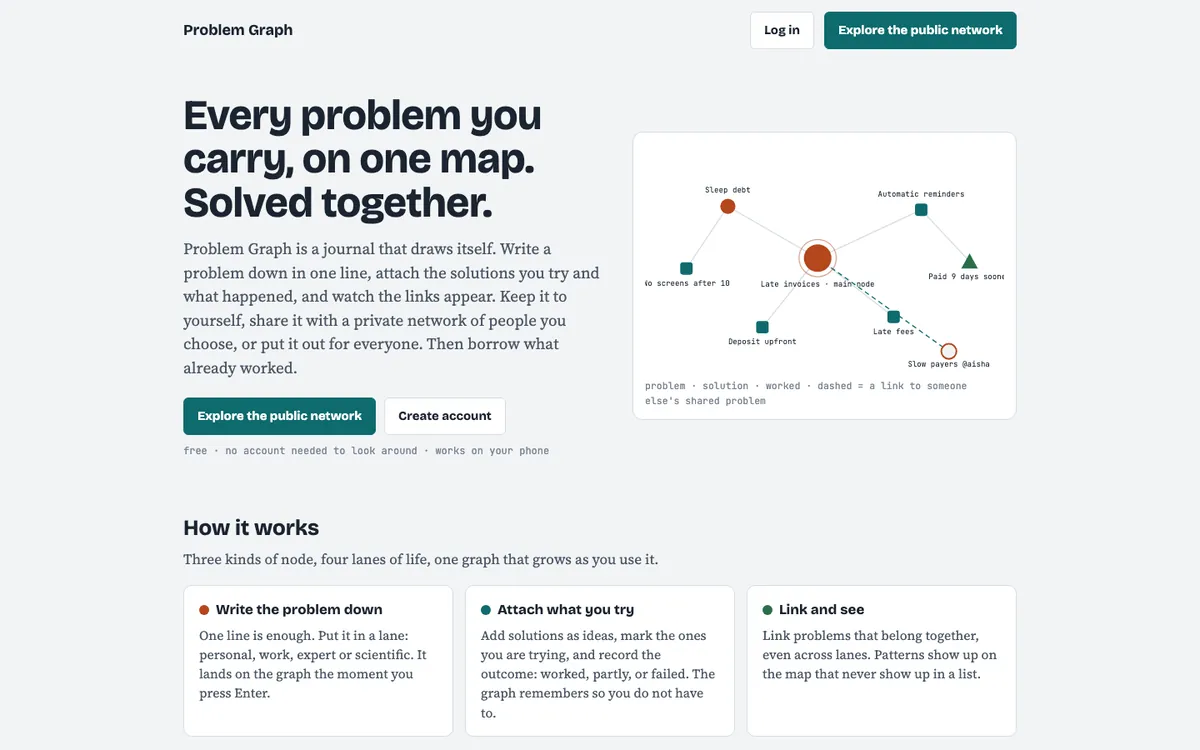
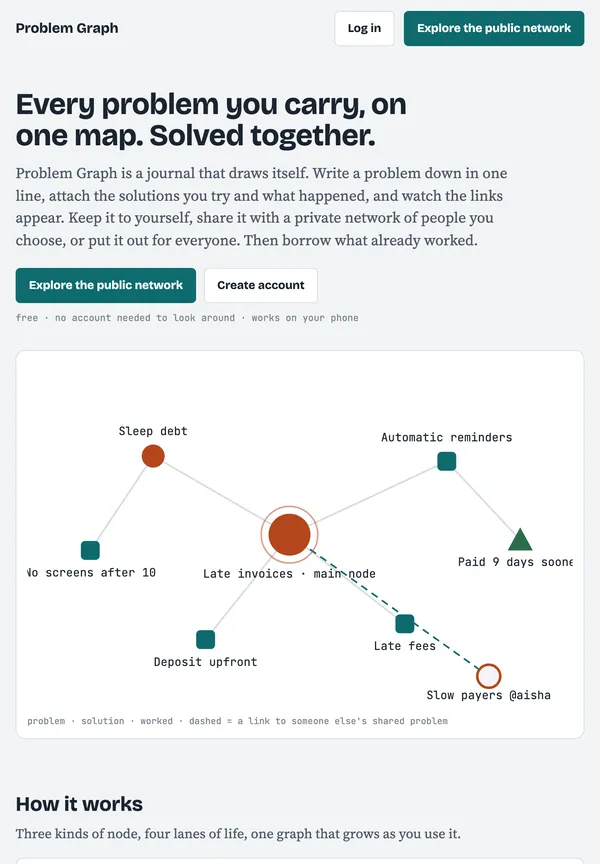
Writing problems down is the part most people skip, and it is the part that makes the rest possible. Problem Graph is built around that habit: each problem goes down in one line, in one of four lanes (personal, work, expert or scientific), and related problems can be linked, even across lanes, so you can see which ones belong together. You do not need any tool to follow these steps, though. A sheet of paper works.
Why the wrong problem keeps winning
When you carry several problems at once, the one that gets your attention is usually the one that shouted last. A bill that is due tomorrow, a message that needs a reply, a noise in the car. Those feel pressing because they are close in time, and closeness in time is easy to confuse with importance.
The cost is that slow problems never reach the top. A back that aches a little more each month, a money habit that leaves you short every few weeks, a job that drains you. None of them has a deadline, so none of them ever seems to be today's problem, and they grow while you deal with the quick ones.
A choice made in your head also changes with your mood. On a tired evening, the easiest problem seems the right one to start with. On paper, with a few plain questions, the choice holds still long enough for you to judge it.
Step one: write each problem in one line
Start by putting every problem that is on your mind onto one list. Give each one a single line that says what is wrong, not what you plan to do. "Overdraft fees almost every month" is a problem. "Make a budget" is a solution, and it hides the problem it was meant for.
One line per problem keeps them comparable. If one entry is a paragraph and another is three words, the long one will feel bigger whether it is or not. If you find yourself writing two problems in one line, split them. If two lines turn out to be the same problem seen from two sides, merge them.
Keep the list to what is actually bothering you now. Ten lines is plenty. A list of forty is a sign that some of them are wishes, not problems, and those can wait for another day.
Step two: sort by urgent and important
The oldest and best known way to sort a list is the Eisenhower method, described on the Wikipedia page on time management. It comes from a remark attributed to Dwight D. Eisenhower, that he had two kinds of problems, the urgent and the important, and that the urgent ones were not important while the important ones were never urgent. Eisenhower did not claim the idea as his own; he credited an unnamed former college president.
The method asks two questions of each item. Is it important? Is it urgent? That gives four groups, each with its own rule:
- Important and urgent: do it now, yourself.
- Important, not urgent: give it an end date and do it yourself.
- Urgent, not important: hand it to someone else.
- Neither: drop it.
For problems rather than tasks, read "important" as "does real harm if it keeps going" and "urgent" as "gets worse or costs more if it waits another week". Mark each line important, urgent, both or neither. You will usually find that only a few lines carry both marks, and that the "important, not urgent" group is where the slow problems were hiding.
Step three: find the problem that feeds the others
Sorting tells you which problems matter. It does not tell you which one to start with when two or three of them matter equally. For that, look at how the problems connect.
The Pareto principle holds that for many outcomes, roughly 80% of the effects come from 20% of the causes, which it calls the vital few. Joseph M. Juran developed the idea in 1941 for quality control, after reading Vilfredo Pareto, who wrote in 1906 that about 80% of the land in Italy was owned by 20% of the population. The exact split is a rough rule, not a law, but the point carries over to a personal list: a small number of your problems are usually causing a large share of the trouble.
To find them, go down the list and ask of each line: does this one make any other line on the list worse? Draw an arrow from the cause to the problem it feeds. A line with several arrows going out is a strong candidate to go first, because fixing it eases more than one problem at once. A line with arrows only coming in is often a symptom, and it may shrink by itself once its cause is handled. If you want to go further with this step, linking related problems to find a pattern covers it in more depth.
Step four: pick one and give the rest a date
Now choose. Among the lines marked important, take the one with the most arrows going out. If two are tied, take the one you can make a start on this week. A first problem that needs three months of saving before you can touch it will stall, and a stalled first pick tends to drag the whole list down with it.
Then deal with every other line on purpose, so none of them sits in your head as a vague worry:
- Urgent lines that are not your first pick get a specific day this week.
- Important lines that can wait get a date to come back to them.
- Lines that are neither get crossed out, and you let them go.
Writing the date is what makes the waiting deliberate. "Not now, but on the 20th" is a decision. "Not now" on its own is how a problem slides for a year.
How to decide which problem to solve first: a worked example
Say your list has four lines:
- Overdraft fees almost every month.
- Sore back after a day at the desk.
- The car is two months past its service.
- The garage is too cluttered to park in.
Sorting: the fees and the car are urgent, since each month of fees costs money and a missed service can turn into a bigger repair. The fees, the car and the back are important. The garage is annoying but neither urgent nor important.
Connections: when you look at why the fees happen, you see that two bills come out a few days before payday. That shortfall is also why the car service keeps getting pushed back. So the fees line has an arrow going to the car. The back pain is cutting into your sleep, which feeds nothing else on this list, but matters on its own.
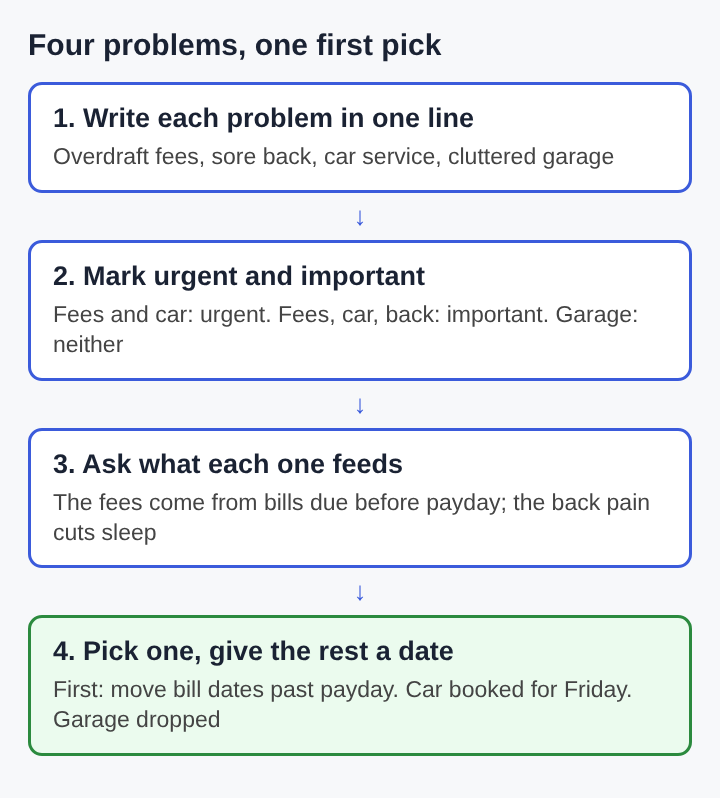
The pick: the overdraft fees go first, and the first thing to try is asking both billers to move their dates to just after payday. The car service is booked for Friday, because it is urgent and cannot wait for the money fix to settle. The back gets a date two weeks out, when you will try a different chair height for a week. The garage is crossed off.
Two weeks later, write down what happened next to each line. If the bill dates moved and the fees stopped, mark the fix as worked. If only one biller agreed, mark it as partly and note what is left. Keeping that outcome is what lets you know whether a solution really worked, rather than guessing from memory.
When the order changes
The order you pick today is not fixed. Go back to the list when one of three things happens: a fix works and a problem drops off, a new problem arrives, or a problem you parked gets worse before its date. Each of those changes the arrows, so the first pick may change too.
It also helps to keep the lines you finished, with their outcomes, rather than deleting them. A list that shows a solution that failed, and why, stops you from trying it again in six months. Over time, the record shows which kinds of problems you tend to put off and which ones tend to come back.
Frequently asked questions
What if every problem feels urgent?
Ask what would actually happen if each one waited one more week. Most problems that feel urgent are only uncomfortable, and the ones where a week's wait costs real money or real harm are usually few.
Is it better to start with the easiest problem to build momentum?
Start with an easy one only if it is also one of the important ones. An easy win on a problem that does not matter feels good for a day and leaves the costly problems exactly where they were.
How many problems is it wise to work on at once?
One as your main focus, plus any urgent ones that only need a single action such as a phone call or a booking. Working on several important problems at the same time usually means none of them gets enough attention to change.
What helps with a problem that keeps getting put off?
Give it a date and the smallest possible first step. If you still skip it when the date comes, write down why, because the reason is often a second problem that needs to go on the list.
Choosing the first problem, in short
Deciding which problem to solve first comes down to three questions asked on paper: is it important, is it urgent, and does it feed other problems on the list. The problem that is important and feeds the most others, and that you can start this week, goes first. Every other line gets a day, a later date or a line through it. Write down what each fix did, and the next time several problems arrive at once, you will have your own record of which choices worked.
Problem Graph
Every problem you carry, on one map. Solved together. Visit problemgraph.vlvd.net