If you ask what is a gatehouse in a castle, the short answer is that it is the building that holds the way in. A castle wall can be long and high, but somewhere it has to open so people, carts and horses can pass. That opening is the weakest place in the whole ring of stone, so builders wrapped it in a building of its own and filled that building with every trap they knew.
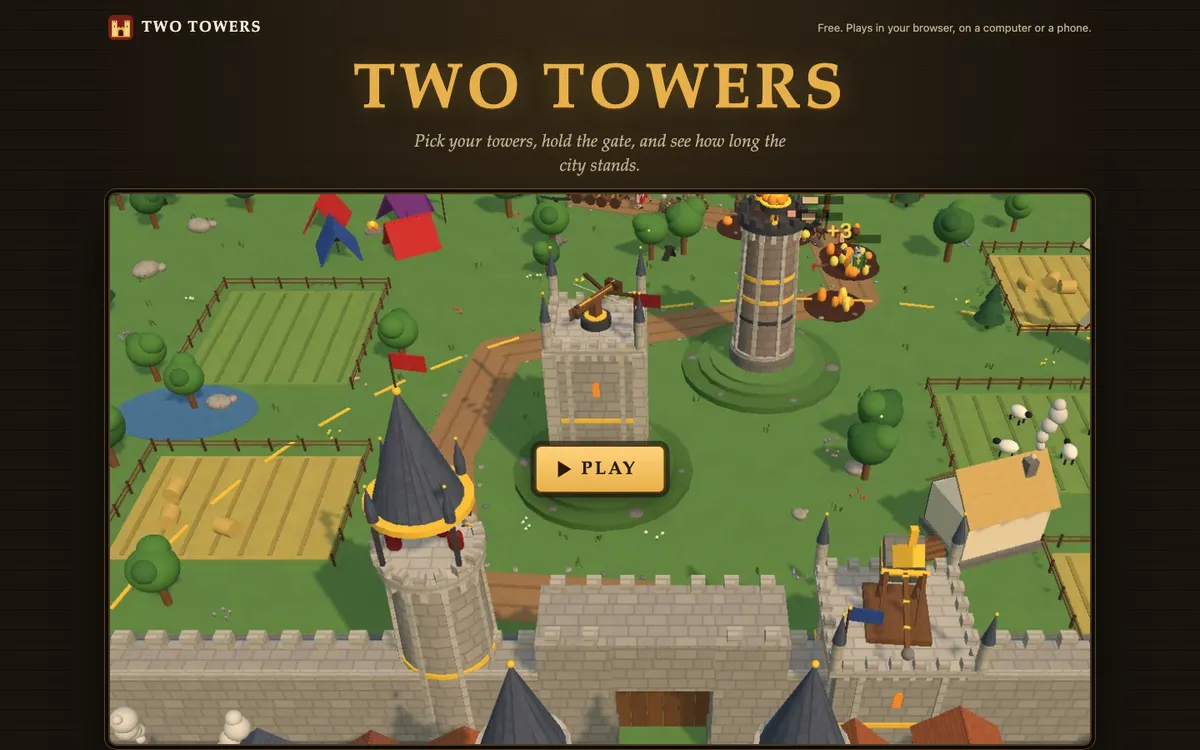
The game Two Towers is built on the same pressure: its title line is "defend the castle gate, stage after stage", and the player holds a city gate against knights, monks, kings and rams. The real gatehouse shows why the gate, and not the wall, is where a defense is won or lost.
What is a gatehouse in a castle, in plain words
The Wikipedia page on the gatehouse defines it as a building that contains the entrance to a large place, such as a walled town, castle, manor, monastery or college, so the people inside can control or defend who comes in. The same page states the reason it mattered: the gatehouse was often the most heavily defended part of a fortification, because the gate was the easiest point for an enemy to attack.
That sentence explains the whole shape of the building. A wall can be climbed or undermined, but that is slow and hard. A gate is made to open. If an attacker breaks or burns a door, the wall around it no longer matters. So the gatehouse is the place where the castle had to be strongest exactly where it was naturally weakest.
A very old idea, long before castles
Fortified gates are far older than the medieval castle. The gatehouse page traces them back to the Bronze Age and names the Ishtar Gate in Babylon as a famous early example. The Romans built gatehouses into their walls across Europe and the Mediterranean, among them the Porta San Paolo in the Aurelian Walls of Rome and the Porta Nigra at Trier in Germany, which was later turned into a church.
Medieval builders did not invent the gatehouse, then. What they did was pack more and more defenses into it, layer by layer, until in some castles it became a fortress in its own right.
What a strong gatehouse held
The gatehouse page lists what a strongly fortified medieval gatehouse may include:
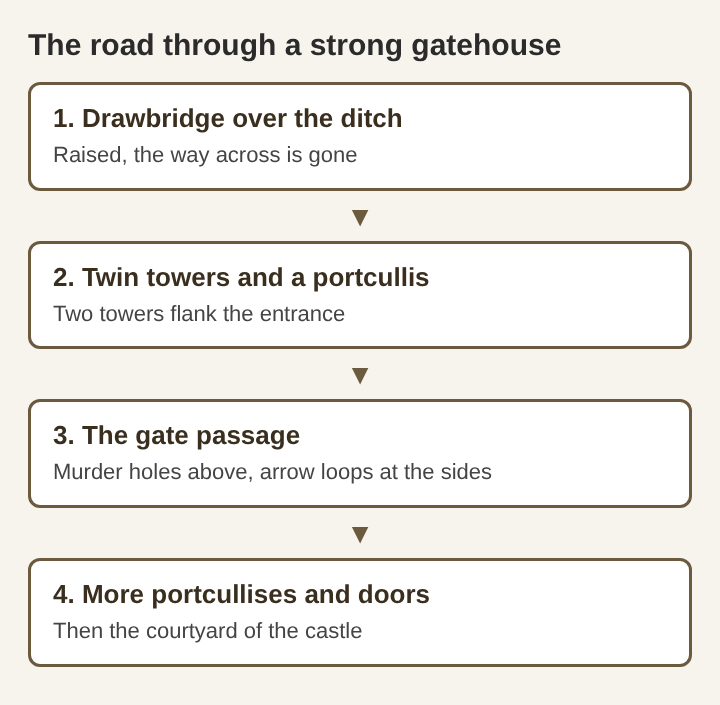
- A drawbridge, a deck over the ditch or moat that could be raised so there was nothing to cross.
- One or more portcullises, heavy grilles dropped in grooves to close the passage.
- Machicolations, openings in a parapet pushed out over the wall face, so defenders could strike at the foot of the gate.
- Arrow loops, narrow slits in the walls for archers, some later turned into gun loops in the late Middle Ages.
- Murder holes, openings in the ceiling of the passage where stones could be dropped on attackers.
Each part has its own story. The drawbridge sits outside, at the very front, as the drawbridge article describes. The portcullis closes the passage itself, and the murder holes watch it from above. Some towns and castles also pushed a barbican out in front of the gatehouse. The gatehouse is the building that gathers them all in one place, so that an attacker meets one barrier after another in a short space.
When the gatehouse became the keep
In most castles the keep was the last and strongest refuge. But the gatehouse page notes that in some castles the gatehouse was fortified so heavily that it took on the job of the keep, and it is then called a gatehouse keep. It names Tonbridge Castle in Kent as the first surviving gatehouse keep, and says the form was used a great deal in the Welsh castles of Edward I.
The words other languages use say the same thing. A very large French gatehouse might be called a châtelet, a small castle, and the German word for gatehouse is Torburg, a gate castle. In both, the gate is not a door in a castle. It is a castle built around a door.
A worked example: walking through Harlech
Harlech Castle in Wales is one of those Edwardian castles, and its gatehouse shows the idea clearly. According to the Wikipedia page on Harlech Castle, it follows the design sometimes called Tonbridge-style, popular in the 13th century, with two massive D-shaped towers on either side of the entrance. Follow the way in step by step, using only what that page records:
- The approach. The main entrance crossed a stone bridge between two ditch bridge towers and the gatehouse. The ditch is the first obstacle, and the bridge is the only way over it.
- The towers. At the end of the bridge, the two D-shaped towers stand on each side of the door. Anyone at the entrance can be struck from both sides at once.
- The passage. Inside, the passage was guarded by three portcullises and at least two heavy doors. Breaking one barrier only brings an attacker to the next, still inside the gatehouse.
- The floors above. The gatehouse has two upper floors divided into rooms, with large windows on the inner side and fireplaces. Historians still argue over who lived there, the constable or senior visitors, but either way the gatehouse was where important people stayed.
Count the barriers: a ditch, a bridge between towers, two flanking towers, three portcullises and at least two doors. That is the gatehouse doing its job, turning one weak opening into a long, guarded corridor. The building lasted, too. The Harlech page says that after a siege in 1468 the castle fell into ruin except for the gatehouse, which was used for the local courts.
Why the gate draws the fight
The gatehouse explains why so much of a siege, and so much of any game about defending a castle, comes down to the gate. Attackers do not spread out evenly along a wall. They go where the way in is. A ram is only useful against a door. That means a defender who strengthens the gate gains more than one who strengthens a long stretch of wall.
It also explains why the defenses are stacked in depth rather than all at the front. If the first door fails, the attacker is not inside the castle. They are inside a narrow passage, with a closed grille ahead, holes overhead and slits in the walls on either side. Each layer exists in case the one before it fails.
From fortress to front door
The gatehouse did not stay a war machine. The gatehouse page says that at the end of the Middle Ages many gatehouses in England and France were rebuilt as grand entrances to manor houses and estates, often standing on their own or attached to the house only by a wall. By then they had lost their defensive purpose and were meant to look impressive and match the house.
Many still stand. The same page names the Constable's Gate at Dover Castle as the largest surviving gatehouse in England, and notes that York's city gates, called Bars, were built as a single tower with barbican. Gatehouses also became a sign in heraldry, used on coats of arms to stand for a city or a fortification.
Frequently asked questions
Is a gatehouse the same as a gate?
No. The gate is the opening and its doors. The gatehouse is the whole building around that opening, with its towers, passage, portcullises and the rooms above it.
What is a gatehouse keep?
It is a gatehouse fortified so strongly that it did the work of the keep, the castle's strongest point. Tonbridge Castle has the first surviving example, and Harlech has one too.
Why were there so many portcullises in one gatehouse?
Each one closed the passage at a different point, so breaking one did not open the way in. Harlech's passage had three portcullises and at least two heavy doors.
Did people live in gatehouses?
Some did. Harlech's gatehouse has upper floors with fireplaces and large windows, and historians debate whether the constable or senior visitors lived there.
The gatehouse as the heart of castle defense
A castle is only as strong as its way in, and the gatehouse is the answer builders gave to that problem for thousands of years. From the gates of Babylon and Rome to the twin towers of Harlech, the idea stayed the same: take the one place an enemy most wants to reach, and make it the hardest place to pass. Layer the barriers, so a broken door leads only to a closed grille. Watch the passage from above and from the sides. In the end, the gatehouse often outlasted the rest of the castle, because it was always the part built to hold.
Two Towers
Defend the castle gate, stage after stage. Visit twotowers.vlvd.net