What is a drawbridge? On a medieval castle it was a wooden bridge over the moat that the defenders could lift from inside the gatehouse. Lowered, it let carts, horses and people walk in. Raised, it took away the only dry road to the gate and stood up against the gate itself as one more barrier. Once you see how it moved, a castle entrance reads as a row of separate barriers, and each one bought time.
A bridge built to be taken away
The Wikipedia page on the drawbridge defines it as a moveable bridge, usually at the entrance to a castle or tower surrounded by a moat. When it is down, it gives access across the defenses. When it is up, raised quickly from within, it denies entry to an enemy force. In some forms of English, American English among them, the same word covers every moveable bridge, from bascule bridges to swing bridges, but the castle sense is the narrow, defensive one.
The same gate puzzle sits at the centre of Two Towers, a castle defense game in the browser whose title line is "defend the castle gate, stage after stage". A real castle answered that puzzle in layers, and the drawbridge was the first layer an attacker met.
Early castles often had a plain wooden bridge across a ditch or moat. Some were built to be destroyed or removed when an attack came. That works once. A drawbridge could be lifted, lowered and lifted again, so it became very common.
Why the moat mattered first
A drawbridge only makes sense with a gap to cross. The Wikipedia page on the moat describes it as a deep, broad ditch around a castle, dry or filled with water. A moat usually blocked all direct land access except at a few narrow places crossed by drawbridges, bridges or causeways. A siege was funneled into those places, which made them easier to defend.
The moat also kept heavy machines away. Siege towers and battering rams had to be brought right up to a wall to work, and a ditch in the way made that hard. A wet moat made mining, digging tunnels to bring a wall down, very difficult too. So the moat pushed every attacker toward the bridge, and the drawbridge decided whether that bridge existed at all.
What is a drawbridge made of, and how was it raised?
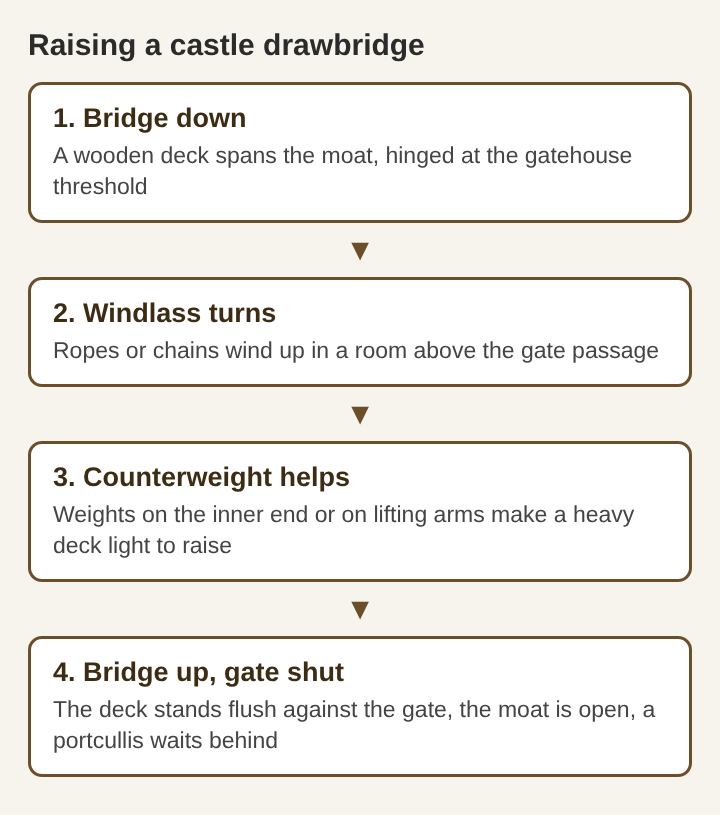
The typical layout put the drawbridge right outside the gatehouse. It was a wooden deck with one edge hinged at the gatehouse threshold. Raised, the deck lay flush against the gate. An attacker now faced a wall of timber in front of the doors, with open air or water beneath their feet.
Ropes or chains ran from the outer edge of the deck up to a windlass in a room above the gate passage. Turning the windlass wound the chains in and swung the bridge up. There was a catch: only a very light bridge could be lifted this way with no help. A deck strong enough to carry carts was heavy, so most drawbridges used a counterweight, an arrangement called a bascule.
Counterweights, pits and lifting arms
Builders found several ways to balance the deck, all described on the drawbridge page. In one, the bridge ran past its hinge into the gate passage. The inner part swung down into a pit as the outer part rose, and that pit was one more obstacle for anyone who got inside. In another, counterweighted beams on the inner end dropped into slots in the floor.
The chains could also carry their own counterweights. At Alnwick, the weight was a portcullis, so dropping the iron grille helped lift the bridge. By the 14th century, many gates used lifting arms called gaffs, set above and parallel to the deck and linked to it by chains. When the bridge was up, the gaffs fitted into slots in the gatehouse wall called rainures. You can still see those slots at Herstmonceux Castle. Inside the castle, the gaffs carried counterweights, or formed the side timbers of a stout inner gate that closed against the arch as the bridge rose.
An older design, the turning bridge, pivoted on central pins. Its inner end held counterweights and sank into a pit, and when level it rested on pegs pushed through the side walls. It was clumsy, and many turning bridges were swapped for better drawbridges.
A worked example: what an attacker meets at the gate
Follow one attacking party from the field to the gate passage, using only what the sources describe.
- The moat. The ground ends at a ditch. There is no land route except the bridge, so the whole party bunches at one narrow crossing.
- The raised bridge. The defenders have wound the windlass. The deck stands flat against the gate. The party cannot cross, and it cannot reach the doors without filling the ditch or bridging it.
- The fire from above. While the party works at the edge of the moat, defenders shoot from machicolations over the gate and arrow slits in the flanking towers.
- The layers behind. If the party does get across, the gate still has one or more portcullises and doors behind the raised deck, and perhaps a pit in the passage floor.
Each step costs the attacker time while the defenders stay under cover. The Wikipedia page on the gatehouse lists the same pieces for a strong gate: a drawbridge, portcullises, machicolations, arrow loops and murder holes. The drawbridge is simply the outermost of them, and the portcullis that comes next has its own story in what a portcullis is and how it worked.
Where working drawbridges still survive
Most castle drawbridges have gone, replaced by fixed bridges or left as slots in stone. A few still move. In France, working drawbridges survive at several châteaux, among them the Château du Plessis-Bourré. In England, Helmingham Hall, which dates from the early sixteenth century, still has two working drawbridges in regular use. Forts kept the idea much later, and film sets build drawbridges out of steel and concrete hidden behind wood and plaster so that they can actually move.
Frequently asked questions
What is the difference between a drawbridge and a portcullis?
A drawbridge is a bridge over the moat that lifts up to close the crossing. A portcullis is a heavy grille that drops down inside the gate passage. A typical castle gate had the drawbridge outside, with one or more portcullises behind it.
Were drawbridges made of wood?
Castle drawbridges were usually a wooden deck. The lifting gear used ropes or chains, a windlass and often counterweights.
How many people did it take to raise a drawbridge?
The sources do not give a number. They say only a very light bridge could be lifted without a counterweight, which is why most drawbridges were balanced so the windlass did less of the work.
Did every castle have a drawbridge?
No. Early castles often had a plain bridge built to be removed or destroyed in an attack, and some used a turning bridge instead. Drawbridges became very common later.
The drawbridge as the first lock on the gate
A drawbridge turned a weak point into a choice the defenders controlled. The moat closed every route but one, and the drawbridge could close that one in moments. Raised, it removed the road, covered the doors and left attackers standing at the edge of a ditch under fire from above. Everything behind it, the portcullis, the murder holes and the inner gates, depended on that first lock holding long enough.
Two Towers
Defend the castle gate, stage after stage. Visit twotowers.vlvd.net