Walk under the arch of an old castle gate and look up. Just inside the opening you may see a slot cut across the ceiling and a deep groove running down each side wall. Those marks answer the question of what is a portcullis: a heavy grille of wood or metal that hung in that slot and dropped down those grooves to shut the gate. It is one of the simplest machines a castle had, and one of the most useful.
Holding a gate is also the whole job in Two Towers, a castle defense game in the browser where you pick a pair of towers, add two more with gold, and hold the city gate against knights, monks, kings and rams, stage after stage. The real gate behind that idea relied on the portcullis more than on any door.
What is a portcullis and how did it work
The name comes from the Old French porte coleice, meaning "sliding gate", according to Wikipedia's page on the portcullis. That is exactly what it was. Where an ordinary gate swings open on hinges, a portcullis moved straight up and down.
It was a latticed grille, made of wood, metal, or wood bound with metal. Its two outer edges sat in vertical grooves cut into each jamb of the gateway, the upright stone sides of the opening. When it was raised, the gateway stood open beneath it. When it was lowered, it filled the opening from one groove to the other.
The lattice mattered. A grid of bars weighs less than a solid slab of the same size, so it was easier to lift, yet it still stopped a person, a horse or a cart from passing.
A grille that rides in two grooves
The grooves did most of the work. Because each edge of the grille sat inside a channel in the stone, the portcullis could not swing, twist or be pushed sideways. Force against its face went straight into the walls on either side. To get past it, an attacker had to break the bars, lift the whole weight, or go around through another part of the castle.
Compare that with a pair of wooden doors. Doors meet in the middle and turn on hinges, so the seam and the hinges are the places a battering ram hits again and again. A grille held in two grooves has no seam in the middle and no hinges to break.
Why a single guard could close it
The portcullis was raised and lowered by chains or ropes attached to an internal winch, as the Wikipedia page describes. Winding the winch lifted the heavy grille. Letting it go allowed the grille to fall back down its grooves.
That second fact was the point. Opening a portcullis took time and effort. Closing it took almost none. The same page notes that a portcullis had an advantage over ordinary gates because a single guard could close it immediately in a crisis.
Picture the moment a raid came. Doors have to be pushed shut against whoever is already in the gap, then barred. A portcullis only needs someone to release it. Even if riders were already galloping toward the gate, one guard at the winch could seal the passage before they arrived.
The double portcullis trap, step by step
Many castles did not stop at one. Two portcullises were often used at a main entrance, one near the outer end of the gate passage and one near the inner end. That pair could do more than keep attackers out. It could catch them.
Follow one attack through a gate with two portcullises and a passage between them.
- The attackers enter. Both grilles are raised. To a group rushing the gate, the way in looks open, and they crowd into the passage.
- The inner portcullis drops first. The grille near the courtyard end comes down. The attackers at the front run into bars, and the ones behind keep pushing in.
- The outer portcullis drops. Now the grille at the outer end falls. The group is shut in a stone box with no way forward and no way back.
- The defenders strike from cover. Above the passage, murder holes open in the ceiling, and arrow slits look in from the side walls.
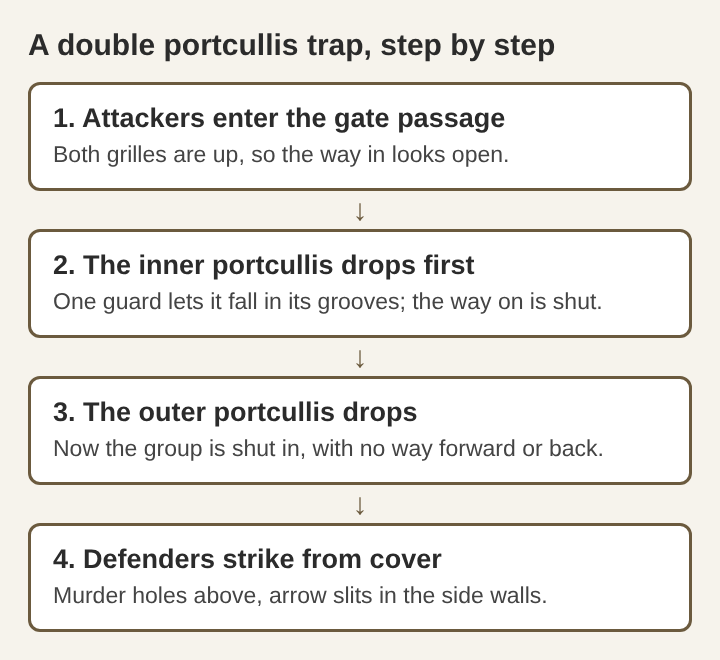
The order is the clever part. Dropping the inner grille first stops the front of the group while the back is still coming in. Dropping the outer grille second closes the trap on the largest number of people. According to the Wikipedia page, defenders then usually dropped burning wood or sand heated in a fire through the murder holes or from the roof, and archers and crossbowmen shot through the slits in the walls. Hot oil, the page adds, was not commonly used, contrary to popular belief, because oil was extremely expensive.
Where the portcullis sat in a gatehouse
A portcullis was rarely the only defense at a gate. Wikipedia's page on the gatehouse lists what a strongly fortified medieval gatehouse might include: a drawbridge, one or more portcullises, machicolations, arrow loops, and murder holes where stones were dropped on attackers. Some gatehouses were so strong that they did the job of a keep, and are called gatehouse keeps.
Seen that way, the portcullis was one layer among several. The drawbridge kept attackers from reaching the gate at all. The portcullis stopped them in the passage. The murder holes and arrow loops punished them while they were stopped. Medieval builders stacked these layers so that castles defended their gates in depth, not with a single wall.
The same logic shows up in tower defense games, which are built around making enemies slow down or stop in a place your defenses can reach. A gate passage with two grilles is the oldest version of that idea: a narrow route, a way to halt traffic in it, and weapons aimed at the spot where traffic halts.
Working portcullises you can still see
Many castles keep the grooves but have lost the grille. Some still have one that moves. In England, the Wikipedia page names working portcullises at the Tower of London, Monk Bar in York, Hever Castle in Kent, and Amberley Castle, which is now a hotel. In Scotland, there is a working portcullis at Edinburgh Castle.
Monk Bar is worth a note of its own. It is one of the gates in the York city walls, and the gatehouse page lists it among gates there that were first built as a single tower with a barbican. So a portcullis was not only for castles. Walled towns used them to close their own gates too.
When you visit a ruin, look for the signs even if the grille is gone: a straight groove down each side of the arch, a slot across the ceiling, and the stone around them where the grille once ran.
From castle gate to badge of Parliament
The portcullis lived on as a symbol long after it stopped mattering in war. It was the heraldic badge of the House of Beaufort. Henry VII, the first Tudor king, came from the Beaufort line through his mother and made the portcullis, along with the Tudor rose, a royal badge of the House of Tudor.
Its best known use today is as the symbol of the British Parliament. That use does not date from the Tudors. It came from Sir Charles Barry's plans to rebuild the Palace of Westminster after the old palace burned down on 16 October 1834. Barry conceived the new building as a "legislative castle", and a castle gate fitted that idea. An office building for Members of Parliament that opened in 2001 is named Portcullis House.
Frequently asked questions
What was a portcullis made of?
It was a latticed grille of wood, metal, or wood with metal fittings. The open grid kept it lighter than a solid slab while still blocking the passage.
How was a portcullis raised and lowered?
Chains or ropes ran from the grille to a winch inside the castle. Winding the winch lifted it, and releasing it let the grille drop back down its grooves.
Why did castles use two portcullises?
Two grilles could trap attackers in the passage between them. The inner one was closed first and the outer one second, so the most people were caught inside.
Did defenders pour hot oil through murder holes?
Rarely, because oil was very expensive. Burning wood and sand heated in a fire were more usual.
The portcullis as the gate that falls first
A castle gate had to do two things that pull against each other. It had to open every day for people, carts and horses, and it had to close in seconds when danger came. Doors were good at the first and slow at the second. The portcullis solved the second: a heavy grille, held in grooves, that one person could drop and that a ram could not swing open. Put two in one passage and the gate stopped being only a barrier and became a trap, with the attackers caught exactly where the defenders could reach them.
Two Towers
Defend the castle gate, stage after stage. Visit twotowers.vlvd.net