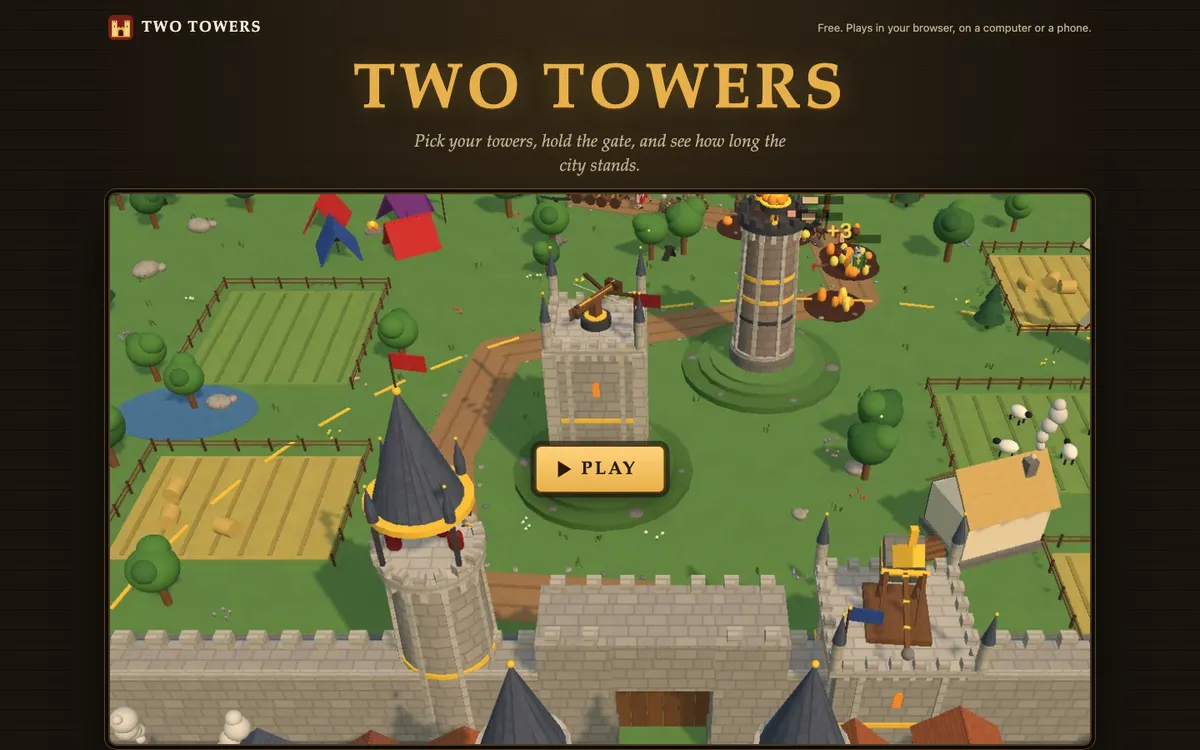
Many old town and castle gates make you walk through a walled outpost before you reach the gate itself. That outpost is a barbican. The short answer to what is a barbican in a medieval castle is this: it is a fortified work built in front of the gate, so attackers have to fight their way through it before they can touch the gate. Tower defense games are built around the same problem, because the gate is the thing the player loses. In a browser game about holding a city gate, you pick a pair of towers, add two more with gold, and hold off knights, monks, kings and rams, stage after stage. The barbican is a useful way to think about where towers should stand in any game of that kind.
What Is a Barbican in a Medieval Castle
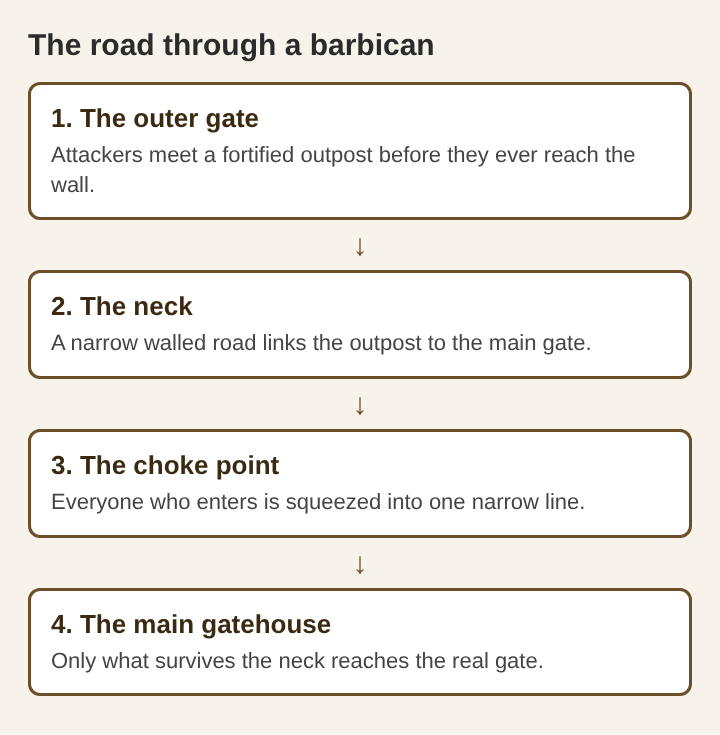
The word comes from the Old French barbacane. Wikipedia's page on the barbican defines it as a fortified outpost or fortified gateway at the outer edge of a city or castle's defenses, or any tower over a gate or bridge that was used for defense. Medieval Europeans usually built it outside the main wall, or right at its edge, and linked it to the wall with a walled road called the neck.
The shapes differ from place to place, but the job is the same. A barbican moves the fight forward, away from the gate. It controls the entrance at what the same page calls the choke point: the one place where everyone who wants in has to pass.
The Neck: a Narrow Road Between Outpost and Gate
The neck is what turns a lone outpost into a trap. Once attackers pass the barbican's outer gate, they are not inside the town. They are on a narrow walled road with the main gate still ahead of them, and every step along it is a step the defenders can see.
That changes what breaking the first gate is worth. Getting through the outer gate costs the attackers effort and men, and it puts them on the most watched ground of the whole approach. The main gate behind the neck can have its own defenses waiting, such as a portcullis and murder holes in the passage roof.
The Krakow Barbican, a Barbican That Still Stands
The clearest surviving example is the Krakow Barbican in Poland. It was built around 1498, in the Gothic style, and its Wikipedia page calls it one of only three such fortified outposts still standing in Europe, and the best preserved.
The numbers on that page show what a serious barbican looked like:
- A round brick structure with an inner courtyard about 24.4 metres across, and seven turrets.
- Walls about 3 metres thick at the base, holding 130 embrasures, the openings defenders shot through.
- An outer gate, the Kleparz Gate, behind a half-circle moat 26 metres wide and 6 metres deep.
- A covered passage that led through St. Florian's Gate into the city, so the barbican also served as a checkpoint for everyone who entered.
It was built in a hurry for a reason. Poland had just lost a battle at the Cosmin Forest, and the city feared an Ottoman attack, so the walls were strengthened and the barbican added. It went on to take part in the defense of Krakow in 1587, 1655, 1657 and 1792, and in 1817 two senators of the Free City of Krakow persuaded the Senate not to pull it down.
Barbicans in York, Portugal, India and China
Barbicans were not only a Polish idea. In England, the city walls of York keep several gates that, according to Wikipedia's page on the gatehouse, were all first built as a single tower with a barbican: Bootham Bar, Micklegate Bar, Monk Bar and Walmgate Bar.
Elsewhere the same idea took local forms. Portuguese builders used the word barbacã for any lower wall outside the main wall that formed a second barrier, sometimes around the whole circuit and sometimes only where the wall was weak. In South Asia, barbicans protected main gates from being rammed by war elephants. Chinese city walls often set an extra archery tower in front of the main gatehouse, linked to it by walls; these enclosures were called "jar walls", and English writers often call them barbicans.
What links all of them is the same habit: put a defended space in front of the opening, so the gate is never the first thing an enemy reaches.
Why Barbicans Faded After the 15th Century
The barbican page notes that barbicans began to lose their significance in the 15th century, as siege tactics and artillery developed. New ones were still built well into the 16th century, and Krakow's own barbican dates from 1498, right at that turning point.
The reason is easy to see from the design. A barbican works by forcing attackers to walk a fixed road under fire. Cannon could break walls from a distance, so an attacker no longer had to walk the road at all.
Barbican Lessons for Tower Defense Strategy
The barbican carries over to tower defense as a set of general habits. They are not a description of any one game's towers or maps.
- Defend the approach, not only the gate. If every tower sits right beside the gate, enemies take damage only in the last few steps. Spread your cover so the damage starts earlier on the route.
- Use the narrow parts. Where a route squeezes enemies together, one tower can hit more of them, which is why splash damage and chokepoints come up together so often.
- Gain time with distance. The neck added steps under fire. In games that have a slow tower, placing it early on the route gives every other tower more time to fire.
- Keep a second layer. The main gate behind the neck meant one failure was not the end. Some cover close to the gate catches the few enemies that slip through.
Rams deserve their own thought. A ram does nothing until it reaches the gate, so every moment spent stopping it on the way counts for more than a moment spent after it arrives.
A Worked Example: Your Next Tower on a Barbican Style Approach
Here is a worked example in general tower defense terms. You have placed your first pair of towers, and you have enough gold for one more. The question is where it goes.
- Look at the route, not the towers. Find the stretch where enemies bunch together before the gate. That stretch is your neck.
- Check your cover. Ask whether your current towers can already fire on that stretch. If they cannot, the new tower belongs there.
- If they can, move earlier. Place the new tower further up the route, so it thins the line before it reaches your strongest cover.
- Watch what gets through. If enemies reach the gate in a tight group, you need more damage where they gather. If they arrive one at a time but too fast, you need more time on the route.
Your next tower should answer the problem that actually showed up, not the one you guessed at. That is close to how Krakow got its barbican: the city saw a threat coming and added a defended space in front of the gate it already had.
Frequently asked questions
Is a barbican the same as a gatehouse?
No. A gatehouse is the fortified building that holds the gate itself, while a barbican stands in front of it as an outpost linked to the wall by the neck. York's old gates were built with both, a single gate tower and a barbican in front.
Where does the word barbican come from?
It comes from the Old French barbacane. Wikipedia notes that the word may go back further still, to Persian or Arabic.
Can you still visit a medieval barbican?
Yes. The Krakow Barbican in Poland is a museum site run by the Historical Museum of the City of Krakow, and its walls, turrets and embrasures still stand.
Why did barbicans stop being built?
From the 15th century, artillery and new siege tactics made them less useful, because cannon could hit walls from far away. Some were still built into the 16th century.
What a Barbican Shows About Medieval Castle Gate Defense
The barbican shows that medieval builders did not trust any single barrier. A gate could be broken, so they placed a defended outpost in front of it. That outpost could be entered, so they linked it to the wall with a narrow road where attackers could be seen and struck. If the outer gate fell, the main gate still waited behind it.
The idea underneath all of this is depth. A defense with depth makes the attacker pay at every step, and it turns an early breakthrough into a worse position. The gate still mattered, but the barbican decided how many attackers would ever reach it, and in what state. A city like Krakow that kept its barbican through four defenses did so because its entrance was a series of problems, each one placed in front of the last.
Two Towers
Defend the castle gate, stage after stage. Visit twotowers.vlvd.net