The great sages of Asia are the teachers of ancient India and China whose ideas about duty, government and inner calm are still read today: the Buddha, Laozi, Confucius and Mencius above all. None of them set out to found an empire or win a war. They talked, they taught small groups, and their students wrote the words down. Those words then travelled further than any army of their time.
Who were the great sages of Asia, and why four names?
Many teachers could be named, but four stand out for how far their ideas travelled. Two came from China in the age before the first emperor. One came from the plains of northern India. The fourth carried the first Chinese sage's ideas into a harsher century. Learn 100 Influential People gives these teachers a course of their own, Sages of Asia, inside its part on how ideas, faiths, inventions and markets spread.
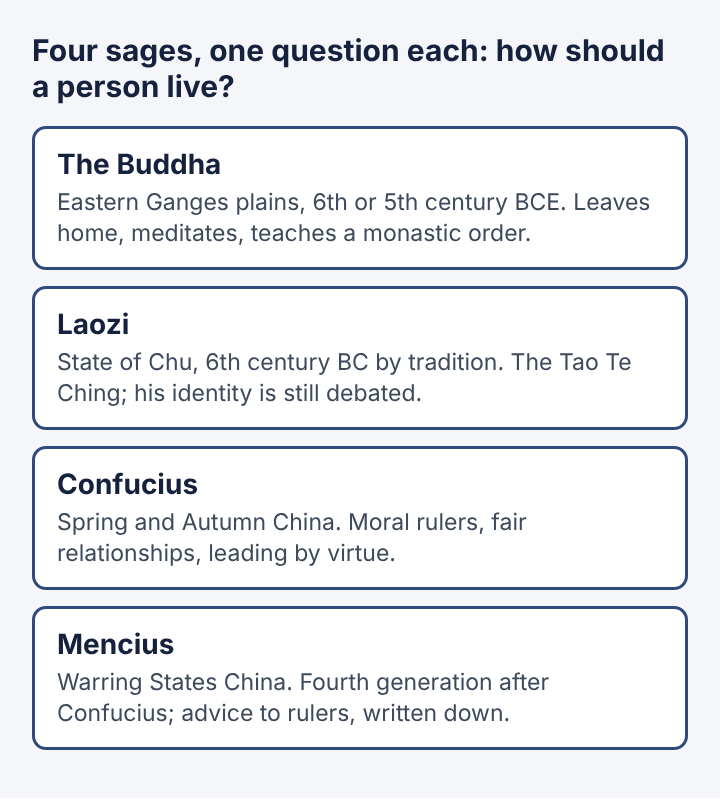
What links the four is a single question asked in different ways: how should a person live, and how should a ruler lead? Each answer came with a different picture of the world. Knowing those pictures side by side makes it easier to read any one of them on its own terms.
Confucius and leading by virtue
Confucius, born Kong Qiu, lived in the Spring and Autumn period of Chinese history and is traditionally held up as the model of the Chinese sage. His teaching, later called Confucianism, centered on personal and governmental morality, harmony in social relationships, righteousness, kindness and sincerity.
The part that shaped politics most was his view of rulers. A ruler, in his teaching, had a duty to lead by virtue. Good order came from the example at the top, not only from punishment. That idea set an ideal officials could be held to for many centuries.
The reach of his teaching is hard to overstate. Much of the shared cultural heritage of the Sinosphere, the countries of East Asia shaped by Chinese writing and thought, comes from the philosophy of Confucius. Family duty, respect for learning and the ideal of the upright official all trace back to his circle of students.
Laozi, the Tao Te Ching and an open question
Laozi is the name tradition gives to the author or first teacher of the Tao Te Ching, one of the founding texts of Taoism. He is also called Li Er or Lao Dan. The traditional story places him in the state of Chu in the 6th century BC, working as a keeper of records at the Zhou court, and makes him an older contemporary of Confucius.
Here the record grows thin. Modern scholars are divided over who Laozi was, when he lived and how he relates to the text that carries his name. Some see the traditional Laozi as mostly or wholly a legend. Others think a real Lao Dan is plausible and accept that he was senior to Confucius.
This uncertainty matters for anyone reading about him. The text is real and its influence is real. The man behind it may be a single teacher, a figure built up over time, or something in between. A careful reader keeps the ideas in the book apart from the stories told about its author.
The Buddha and a path out of suffering
Siddhartha Gautama, known as the Buddha, was a wandering religious teacher in the eastern part of the Indo-Gangetic Plains in the 6th or 5th century BCE, and the founder of Buddhism. Buddhist tradition says he was born in Lumbini, in what is now Nepal, to royal parents of the Shakya clan.
The turning point of his life, as the stories tell it, was a choice to give up his home and live as a wandering ascetic. After years of begging, self-denial and meditation, he reached nirvana at Bodh Gaya, in what is now the Indian state of Bihar. He then walked the lower Ganges plain teaching, and he built a monastic order, the sangha.
That order is the key to how his teaching survived. A community of monks and nuns memorized, repeated and later wrote down what he taught. Tradition holds that he died at Kushinagar. His order outlived him and kept carrying his ideas to new places.
Mencius, the Second Sage
Mencius, born Meng Ke, is often called the Second Sage, a title that shows how highly later Confucians ranked him, just after Confucius himself. He belonged to the fourth generation of Confucius's disciples. He took the teaching he inherited and developed it further.
He lived in the Warring States period, a time of constant conflict between rival Chinese states. Tradition says he spent much of his life travelling from court to court, offering advice to rulers. His conversations with those rulers became the book called the Mencius, which was later made one of the Confucian classics.
The life of Mencius shows how a sage's ideas spread after the sage is gone. The first sage had students. Those students taught others. Three generations later, Mencius was still carrying the same core concern, how a ruler should lead, into new courts and a more violent age.
Reading a sage the way a historian does
Anyone reading about these four teachers meets the same problem: the oldest stories mix fact, memory and devotion. A simple routine helps sort them. Ask three questions of each sage, in order.
- What is known with fair confidence? The period, the region and the main ideas.
- Who recorded the words, and when? Students, later followers, or a school that grew up around the name.
- How did the ideas travel? Through a community, a book, a ruler, or all three.
Work it through for Mencius. First, what is known: a Confucian thinker of the Warring States period, fourth generation after Confucius. Second, who recorded it: his talks with rulers form the book that bears his name. Third, how the ideas travelled: the book became a Confucian classic, read by every later student of that school.
Now try Laozi. First, what is known: the Tao Te Ching exists and founded a tradition. The man is uncertain, and scholars still argue over whether he lived at all. Second, who recorded it: unknown with confidence. Third, how it travelled: through the text and the Taoist tradition built on it. The same three questions give a very different picture, and that difference is the most useful thing to notice.
The Buddha sits between the two. The region and the rough century are clear, many details of his early life come from legend, and the sangha he built carried the teaching forward. Writing all three answers for each sage in a notebook takes about ten minutes and makes later reading much sharper.
Frequently asked questions
Did Confucius and Laozi live at the same time?
Tradition makes Laozi an older contemporary of Confucius, both in the Spring and Autumn period. Modern scholars are divided on this, and some doubt Laozi was a single historical person.
Why is Mencius called the Second Sage?
Later Confucians ranked him just after Confucius. He belonged to the fourth generation of Confucius's disciples and developed the teaching further in his talks with rulers.
Where did the Buddha live and teach?
He lived in the eastern Indo-Gangetic Plains in the 6th or 5th century BCE. Tradition places his birth in Lumbini, in present-day Nepal, and his awakening at Bodh Gaya in India.
Which book is linked with Laozi?
The Tao Te Ching, one of the founding texts of Taoism. Scholars still debate how closely the book is tied to a single author.
Why the sages of Asia still matter
The sages of Asia did not leave cities or monuments behind. They left questions and the communities that kept asking them. Confucius asked what a good ruler owes the people. Mencius carried that question into an age of war. Laozi's text asked what lies beneath all the striving. The Buddha asked how a person can step out of suffering, and his order kept the answer alive.
Each of those questions is still open in daily life, in families, in offices and in governments across Asia and far beyond it. The words of the great sages of Asia lasted because students repeated them, wrote them down and passed them on, one generation to the next.
Learn 100 Influential People
100 people who shaped history, from Moses to the web. Visit influentialpeople.vlvd.net