Market segmentation for a small business means splitting the people who might use what you make into groups that behave alike, then choosing one group to serve first. A large company can afford to speak to everyone at once. A business with one or two people cannot, so the split decides who you talk to, what you build first and where you spend your few hours each week.
What is market segmentation for a small business?
In marketing, market segmentation is the process of dividing a consumer or business market into meaningful sub-groups of current or potential customers, called segments. The aim is to find segments a company can serve with a tailored offer and tailored marketing. For a small business the important word is "one": you look at every group, then commit to the single one where you can win first.
The AI Entrepreneur lessons put this kind of work in their "Your first business" part, which starts with finding a real problem before building anything. Segmentation is how that problem gets an owner: not "small businesses" or "busy people", but a group you could list by name.
Where the idea came from
The history of market segmentation usually starts with Wendell R. Smith, who is generally credited with bringing the idea into the marketing literature in 1956. His article was called "Product Differentiation and Market Segmentation as Alternative Marketing Strategies". The title shows the choice he saw: either make your product look different from everyone else's, or shape it around the needs of one part of the market.
A small business rarely has the money to make itself stand out to a whole market. Shaping the offer around one group is the cheaper path, and it is the one segmentation describes.
Four common ways to split a market
The most common bases for segmenting consumer markets are geography, demographics, psychographics and behaviour. Each one asks a different question about the people in front of you.
- Geographic: where they are. Markets can be split as broadly as continents or as narrowly as neighbourhoods and postal codes.
- Demographic: who they are, using variables such as age, family size and socio-economic status.
- Psychographic: how they live, measured through their activities, interests and opinions.
- Behavioural: what they do, such as when they use a product and which benefit they want from it.
The same page notes that many marketers hold behavioural variables to be stronger than demographics and geography for building segments. For a new business that matches plain experience: two people of the same age in the same town can have very different problems, while two people who do the same task the same way usually share the same pain.
If you sell to other businesses, the split changes shape. Business-to-business sellers often segment by company type, industry or location, and a useful extra cut is size: a business of one person decides differently from one with fifty.
Five signs a group is worth choosing
Any base can work, the market segmentation page says, provided the segments it gives are identifiable, substantial, responsive, actionable and stable. Each sign turns into a short question you can answer about a group before you commit to it.
- Identifiable: can you recognise who is in the group and who is not?
- Substantial: is it large enough to keep the business going once you have reached a good share of it?
- Responsive: are its members likely to answer an offer made for them?
- Actionable: does knowing the group change what you build or where you go to find people?
- Stable: will the group still look the same in a year?
A small business can bend the second sign at the start. The first group only needs to be large enough to learn from; it can be widened later, once the business knows what the group values.
Segmentation, targeting and positioning
Marketers often use a three-step frame called S-T-P, for segmentation, targeting and positioning. Segmentation draws the map of groups. Targeting picks the group, or groups, to serve. Positioning decides how the offer should look to that group compared with what they use today. Segments can also be described as imaginary people, so a team can picture who it is building for.
The group you pick in the second step is your target market: a subset of the total market, usually people with similar characteristics such as age, location or lifestyle, at whom the business aims its product and its marketing. Segmentation without targeting is only a list. The decision is the useful part.
The order matters. If you write the message before you pick the group, the message ends up vague, because it has to fit everyone. Once the group is chosen, the message can use its own words. The short statement of who a product is for and why it beats the usual way is written for the segment, not for the whole market.
Splitting the market for a tutoring tool
Here is one split worked through from the start. The business is invented: an AI tool that turns a private tutor's short session notes into a weekly progress note for parents. The founder works alone and has about ten hours a week to find customers.
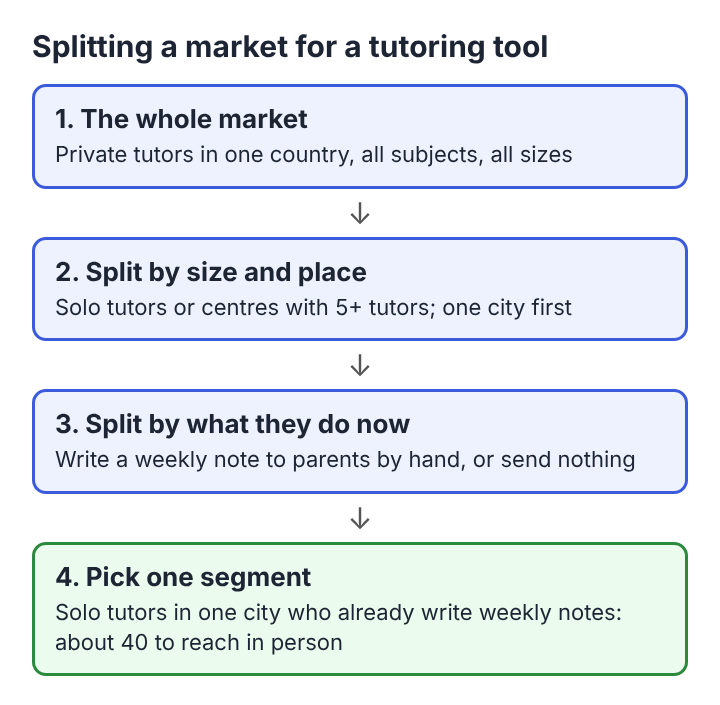
- Start with the whole market. Private tutors in one country, every subject, every size. It is far too broad to reach or to speak to with one message.
- Split by size and place. Solo tutors work differently from tutoring centres with five or more tutors: the centre has an office manager and its own systems, the solo tutor has evenings. Starting in one city means the founder can meet people face to face.
- Split by what they do now. Some tutors already write a weekly note to parents by hand. Others send nothing. The first group has the job and feels the time it takes; the second has no job to save time on.
- Pick one segment. Solo tutors in one city who already write weekly notes by hand. The founder estimates about 40 of them can be reached through local listings and school notice boards.
Now run the five signs. The group is identifiable, because a tutor either writes those notes or does not. It is responsive, because it already spends evenings on the task. It is actionable, because it tells the founder to build the note first and to look for tutors in that one city. It is stable, because weekly notes to parents are a long habit. It is not yet substantial, but 40 people are enough to learn whether the tool saves real time, and the next city can follow.
Notice what the split leaves out on purpose. Tutoring centres might be a larger group later, but they need sign-off from a manager and links to their own systems. Starting there would slow everything down.
Mistakes small businesses make when splitting a market
- Stopping at demographics. "Parents aged 30 to 45" is easy to write and hard to act on. Add what the group does, and the segment starts to tell you what to build.
- Picking several groups at once. Three segments mean three messages, three places to look and three sets of requests. A business of one rarely has time for more than one.
- Choosing a group you cannot reach. A segment you cannot name, list or meet fails the first sign, however promising it looks on paper.
- Never redrawing the map. The first split is a guess. What early customers do, and which ones stay, should change it.
Frequently asked questions
What is the difference between a market segment and a target market?
A segment is any group the split produces. A target market is the segment, or segments, a business decides to serve and aim its marketing at, as the target market page describes.
How many segments should a small business target?
Usually one at the start. A single group lets one message, one place to look and one first version of the product all fit together, and more groups can follow once the first one is served well.
Which base works for a business that sells to other businesses?
Business-to-business sellers often split by company type, industry or location, as the market segmentation page notes. Company size and the way the work is done today are often the sharpest cuts for a small seller.
Can a segment be too small?
For the long run, yes: a segment should be substantial enough to support the business. For a first group, a few dozen reachable people can be enough to learn whether the product solves their problem.
Why market segmentation starts with one group
Market segmentation looks at first as if it narrows a business down, but for a small business it does the opposite. A group you can name, reach and understand gives you clear words for your message, a short list of people to talk to and a first version of the product that fits someone exactly. Wider markets come later, built from the groups next to the first one, each chosen with the same five signs and the same honest look at what people do today.
AI Entrepreneur
Building a business in the age of AI, from a first project to a company. Visit aientrepreneur.vlvd.net