Why asking for help often goes nowhere
Knowing how to ask for help with a problem you cannot solve is a skill of its own, separate from solving it. Most requests fail for the same reason: the person asking hands over a feeling ("nothing works") instead of a record the helper can use. The helper then spends the first ten minutes asking questions you could have answered in the first message, and many helpers give up before that.
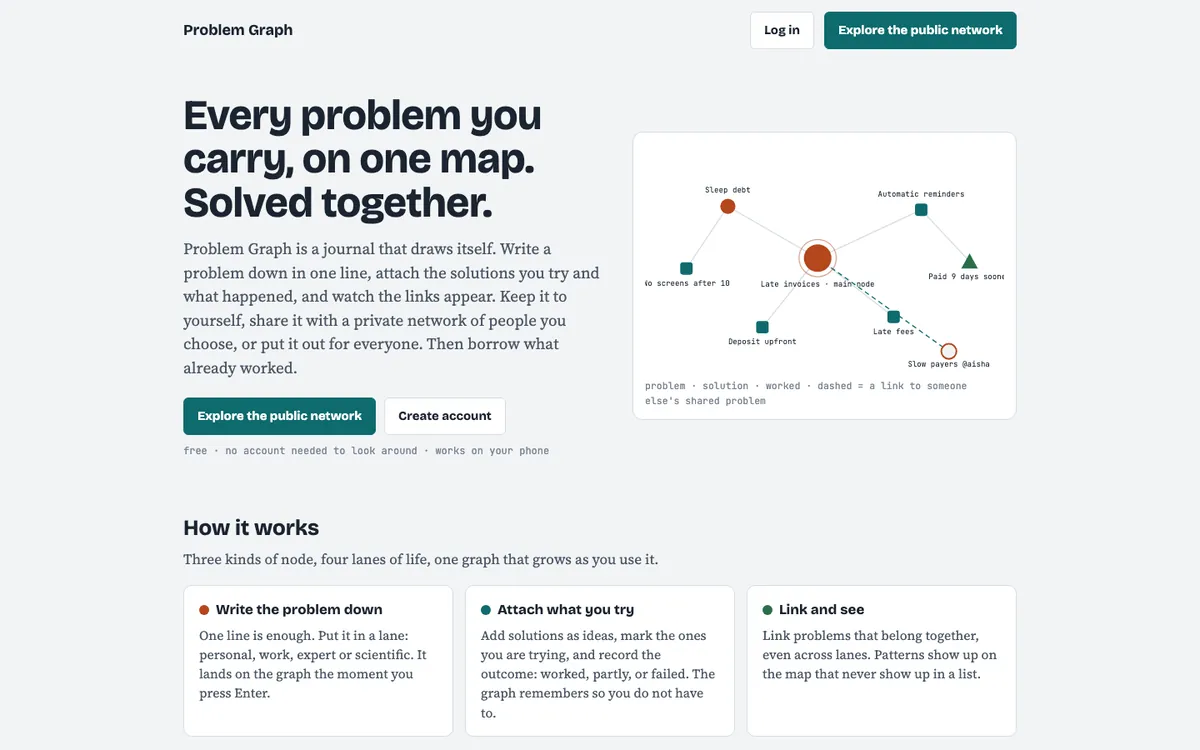
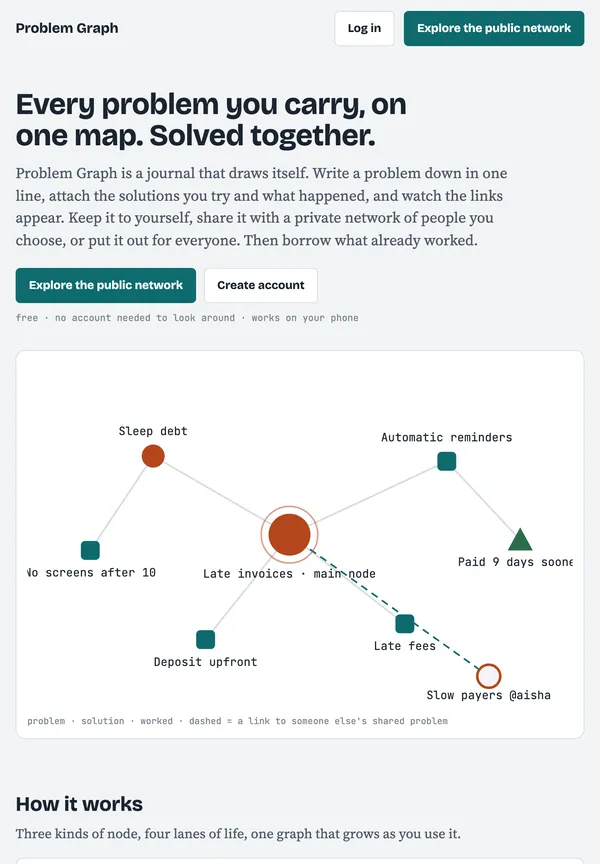
A request that gets a useful answer carries five things: the goal, the problem in one line, what you already tried and how each attempt went, the smallest example that shows the problem, and one clear question. If you already keep a record of your attempts, most of the request is written. A tool such as Problem Graph stores exactly that kind of record: a problem in one line, the solutions tried, and an outcome of worked, partly or failed on each.
There is also an older reason people hold back. Early research on help-seeking treated it as a sign of dependency, even incompetence. That view has changed: the help-seeking literature now broadly agrees that adaptive help-seeking is an important and effective strategy for learning on your own. Asking well is part of solving, not a step away from it.
Ask about the goal, not the fix you are stuck on
The most common mistake has a name. The XY problem is what happens when someone asks about their attempted solution, X, instead of the problem underneath it, Y. The term traces to Eric S. Raymond's guide on asking questions, and the fix it describes is for the helper to keep asking why the person needs the answer until the real problem appears.
You can save the helper that work. Before you write the question, write one line that says what you are actually trying to get, in plain terms. "How often should tomatoes be watered?" is an X. "Why are the tomato plants turning yellow, and how can that stop?" is the Y. A helper who sees only the X can answer it perfectly and still leave you with yellow plants.
Put the goal first in the request, before any detail about what you tried. If the helper knows a better path to the goal, they can say so at once.
How to ask for help with a problem, in five parts
- The goal. One line, in plain words, that says what a good result looks like.
- The problem in one line, with a count. What goes wrong, how often, and since when. "Sometimes" gives the helper nothing to work with; "4 of 6 plants, within 2 weeks" does.
- What you tried, with outcomes. Each attempt, how long it ran, and whether it worked, partly worked or failed. This stops the helper from suggesting the thing you did last week.
- The smallest example. The least you can show that still makes the problem visible: one photo, one short log, one page.
- One clear question. Not "any ideas?" but a question the helper can answer in a few lines.
The order matters. The goal and the problem tell the helper whether they can help at all. The attempts and the example tell them where to start. The question tells them when they are done.
A worked example: tomato plants turning yellow
You planted six tomato plants in pots. Within two weeks the lower leaves on four of them turned yellow. You have a neighbor who grows vegetables every year, and you want to ask them.
The weak version of the message reads: "The tomatoes are dying, nothing works, what should be done?" The neighbor has to ask how many plants, which leaves, what you tried, how much you water and how much sun they get. Each of those is a round trip.
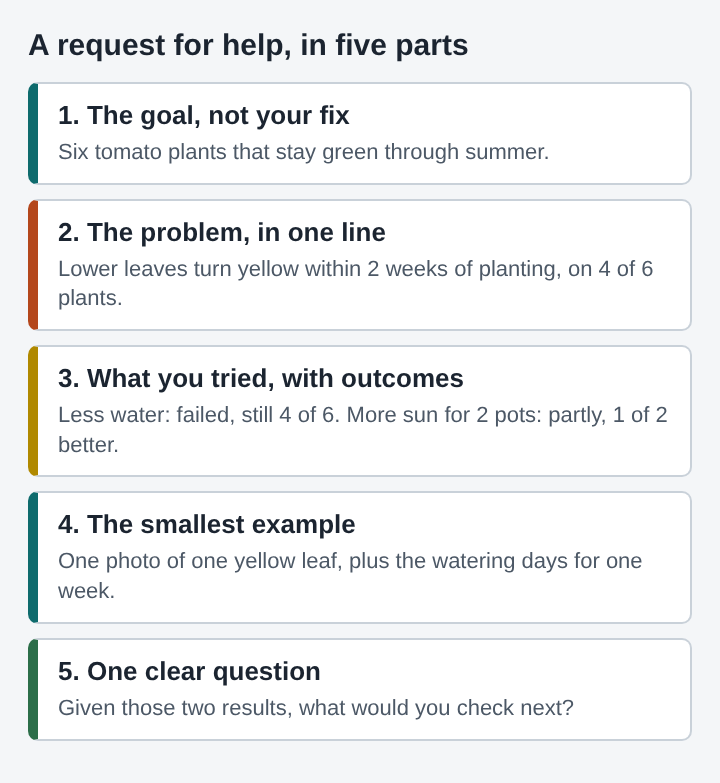
The strong version follows the five parts. The goal: six plants that stay green through the summer. The problem: lower leaves yellow within two weeks of planting, on 4 of 6 plants. What you tried: watering every other day instead of daily for one week, which failed, because 4 of 6 were still yellow; and moving two pots into full sun, which partly worked, because one of the two looked better after a week. The smallest example: one photo of one yellow leaf and a list of the watering days for one week. The question: given those two results, what would they check next?
That message takes five minutes to write. The neighbor can answer it in one reply, and the answer will build on what you already learned instead of repeating it.
Show the smallest example that still shows the problem
Programmers have a name for part four. A minimal reproducible example is the smallest set of code and data that still demonstrates the problem: just enough to show it, with nothing extra that makes it harder to solve. The same idea works far from code.
Making the example small is a step toward the answer in its own right. When you cut the problem down to one plant, one week and one photo, you often notice something you missed: the yellow plants are the ones by the drain, or the yellowing started the week the weather turned. Many people solve their own problem while trimming the example, before they ever send it.
Keep the example honest. Do not trim out the part you think is irrelevant if you are not sure. If something is left out, say what it was in one line, so the helper can ask for it.
Choosing who to ask
A good request still needs the right reader. Three kinds of helper are worth thinking about. Someone who has had the same problem knows which fixes failed for them. Someone with training in the area knows causes you have not thought of. And someone who knows you well can spot when the problem is really a different one.
A written record makes all three easier to reach. You can send the same five parts to a friend, post them where people with the same problem gather, or share them with a small group. Some tools let a written problem stay private, go to a few people you choose, or go public, carrying its attempts and their outcomes with it, so the helper sees the whole history at once.
After you get an answer, add it to the record as a new attempt, with its own outcome when you know it. That way the next request, if one is needed, starts from where this one ended. For more on keeping that record, see the live articles on how to track what you tried to solve a problem and how to write a problem statement for a personal problem.
Frequently asked questions
How much detail belongs in a request for help?
Enough for the helper to answer without a follow-up question, and no more. The five parts usually fit in a short message: one line each for the goal and the problem, a line per attempt, the example and the question.
Is it a sign of weakness to ask for help?
No. Older research treated help-seeking as dependency, but the current view is that adaptive help-seeking is an effective strategy for learning on your own. Asking after real attempts, with their outcomes written down, is the adaptive kind.
What is the XY problem?
It is asking about the fix you are stuck on instead of the goal behind it. Stating the goal first lets the helper suggest a better path if one exists.
What if nobody answers the request?
Read it again as a stranger would. Usually the goal is missing, the problem has no count, or the question is too broad; fix the weakest part and ask someone else.
What a good request for help looks like
A request for help is a short record of a problem that someone else can act on. It names the goal before the stuck fix, puts the problem in one counted line, lists each attempt with how it went, shows the smallest example that still makes the problem visible, and ends on one question that can be answered. Written that way, it saves the helper's time, keeps you from hearing the advice you already tried, and often points to the answer before anyone replies.
Problem Graph
Every problem you carry, on one map. Solved together. Visit problemgraph.vlvd.net