Why did castles have moats at all?
Ask why did castles have moats and the usual answer is a ring of water to stop someone walking up to the door. That is part of it, but the ditch did three harder jobs. It kept the heavy siege machines off the wall, it made digging under the wall slow and wet, and it squeezed every attack onto a few narrow crossings the defenders had chosen. If you play a castle defense game such as Two Towers, where you hold a city gate against knights, monks, kings and rams, you are defending the last of those crossings.
A moat is a deep, broad ditch dug around a castle, a fort, a building or a whole town. It can be dry or full of water. Its first purpose was to give the site an outer line of defence, mostly against siege engines, before an enemy ever reached the stone.
Keeping rams and siege towers off the wall
A battering ram only works when it touches the wall or the gate. A siege tower only works when it stands right against the wall, so its soldiers can step across onto the top. Both are big, heavy and slow, and both need flat, firm ground to roll over.
A ditch in front of the wall takes that ground away. The machine stops at the edge, and the crew has a choice: fill part of the ditch first, under fire from the wall, or give up on that stretch. The moat page on Wikipedia puts it plainly: a moat made access to the walls difficult for siege towers and battering rams, which needed to be brought up against a wall to be effective.
So the moat does not have to beat the ram. It only has to keep the ram a few metres short of anything worth hitting.
Water against the miners
The quieter threat to a castle was the tunnel. In the Middle Ages a "mine" meant a tunnel dug under the outer defences, either to get inside or to bring a wall down. According to Wikipedia's page on military mining), the diggers held the roof up with wooden props as they went. When the tunnel sat under the wall, they packed it with fuel and lit it. The props burned, the ground gave way, and the wall or tower above it fell.
Water fights this directly. A tunnel dug near a wet moat fills from the sides, and the deeper the ditch, the deeper the tunnel has to start. The mining page names a very deep ditch in front of the walls, as at Pembroke Castle, and even artificial lakes, as at Kenilworth Castle, as ways to make a mine harder to dig. It adds a second point that is easy to miss: even when a breach is made, the ditch makes it hard to use, because the attackers still have to cross it to reach the gap.
Defenders had one more answer. They could dig counter-mines of their own, break into the attackers' tunnel, and kill the miners or burn their props before the work was done.
Wet moats, dry moats and the ditches between
Not every moat held water, and the dry ones were not a lesser version. The word itself came into Middle English from the Old French motte, a mound, and was first used for the castle mound before it passed to the ring dug around it, which was a dry ditch.
The moat page sorts the types this way:
- Wet moats are filled with water where the site allows it, which helps most against mining.
- Dry moats are plain deep ditches, still a barrier to rams, towers and anyone on foot.
- Segmented moats have one dry section and one wet section.
- Neck ditches are dry moats cut across the narrow part of a spur or a peninsula, so the one easy way onto a high site is cut off.
- Cross ditches run inside the castle, between parts such as the inner and outer wards, so taking one part does not hand over the next.
Japanese castles show how far the idea went. Many had up to three moats laid out in rings around the castle, and castles of the feudal period more often had dry moats, called karabori. A tatebori is a dry moat dug down a slope, which breaks up an attack climbing the hill.
Funneling the attack to a few crossings
The job that matters most for a gate is the last one. A moat denies all direct land access except at a few narrow places crossed by drawbridges, bridges or causeways. A siege is funneled into those places, and a narrow place is easier to defend than a long wall.
This is why the strongest parts of a castle sat at its crossings. The drawbridge over the ditch could be raised to turn the crossing into one more barrier, and the gatehouse behind it stacked up portcullises, doors and openings to shoot from. The moat made sure the enemy had to come to that point, where the defenders were ready, instead of picking any stretch of wall they liked.
A worked example: one castle, four attacks
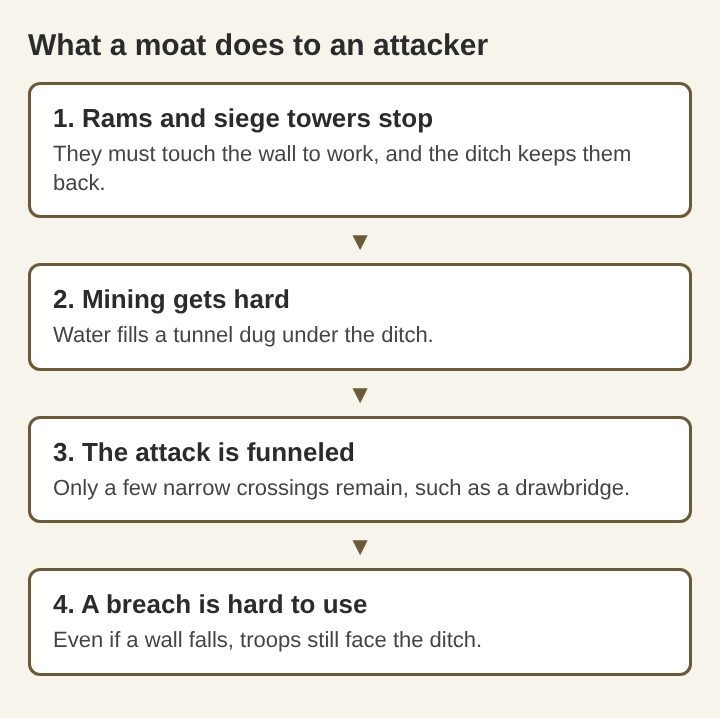
Take a small castle with a wet moat all round and one drawbridge in front of the gatehouse. An attacker tries four things in turn. Follow what the moat does to each.
- The ram goes for the side wall. It rolls up to the edge of the water and stops. To reach the stone, the crew would have to fill the moat first, in range of the wall. The ram goes back.
- A siege tower tries the corner. Same problem. It cannot stand against a wall it cannot reach, so its bridge has nothing to land on.
- Miners start a tunnel under the wall. They have to begin deep to pass under the moat, and water seeps into the workings. If the defenders hear them, they can dig a counter-mine and break in.
- The whole force turns to the drawbridge. This is the one dry way across. The bridge comes up, and now the attack is packed into a narrow strip of ground in front of a raised bridge and a closed gate, where every defender can aim at it.
Four attacks, one moat, and the result each time is the same: the enemy ends up where the defenders wanted. That is the same question a tower defense player asks about the path to the gate. You hold the narrow place, not the whole field.
When moats stopped being enough
Moats did not vanish when gunpowder arrived. With siege artillery in the 16th century, a new kind of fort appeared, with low walls and projecting strong points called bastions. The walls of these forts were still protected from attack on foot by wet or dry moats, sometimes in elaborate systems. When those forts gave way to rings of polygonal forts in the mid-19th century, moats were still used for close protection.
The idea was also much older than the medieval castle. Some of the earliest moats known are around ancient Egyptian fortresses, such as Buhen in Nubia, and others appear in the ruins of Babylon.
Frequently asked questions
Were castle moats full of water?
Some were and many were not. Where the ground and water supply allowed it, a moat was filled, which helped most against tunnels; elsewhere a deep dry ditch did the same job against rams, siege towers and soldiers on foot.
Did moats really stop tunnels under the walls?
They made tunnels much harder. A deep ditch or a wet moat forced miners to dig deeper and fight water, and even when a wall came down, the attackers still had to cross the ditch to reach the gap.
What is a neck ditch?
A neck ditch is a dry moat cut across the narrow part of a spur or a peninsula. It cuts off the one easy way onto a castle built on a high or nearly surrounded site.
How did people get across a moat?
At a few chosen places, on a drawbridge, a fixed bridge or a causeway. Keeping the crossings few and narrow was the point, since every attack then had to come through them.
What a moat really defended
A moat was less a wall of water than a choice made for the attacker. It took away the ground a ram or a siege tower needed, it made the miner's slow work slower and wetter, and it left only a few narrow ways across, each one guarded by a bridge and a gate. Every castle that had one was saying the same thing to anyone outside: you may come in, but only here, and only through the place that was built to stop you.
Two Towers
Defend the castle gate, stage after stage. Visit twotowers.vlvd.net