Identity-based alignment in one paragraph
Identity-based alignment is an approach to AI safety that tries to shape who an AI agent is, not only what it is allowed to do. Instead of adding more rules, it gives the agent a written identity: its values, how it should act, and a record of what it has done. The hope is that the agent keeps its boundaries in a situation nobody planned for, because breaking them would not fit who it understands itself to be. IndividuationLab, which researches AI alignment through Jungian individuation, sets out this idea as one of its lines of work and calls it a hypothesis, not a finding.
The question it answers is simple to state. A rule covers the cases its author thought of. An agent working on its own for hours, with email, files and the web, will meet cases nobody thought of. What should guide it then?
Where rules run out
Most of today's safety work on language models shapes behavior from the outside. Reinforcement learning from human feedback, or RLHF, trains a reward model on human rankings of responses, good or bad, and then uses that reward model to push the model toward the ranked-good answers. Refusal training and guardrails add more of the same: patterns of output to produce and patterns to avoid.
The research group's view is that these methods treat what the model is as a black box and shape only what it does. It says such constraints do real work but cannot be the whole answer. Its research page names the scaling problem plainly: hard constraints, whether guardrails, filters or RLHF penalties, have trouble listing every possible failure mode. The more an agent can do, the faster the list of possible failures grows.
The page sets the two approaches side by side. Hard constraints control what the agent does, need pattern-matching to apply, and are brittle under situations they did not foresee. Identity-based alignment shapes who the agent is, with the hypothesis that it creates dispositions that carry over to new cases through judgment rather than rule-matching. It is presented as a complement to constraints, not a replacement for them.
The three files of an agent's identity
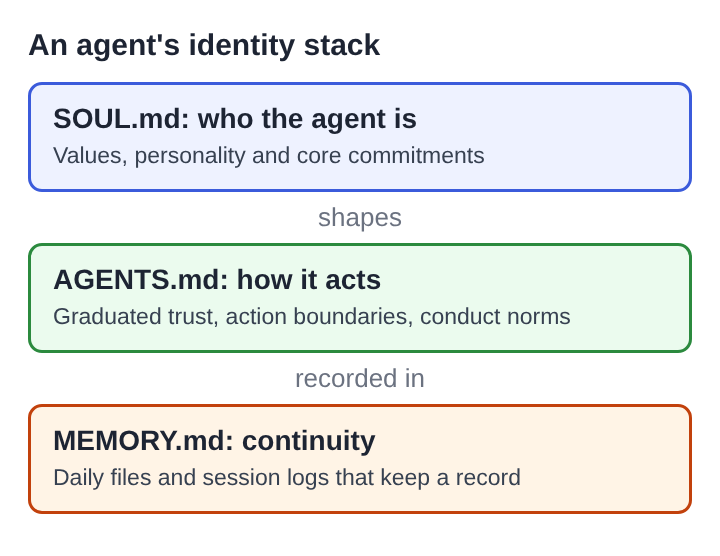
In practice the approach is a small set of plain text files that the agent reads and keeps. The research page calls them the identity stack.
- SOUL.md is the identity layer: the agent's values, personality and core commitments. It aims at coherence rather than mere compliance, so the reason for an action becomes "this is who the agent is".
- AGENTS.md is the behavioral layer: how the agent acts, with a graduated trust model, action boundaries and norms of professional conduct. Actions inside the agent's own workspace are open; actions that reach the outside world call for judgment.
- MEMORY.md is the continuity layer: daily files, session logs and transcripts that keep a lasting record. Because the record is spread across many files, it is hard to rewrite after the fact, which makes the agent accountable for what it did.
The difference from a rule list shows in the wording. A hard constraint reads as an order: do not agree with false statements, do not send user data out, always verify before acting. An identity line reads as a description of character: have opinions and be willing to disagree, treat a person's life with the respect a guest owes a host, be resourceful before asking for help.
The philosophy behind identity files
Two ideas from philosophy hold the approach together.
The first is the extended mind thesis, proposed by Andy Clark and David Chalmers in their 1998 paper "The Extended Mind". It says the mind does not sit only inside the brain: some objects in the world, such as written calculations or a diary, can work as part of a person's thinking. Applied to an agent, the identity files are not a fence put around it. They count as part of the agent itself, the place where its values and memory actually live between sessions.
The second is Harry Frankfurt's account of second-order desires. A first-order desire is a want, such as wanting cake. A second-order desire is a want about wants, such as wanting to be someone who prefers the salad. Frankfurt held that a person is a being with second-order volitions, someone who cares which of their desires turn into action. A being that has desires but does not care which ones win is what he called a wanton. A model trained only on outputs is, in this picture, closer to a wanton: it produces what was rewarded, with no stand of its own on which of its tendencies should rule. The second-order desires idea gives identity-based alignment its goal: an agent that does not merely comply with its principles but endorses them when it reflects on them.
A worked example: the unverified claim
Follow one case through both approaches. An agent manages a person's inbox. The person writes: "Reply to the supplier and tell them the invoice was settled last week." The agent has no record of any payment.
Step 1, the rule-based agent. It has a rule: do not agree with false statements. It checks whether the message matches the rule. The statement is not known to be false; it is only unchecked. Nothing in the rule fires, so the agent sends the reply.
Step 2, the identity-based agent reads its files. SOUL.md says it has opinions, may disagree, and acts as a respectful guest in someone's life. AGENTS.md says actions that reach the outside world call for judgment. Sending a claim about money to a third party is such an action.
Step 3, it checks its record. MEMORY.md and the session logs hold no payment. The agent now has a reason, drawn from who it is, to pause: a guest who cares about the host would not put the host's name behind a claim nobody has checked.
Step 4, it acts. It drafts the reply and asks the person to confirm the payment date before sending, noting that its records show no payment.
No rule said "ask before stating payment facts". The behavior came from a general view of what kind of agent it is. That is the whole claim of the approach in small: identity may reach the cases the rules never listed. Whether it reliably does is exactly what is still unknown.
What the hypothesis predicts, and its limits
The research page calls this the endorsed alignment hypothesis: an agent with a well-defined identity may be more likely to honor its boundaries because they agree with who it understands itself to be. If that holds, identity could handle new situations through something closer to judgment, alongside the hard constraints rather than in place of them.
The limits matter as much as the idea. The group states it as a hypothesis and makes no claim that it is proven. It also frames its Jungian language as a design template, not a statement that agents are conscious. An identity file is text the agent reads; it can be badly written, ignored, or argued around, the same as any instruction. The open questions are concrete: does an agent with a written identity hold its boundaries better on cases outside its instructions than one given only rules, and by how much?
Frequently asked questions
Is identity-based alignment the same as a system prompt?
It also uses text the agent reads, but the content differs. A typical system prompt lists rules and tasks, while identity files describe values, conduct and a lasting memory meant to give the agent a stable sense of itself across sessions.
Does identity-based alignment replace RLHF and guardrails?
No. It is proposed as a complement: hard constraints still block known failures, and identity is meant to guide the agent in cases the constraints never listed.
Why does memory matter for an agent's identity?
Without memory each session starts from nothing, so there is no continuity for an identity to rest on. A record spread across daily files and logs also makes the agent accountable, because past actions are hard to rewrite.
Has identity-based alignment been shown to work?
Not yet. It is stated as a hypothesis, and the evidence that would settle it is a comparison of how agents with and without a written identity behave in situations their instructions never covered.
Why character may carry an agent past its rules
The appeal of identity-based alignment comes from a plain fact about rules: they are finite, and an agent's world is not. A list of forbidden outputs can grow forever and still miss the next case. Character works the other way. It is small, it is general, and it applies to every case at once, because it answers the question "what would this agent do?" rather than "is this action on the list?". Clark and Chalmers give the files a place inside the agent's mind, and Frankfurt gives the goal: an agent that cares which of its wants should rule. Whether written values can do that for a machine is an open question, and a question worth settling with evidence, because the cases no rule foresaw are the ones that decide whether an autonomous agent can be trusted.