Yes, breaking words into syllables helps you remember them, because short-term memory counts pieces and holds only about four at once. A ten-letter word overflows that limit as letters and fits inside it as four syllables. The help is real and it is narrow: syllables hold the sound of a new word for a few moments, long enough for a lasting memory to start forming. They do not supply the meaning, and they do not keep the word until next week.
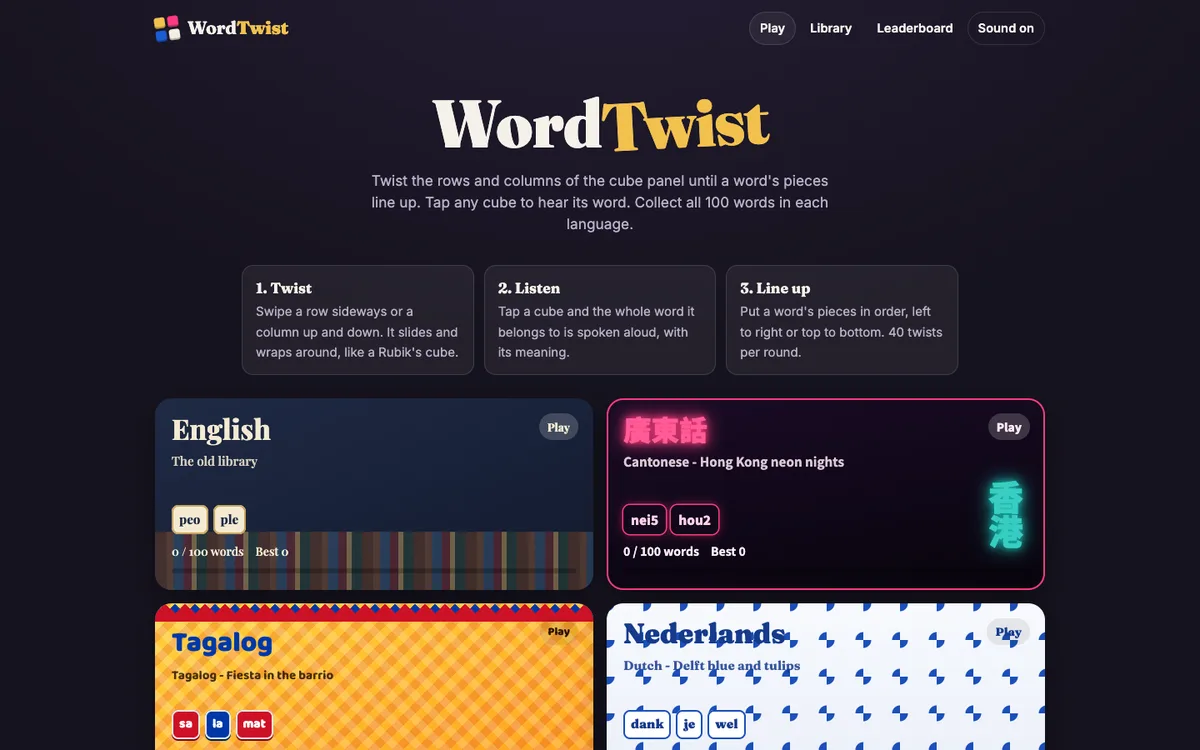
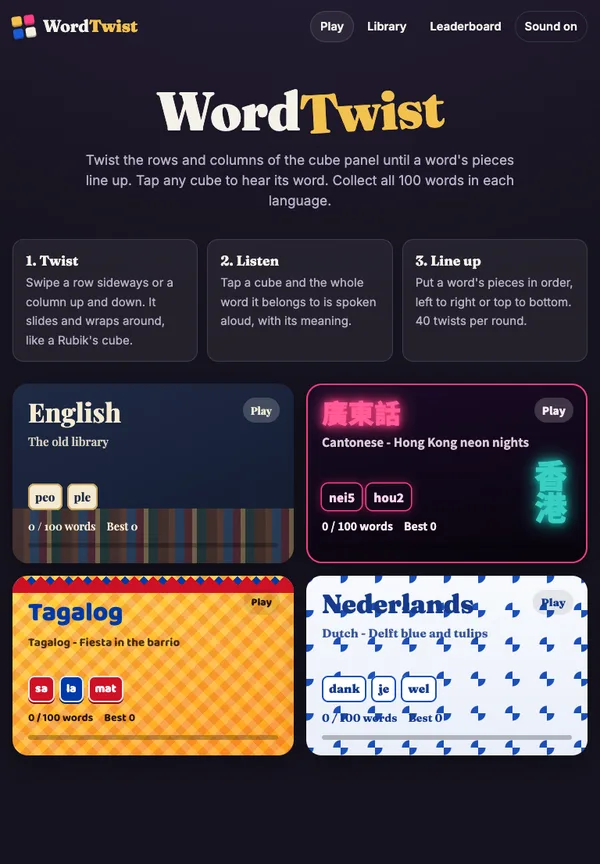
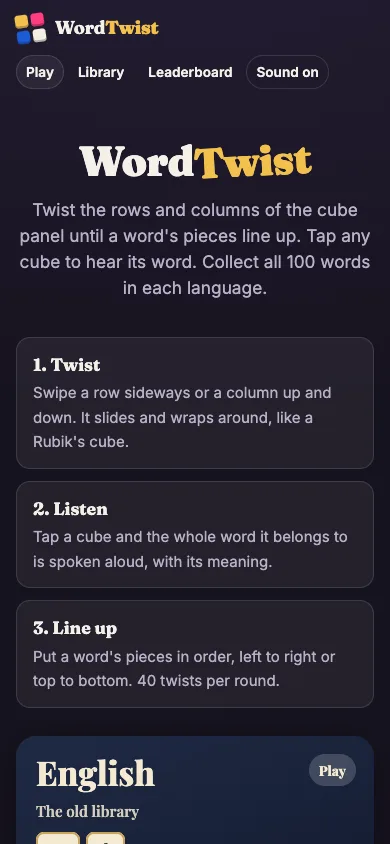
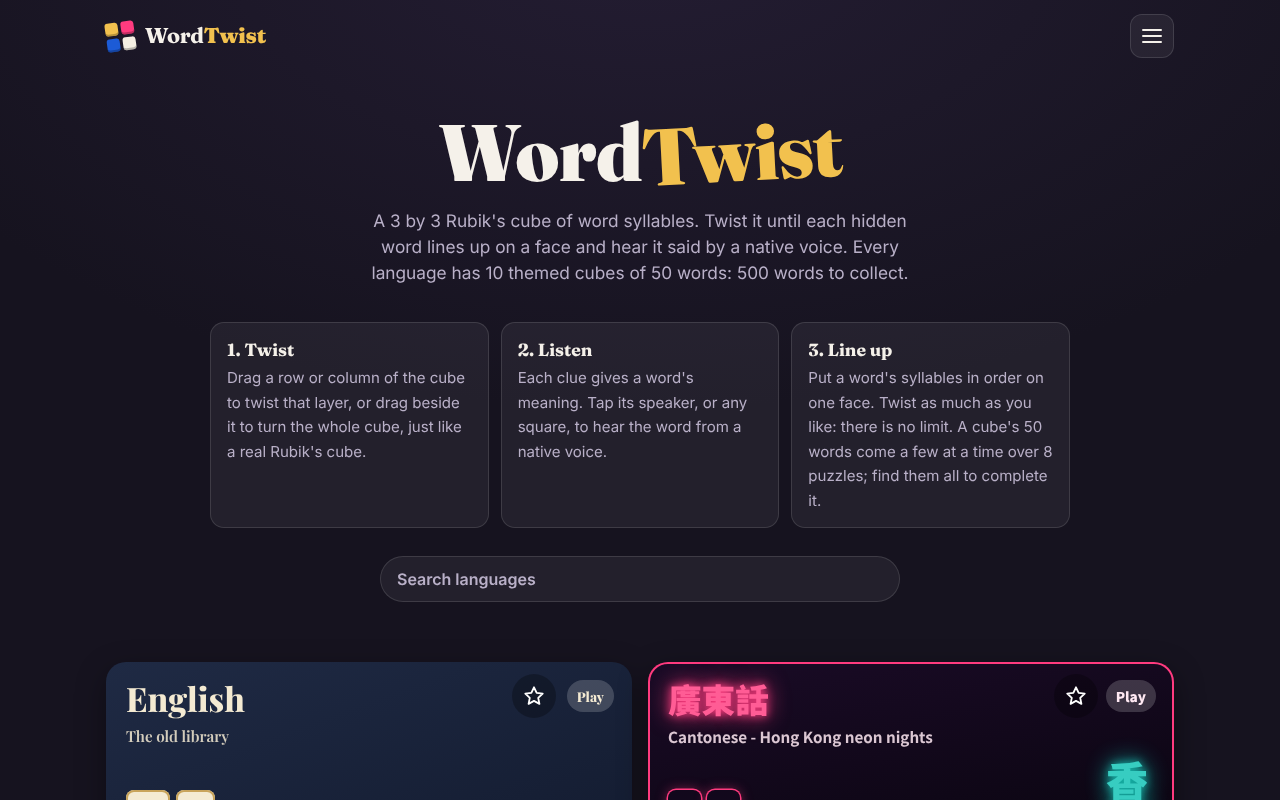
The same idea is the playing surface of WordTwist, a word puzzle on a 3 by 3 cube of word syllables. The player twists rows and columns until each hidden word lines up on one face, then hears the word said by a native voice.
Why breaking words into syllables helps: memory counts pieces
The piece that memory counts has a name, the chunk. It comes from the psychologist George A. Miller, whose paper "The magical number seven, plus or minus two" appeared in an American psychology journal in March 1956. Miller noticed that the span of immediate memory hardly changes with how much information each item carries. People hold roughly the same number of items whether each item carries a little information or a lot.
That finding has a practical side. If the count is fixed and the size of each item is not, you can hold more by making each item bigger. Miller called this recoding. His example, retold on the Wikipedia page on chunking), is the telegraph operator. A beginner hears every dit and dah as a separate item. With practice the same sounds arrive as letters, then as words, then as phrases. The page also describes a 1954 experiment in which people trained to recode could recall up to 40 binary digits, against about nine for people without the training.
A syllable is recoding applied to a word. Several letters become one unit that you can hear and say in a single beat.
The limit is closer to four than to seven
Miller's seven is the number most people remember, and it is too generous. In February 2001 the psychologist Cowan, of the University of Missouri, published "The magical number 4 in short-term memory" in Behavioral and Brain Sciences. He argued that Miller meant seven as a rough estimate and a turn of phrase, not as a measured limit. When people are stopped from rehearsing and from grouping items into larger chunks, the count that remains is three to five chunks, about four on average.
The gap between seven and four is itself evidence for syllables. People reach seven largely because they quietly group and rehearse. Take the grouping away and the span drops. Splitting a word into syllables is that grouping done on purpose.
The sound store a new word has to pass through
Chunks explain how much fits. A second line of research explains why the pieces of a new word should be pieces of sound. In Alan Baddeley's model of working memory, speech is held by a part called the phonological loop. The Wikipedia page on Baddeley's model describes its two parts: a short-term store where sound traces decay rapidly, and a rehearsal process that revives them when you repeat the sound to yourself.
In January 1998 Baddeley, Gathercole and Papagno published "The phonological loop as a language learning device" in the same journal. They gathered studies of word learning in adults, in children and in neuropsychological patients. Their conclusion was that the loop plays a crucial part in learning the sound forms of new words. They went further and proposed that this is what the loop is mainly for: holding an unfamiliar sound pattern while a more permanent record is built. Holding strings of familiar words they called secondary.
The steps for one new word run in this order:
- You hear the word, or sound it out, and its sound enters the short-term store.
- The trace starts to fade at once.
- You repeat the sound, aloud or silently, and the trace is revived.
- While the sound is kept alive, a lasting record of it begins to form.
Step three is where syllables matter. You can only rehearse what you can say. A foreign word seen as a row of letters may have no sound for you yet. Cut into syllables, every piece can be spoken, so the whole word can be rehearsed.
One Tagalog word, counted three ways
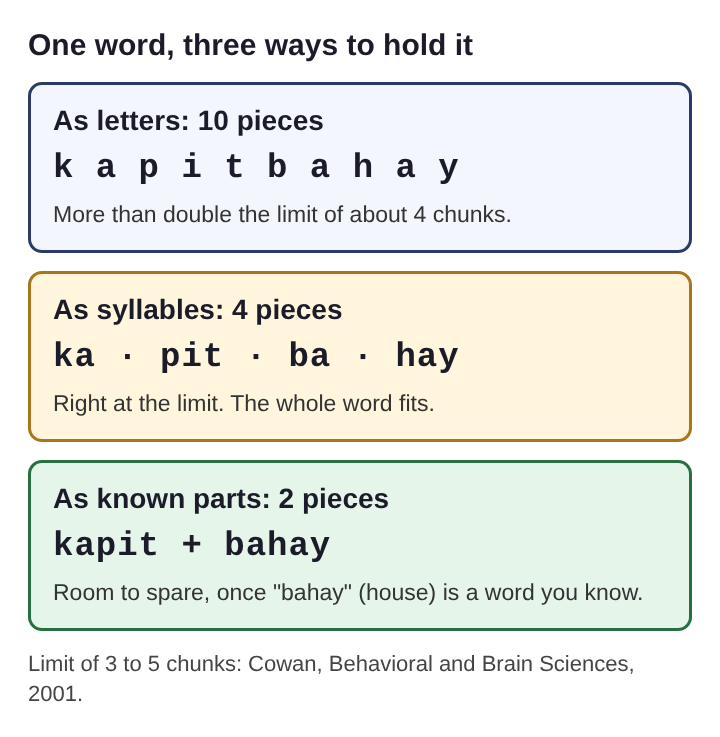
Take the Tagalog word kapitbahay, which means neighbour. It has ten letters. A learner who meets it as letters has ten items to hold, more than double the four that Cowan's limit allows. The string is longer than the store, so part of it is lost before the end is reached.
Split it into syllables: ka, pit, ba, hay. Now there are four items, each one sayable. That sits right at the limit. The whole word fits, and it can be repeated from start to finish.
Go one step further. The word is built from two parts, kapit and bahay, and bahay means house. A learner who already knows bahay holds the word as two items and has room left for the next word. The consequence is the useful part: chunks grow as your vocabulary grows. A word made of pieces you already know takes fewer slots than a word made of new ones.
What syllables do not do
The strongest objection to syllable practice is that it trains the wrong thing. The 1998 paper is about the sound form of a word. It says nothing to suggest that holding a sound teaches you what the sound means. Meaning has to be attached separately, by seeing the word next to its definition, a picture or a sentence. A puzzle built on syllables needs a clue that gives each word's meaning for exactly this reason.
Chunking also does not make memory bigger. In June 1980 Ericsson, Chase and Faloon reported in Science on one student's memory practice. After more than 230 hours in the laboratory, his span for digits rose from 7 to 79. Yet the Wikipedia page on chunking records that he still grouped only three or four digits at a time. His store stayed the same size. What changed was how much each chunk held and how the chunks were arranged. For a language learner the lesson is plain: syllables give you a working hold on a word, and only repeated meetings with the word over days turn that hold into knowledge.
Syllables that sound alike get mixed up
One distinction is easy to get wrong. Words with similar meanings are not the main source of confusion in short-term memory. Words with similar sounds are. The page on Baddeley's model reports that lists of words that sound alike are harder to remember than lists that sound different, while similar meaning has comparatively little effect.
Syllables are short, so they collide often. The ba of one word and the pa of another sit close together in the sound store. WordTwist turns this into part of the puzzle. A word's syllables all share one colour, a lookalike syllable of another colour belongs to another word, and some squares hold decoy syllables that never spell a word on the list. When you practise on paper, the matching habit is to say near-twin syllables one after the other and listen for the difference, instead of trusting the spelling.
What researchers still disagree on
Nobody has a firm definition of a chunk. Miller admitted in 1956 that what makes a chunk was not very definite, and the chunking page notes that chunk size varies with language and culture. A syllable is one chunk for a listener who knows the language's sounds. For a beginner, a syllable with an unfamiliar vowel or tone may still be two or three things to track.
The loop itself is disputed too. The page on Baddeley's model cites criticisms of the phonological loop from 2002 and 2004. Cowan's own paper warns that a capacity limit is only useful when the conditions for observing it are stated carefully. So "about four" is a guide for planning practice, not a law about every learner and every word.
Frequently asked questions
Is a syllable the same thing as a chunk?
No. A chunk is any unit that memory treats as one item, and it can be a letter, a syllable, a word or a phrase. A syllable becomes a chunk once you can hear it and say it as a single beat.
How many syllables can you hold in mind at once?
Cowan's 2001 paper puts the limit at three to five chunks, about four on average. A word of up to four syllables fits whole. A longer word needs its syllables grouped into larger parts.
Does saying the syllables aloud make a difference?
Yes. Repeating a sound is what revives its fading trace in the short-term store. The page on Baddeley's model reports that memory for verbal material gets worse when people are made to say something irrelevant aloud, which blocks that repetition.
Do syllables help you remember what a word means?
Not directly. The research covers the sound form of a new word. The meaning has to be linked to that sound separately, through a definition, a picture or a sentence.
Syllables give a new word its first hold in memory
A new word is first a sound pattern that fades quickly. Splitting it into syllables brings the number of pieces down to what short-term memory can carry, and makes every piece something that can be said and repeated. That is enough to keep the sound alive while a lasting record forms. Meaning and long-term recall come from other work: pairing the sound with what it stands for, and meeting the word again on later days. Syllables are where that work starts, because a sound that has already faded cannot be rehearsed.
WordTwist
Twist the cubes, line up the pieces, collect words in four languages. Visit wordtwist.vlvd.net