What to ask yourself at the end of the month, and what to answer from
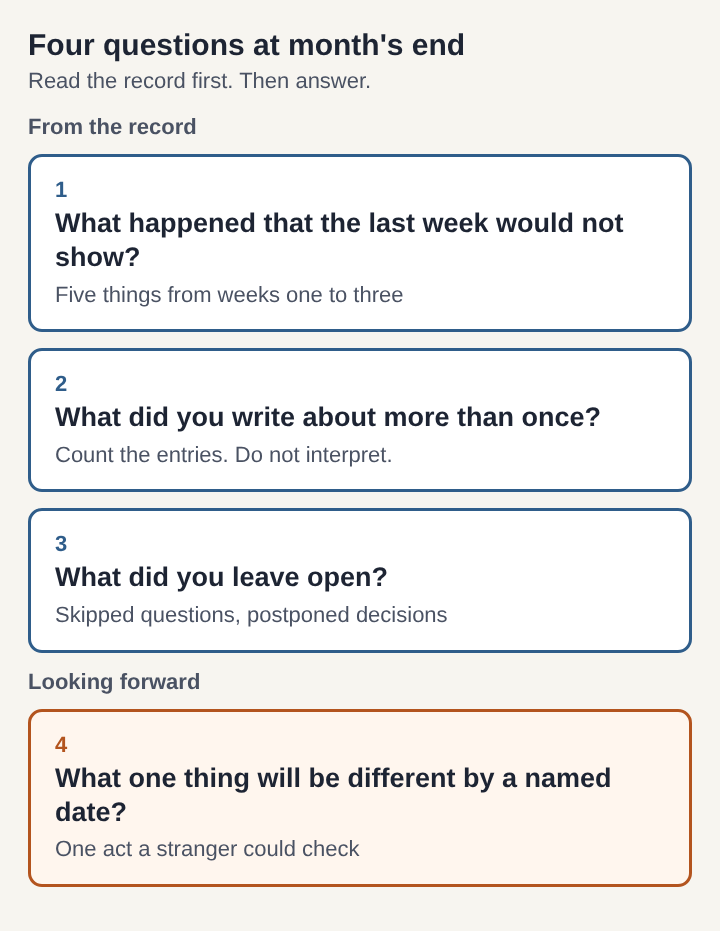
What to ask yourself at the end of the month comes down to four questions: what happened, what kept coming back, what stayed open, and what one thing changes next month. Answer them with the month's own record open, because memory keeps the worst day and the last few days and drops most of the rest.
The order matters. The first three questions only collect what is already on the page. The fourth is the only one that looks forward, and it is small on purpose.
A daily record makes the month-end look back much shorter. EnrichAI asks five questions a day about your own life, and its daily readout sets the day beside your week and your month. A paper notebook, a calendar or a notes file does the same job, as long as the entries were written on the day they describe.
Why thirty days do not fit in memory
Memory does not store a stretch of time evenly. In a study published in the journal Pain in July 1996, Donald Redelmeier and Daniel Kahneman recorded pain in real time for 154 patients having a colonoscopy and 133 having lithotripsy. Afterwards they asked each patient how much pain the whole procedure had held. The later judgments tracked two moments: the peak, and the last 3 minutes. Long procedures were not remembered as especially bad, even though they held more pain in total.
That study measured minutes of pain, not a month of ordinary days, so carrying it over is an inference. Still, it names the two errors to guard against. Asked cold, "how was October?" tends to return the hardest day and the final week. The other twenty or so days are in the record or nowhere.
So the first step is to read, and only then to answer. Ten minutes of rereading changes the answers more than any clever wording of the questions.
Benjamin Franklin's little book: the monthly look back has an old form
The habit of going over a longer stretch from daily marks is older than any app or printed planner. In chapter IX of his Autobiography, Benjamin Franklin describes a little book with a line for each of thirteen virtues and a column for each day of the week. Each evening he put a black spot beside any virtue he had failed at that day. He gave one week of strict attention to each virtue in turn, so a full course took thirteen weeks and he could run four courses in a year.
Two details from his account still matter. First, he reports being surprised to find far more faults than he had imagined, and then seeing them diminish. The marks told him something his memory had not. Second, the schedule did not last. He went down to one course a year, then one in several years, then none, though he says he always carried the book with him.
The lesson for a month-end session is plain. The long view was only a count of marks made on the day. And a plan with thirteen lines lapsed even for its inventor, which is a reason to keep yours to four questions.
The four questions, one at a time
1. What happened this month that the last week would not show? Read the entries from the first three weeks and write down five things from them. This question exists to push against the pull of the final days. If you cannot find five, the record is thin, and that is worth knowing too.
2. What did you write about more than once? Count, do not interpret. A name, a place, a worry or a plan that appears in six entries took up six days of attention, whatever you now think of it. Write the number next to the word.
3. What did you leave open? Look for questions you skipped, decisions you postponed and sentences that end with "later". Some question-based journals mark this for you: on that same home page, the readout is said to state plainly what was left unanswered, and the next day's questions follow what was left open. On paper, a small circle in the margin on the day does the same.
4. What one thing will be different by a named date? One thing, one date. The answer should be something a stranger could check: a call made, a page written, a bill sent.
Notice what the list leaves out. None of the four asks how the month felt overall, and none asks why. The first omission follows from the 1996 finding. The second has its own reason, and it is the strongest objection to the whole practice.
A worked month: 31 days, 22 entries
Take a person at the end of October with a short journal. From memory, the month reads as bad: a deadline was missed on the 14th, and the last four days were tired ones. That is the peak and the end.
Now the record. October had 31 days and the journal holds 22 entries.
- Question 1. Weeks one to three hold a finished course module on the 3rd, a long walk with a friend on the 9th, the missed deadline on the 14th, a repaired bike on the 17th and a good conversation with a manager on the 20th.
- Question 2. Sleep appears in 9 entries. A sister's phone call appears in 6. The deadline appears in 3.
- Question 3. The sister called on the 6th. Four of the six entries that mention her say some form of "should call back". On the 29th the call is still not returned.
- Question 4. Call her on Sunday 1 November, before noon.
The consequence is a different headline. Memory put the deadline first, yet it filled 3 entries out of 22. The unreturned call filled 6 and was open for 23 days. It was never the worst moment of the month and it was not in the final days, so memory ranked it low. The count ranks it first, and the one dated action goes to it instead of to a deadline that has already passed.
The strongest objection: you may not know why you did it
The case against month-end questions is that people are poor witnesses to their own reasons. The Stanford Encyclopedia of Philosophy's entry on introspection sets out the work of Richard Nisbett and Timothy Wilson from 1977. They describe cases where people show poor knowledge of the causes of their own behavior. Shoppers choosing between pairs of stockings seemed unaware that position on the display affected their choice. And the explanations people gave for themselves closely matched what outside observers guessed. A person explaining their own month may be using the same general theories a stranger would use.
The same entry records the limit the two authors set. On their view, what is missing is access to the processes or causes behind behavior. Attitudes and current sensations, they held, can be known with near certainty. That line is exactly where the four questions stop. "What happened" and "what stayed open" are answered from marks made on the day. "Why did October go wrong" asks for a cause, and the answer will be a theory.
How far the objection reaches is not settled. The entry calls the evidence for full parity between self-knowledge and knowledge of others contentious, and says complete parity is probably impossible to sustain. It also reports Eric Schwitzgebel's 2012 view that introspective judgments come from a shifting mix of many processes. Nor does anyone know from the 1996 study whether the peak and the end rule a month the way they ruled a procedure. Until that is known, the record is the safer witness.
Frequently asked questions
How long should a month-end reflection take?
About 20 to 30 minutes, with most of it spent rereading. If the answers take longer than the reading, you are probably answering from memory.
What if there is no journal to reread?
Use any record made on the day: a calendar, sent messages, photos, a bank statement. Mark anything answered from memory alone as memory, so you can see how much of the month rests on it.
Does it have to be the last day of the month?
No. Any fixed day works, as long as it is the same one each month and the entries you read cover the same length of time. Franklin's own unit was a week, with thirteen of them to a course.
Should a month-end question ever ask why?
It can, if the answer is written as a guess and checked against next month's record. Stated as fact, a reason for your own behavior is the kind of claim the 1977 research found people get wrong.
What the end of the month can and cannot tell you
Asked from the record, the end of the month can tell you three things with some confidence: what happened, how often each concern returned, and what is still open. Those are counts, and counts do not depend on your mood on the 31st.
It cannot tell you why the month went as it did, and it cannot promise the next one. Franklin's marks showed him more faults than he expected, not their causes. The four questions accept that limit. They turn thirty days into a short list and one dated act, and they leave the explanations as open questions for the next month's entries to confirm or contradict.
EnrichAI
Five questions a day about your own life, each a little deeper. Visit enrich.vlvd.net