How to memorize definitions for an exam
How to memorize definitions for an exam comes down to one rule: cover each definition, say its meaning from the term alone, check it, and keep going until you have recalled it correctly three times in one session. Then come back on three later days and recall each one correctly once more. Both numbers come from experiments, not from habit.
The method needs a list of terms, a way to hide the meanings, and a calendar. Paper cards work. A sheet folded down the middle works. So does a quiz made from the page itself: Study Shot turns a photo of a page from a textbook, notes or a worksheet into multiple-choice practice questions and explains every answer.
What matters more than the tool is the rule for when a definition counts as done. Most students stop at the first right answer, and the research says that is too early.
Why one correct answer is not enough
The clearest evidence is a study that Karpicke and Roediger published in the journal Science on 15 February 2008, The Critical Importance of Retrieval for Learning. Students learned foreign language vocabulary, which is the same job as learning definitions: one word on one side, its meaning on the other.
The design turned on a single moment, the first time a student produced a word correctly. From that point the groups split. One group kept reading the word but was never asked for it again. One group kept being asked for it but never read it again. One group dropped it completely, as most students do with a card they got right.
The result on the delayed recall was lopsided. Reading a word again after that first correct answer had no effect. Being asked to recall it again had a large positive effect. The first correct answer is the point where rereading stops paying and recalling starts to.
The same paper found a second thing. Students were asked to predict how much they would remember, and their predictions were uncorrelated with what they actually remembered.
Three correct recalls today, three returns later
Rawson and Dunlosky at Kent State University asked how many recalls are enough in a 2011 paper in the Journal of Experimental Psychology: General. Across 3 experiments, 533 students learned conceptual material by recalling it and then checking the answer. More than 100,000 short-answer responses were collected and marked by hand.
Two things were varied. The first was how many times a student had to recall an item correctly in the first session before it was set aside: 1, 2, 3 or 4. The second was how many later sessions followed, from 1 to 5, each one continuing until the item was recalled correctly once. Memory was then measured 1 to 4 months after practice.
Their conclusion for students is specific: recall each concept correctly 3 times in the first session, then relearn it 3 times at widely spaced intervals.
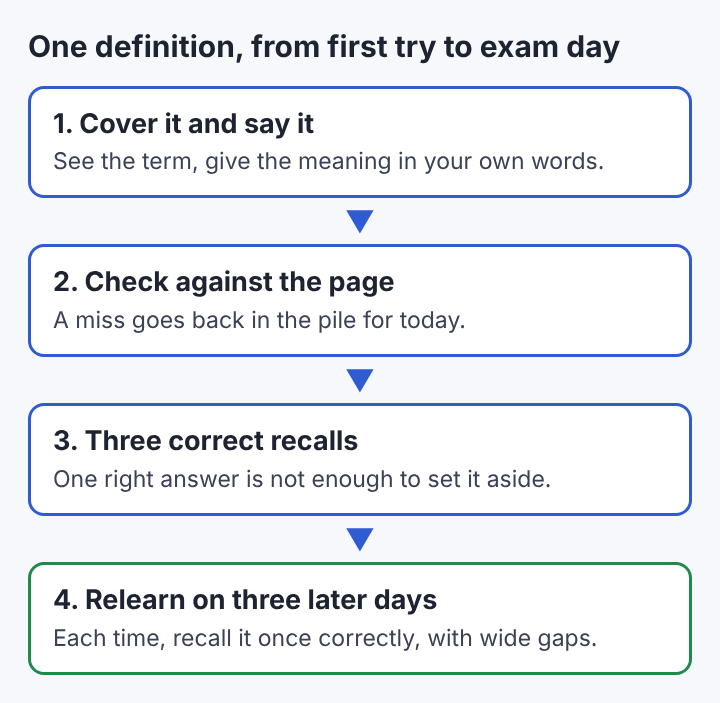
The two halves of that rule do not do equal work. The paper reports that the first-session number mattered a lot when there were no later sessions. As later sessions were added, its effect shrank. The more often a student returned, the less the strictness of the first session mattered.
The returns were also cheap. The paper reports that relearning had pronounced effects on long-term retention with a relatively minimal cost in additional practice.
That changes how to spend a fixed amount of time. One long session the night before puts all the effort into the half of the rule that fades. Four shorter sessions put most of it into the half that lasts. The spacing effect is the older name for why the gaps help.
Say the meaning, not the sentence
The Kent State students were marked on short answers they wrote themselves, not on picking the right line from a list. If the meaning is in front of you and it looks right, you have recognized it. If the term is in front of you and you can produce the meaning, you have recalled it. Only the second counts toward the three.
Unless the exam asks for exact wording, as it can with a legal rule or a stated law in physics, aim for the meaning in your own words. A recited sentence breaks when the exam phrases the question differently. Add one example to each definition as you say it. For osmosis, that could be water moving into a root hair cell.
Run the cards in both directions when the exam can ask in both directions. Naming the term from a description is a different skill from giving the meaning, and it needs its own correct recalls.
Where memory tricks and rereading fit
The strongest objection to all this is that it sounds slow, and that a good memory trick is faster. The best known trick for definitions is the keyword mnemonic: link the new term to a familiar word that sounds similar, then picture the two together.
In 2013 Dunlosky, Rawson, Marsh, Nathan and Willingham assessed 10 learning techniques in a monograph for Psychological Science in the Public Interest. The keyword mnemonic was one of five techniques they judged to be of low utility. Their reasons were practical: it is difficult to use in some contexts, and it appears to help for a limited number of materials and over short retention intervals.
Rereading landed in the same low group. The authors note that most students report doing it, yet it does not consistently improve performance. A trick still has a place: use one for the three or four terms that refuse to stick, then put those terms through the same three recalls as the others.
A worked example: 20 definitions, 9 days
Take a glossary page of 20 biology terms and an exam in 9 days. One way to set it up is a quiz from a photo of the page. Study Shot's guide on choosing a level suggests Basic with 10 or 20 questions for learning definitions, each question has four choices, and each answer is checked right away and explained. Because four choices show the meaning, cover them, say your answer first, then uncover and pick.
Day 1, the first session. Round one: 11 right, 9 missed. Read the explanation for each miss. Round two covers the 9 misses and the 11 that still need more correct recalls. Keep cycling until every term has 3 correct recalls. Suppose the misses run 9, then 4, then 1. That is 60 correct recalls plus 14 misses, 74 attempts. At about 20 seconds each, the session takes roughly 25 minutes.
Days 3, 5 and 8, the returns. Each return ends when every term has been recalled correctly once. A quiz kept in a library can simply be taken again. Suppose 6 terms have slipped by day 3, 3 by day 5 and 1 by day 8. The returns cost 26, 23 and 21 attempts.
The total is 144 attempts, under an hour across nine days. The three returns together cost 70 attempts, fewer than the first session alone. And the terms that slipped on day 3 are the ones a single long session on day 1 would have hidden until the exam.
What the research has not settled
The 2011 rule says the returns should be widely spaced, but it does not give the gaps for an exam that is 9 days away. The experiments measured memory 1 to 4 months after practice. Three returns inside a week is a reading of the rule, not something the paper measured.
The material is a second open point. The 2008 study used foreign vocabulary with university students, and the 2011 experiments used conceptual material. Whether the same numbers hold for younger pupils, or for answers that must be word for word, is not something those findings show.
The third is format. Both studies had students produce the answer. How much of the benefit survives when the answer is chosen from a list is a separate question, which is the reason for covering the choices first.
Frequently asked questions
How many times should you recall a definition before setting it aside?
Three correct recalls in the first session, according to the 2011 Kent State experiments. After that, relearn it on three later days, each time until you recall it correctly once.
Should a definition be memorized word for word?
Only when the exam asks for exact wording. Otherwise learn the meaning in your own words and attach one example, so a differently phrased question does not throw you.
Does reading the definitions again help?
It helps until the first time you can produce the definition. In the 2008 Science study, reading an item again after that point had no effect on delayed recall, while recalling it again had a large one.
Do memory tricks work for definitions?
They can help with a few stubborn terms. The 2013 monograph judged the keyword mnemonic to be of low utility overall, because it suits a limited number of materials and its benefit appears over short intervals.
Memorizing definitions, in the end
A definition is not learned when you first get it right. It is learned when you have pulled it out of memory several times, with gaps in between, and the last few times it came back without effort. Three correct recalls and three returns is the most exact form of that idea measured so far. The feeling of knowing a term is a poor guide, so count the recalls and keep the count honest.
Study Shot
Turn any page into a practice quiz. Visit studyshot.vlvd.net