How to study for an exam from your own notes
Your notes are the closest record of what the course actually covered, so the work starts there. The trouble is what most students do with them: read them again, then again, until the pages look familiar. If you want to know how to study for an exam from your own notes, the short answer is to stop treating them as something to read and start treating them as a source of questions. Turn each page into questions, answer them with the page closed, check every answer, and come back to the misses on later days.
That method works with any notes: handwritten pages, printed slides with your marks on them, a worksheet you filled in during class. It also suits tools built around the same idea. Study Shot, for one, takes a photo of a page from a textbook, notes or a worksheet and writes multiple-choice practice questions about it, from the basics to advanced, explaining every answer.
Why reading your notes again is not enough
Reading your notes feels productive because the words are yours. You recognise every line, and recognising feels the same as knowing. But an exam does not show you your notes and ask whether they look right. It asks you to pull the answer out of memory with nothing in front of you.
Research on retrieval practice backs this up. Recalling what you know does more for learning than only reading or passively studying the same material, and the gain is larger when the recall takes effort. The idea is old. In 1620 Francis Bacon wrote that if you read a text through twenty times, you will not learn it as well as if you read it ten times while trying to recite it, and checking the text when your memory fails.
There is also a timing trap. Material you just reread is often easier to recall straight away than material you practised recalling. Over the following days that flips: the material you recalled holds up better. So the method that feels best on the evening you study is the one that fades fastest by the exam.
Turn each page of notes into questions
Work one page at a time. For each page, write questions whose answers are on that page and nowhere else. A good set for one page mixes three kinds:
- Basic questions that ask for a term, a date, a definition or a single fact.
- Middle questions that ask why something happens or how two ideas connect.
- Hard questions that ask you to apply the idea to a case the notes do not show.
About ten questions per page is enough for most notes. Fewer and you skip parts of the page; many more and you start writing the same question twice. Keep the questions apart from the notes, on a separate sheet, in a document, or in a quiz you can open again later. The point is that you can see the question without seeing the answer.
If writing the questions yourself takes too long, a photo of the page can do the work. A quiz made this way has 5 to 20 questions, each with four choices, sorted from the basics to the hardest, and every quiz is kept with its page photo so you can take it again. Its own guide suggests 10 questions per page, on the level that climbs from basic to advanced, when you work through a chapter page by page.
Answer with the notes closed, then check
Close the notes before you start. Answer every question from memory, even the ones you are unsure of. A guess that turns out wrong is still useful: the work of trying to produce an answer helps you hold on to the right one once you see it.
Then check each answer straight away. Feedback is what turns a miss into learning. Recall followed by feedback works better than either study alone or recall with no check. When you get one wrong, open the notes to the exact line it came from and read only that line and the lines around it. Mark the question so you can find it again, and come back to it the way learning from the questions you get wrong describes.
Two habits make this step stronger:
- Say why the right answer is right. If you picked it but cannot explain it, count it as a miss.
- Cover the choices on multiple-choice questions. Try to answer before you look at the options, then pick. That keeps the recall honest.
Spread the rounds over several days
One long session the night before is the most common plan and one of the weakest. The spacing effect describes why: study spread over several sessions puts more into long-term memory than the same amount of study packed into one block, which is what cramming is. In a 2006 analysis of many studies by Cepeda and colleagues, spaced practice did better than massed practice in 259 of 271 cases.
For notes, spacing means coming back to the same questions on later days instead of answering them all once. Each return should be a little harder than the last: the misses first, then a mixed set from several pages, so you cannot lean on the order of the notes. Advice built on this research says the same: spread out your recall, and check your answers each time.
A gap of a day or two between rounds is enough in the final week. If you have longer, make the first gap shorter and the later ones longer.
A worked example: six pages, seven days
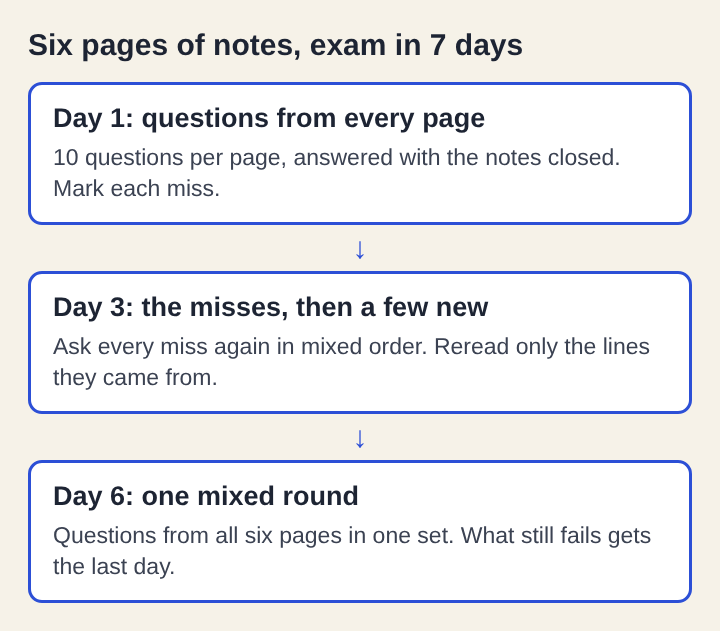
Say your exam is next Friday and your notes for the unit fill six pages. Here is how the week could run.
- Saturday, day 1. Make 10 questions for each page, 60 in all. Answer each page's set with the notes closed and check every answer. Say you get 41 right and 19 wrong. Mark the 19.
- Monday, day 3. Ask the 19 misses again, in mixed order, with the notes closed. Say 12 come back. For the 7 that still fail, reread only the lines they came from, then add a few new questions on those same lines.
- Thursday, day 6. Build one mixed round: some questions from every page, with the misses from Monday included. Whatever still fails tells you exactly which lines need the last evening.
Notice what does not happen. You never reread all six pages from top to bottom. Your time goes to the lines that did not come back, and the rest are checked only by recall. By Thursday you know which parts of the notes you can produce from memory, rather than which parts look familiar.
The same pattern fits a guide's suggestion for the week before an exam: harder questions, 10 or 15 at a time, taken again until every answer comes back right.
Frequently asked questions
Should you rewrite your notes before an exam?
Rewriting can help you organise messy notes, but it is mostly copying, not recall. If time is short, spend it answering questions about the notes instead.
How many questions should you make from one page of notes?
About ten per page covers most notes, mixing basic facts, why and how questions, and a few that apply the idea to a new case. A dense page can take more.
What if your notes are incomplete?
Fill the gaps first from the textbook or the course slides, then make questions from the filled page. Questions can only cover what the page says.
Is it too late to start the night before?
One evening of answering questions with the notes closed still beats one evening of rereading. Start with the pages you know least, check every answer, and sleep.
Studying from your own notes, in the end
Your notes already hold the material. What they cannot do on their own is show you what you have actually learned. Questions do that. Each round of answering with the page closed shows you which lines stick and which slip, and each return a few days later makes the lines that stuck harder to lose. Studying from your own notes comes down to that loop: ask, answer from memory, check, and come back to what failed until it no longer does.
Study Shot
Turn any page into a practice quiz. Visit studyshot.vlvd.net