How to know if you are ready for an exam
The night before an exam, most people ask themselves whether they are ready, and the usual answer comes from a feeling. You flip through your notes, every page looks familiar, and you decide you are fine. The trouble is that a familiar page and a page you can recall are not the same thing. The only reliable way to know if you are ready for an exam is to close every page and find out what comes back without it, then do it again a few days later.
A good readiness check has three parts. You answer questions from memory, not from the page. You leave a gap of at least a day or two before you answer them again. And you count what came back, page by page, instead of judging the whole subject at once. Tools such as Study Shot, which turns a photo of a textbook or notes page into multiple-choice questions with every answer explained, make the first part quick, but the method works with questions you write yourself.
Why the feeling of being ready misleads you
When you look at a page you have studied, the words read smoothly. Your mind takes that ease as a sign the ideas are stored. Often they are only recognised. Recognition needs the page in front of you. An exam takes the page away and asks you to bring the idea back on your own.
That is why the feeling is strongest right after study and least useful then. You have just seen the material, so everything is fresh. But the exam is not in five minutes. It is in a few days or a week, and memory does not hold still across that gap.
What the forgetting curve says about readiness
The forgetting curve describes how memory of new material fades over time when nothing is done to keep it. Hermann Ebbinghaus mapped it by studying his own memory of nonsense syllables such as "WID" and "ZOF" between 1880 and 1885, recalling them after different gaps and recording what was left. He published the results in 1885. A typical graph of the curve shows people losing about half of newly learned material within days or weeks unless they go back over it.
For readiness, the lesson is about timing. A check you run ten minutes after studying measures what is still in short reach, not what will be there on exam day. A check run after a gap of a day or two measures something closer to what the exam will find. If an answer survives the gap, it has a fair chance of surviving to the exam. If it fades in two days, it will likely fade in seven.
Ebbinghaus also held that the best ways to strengthen memory were better ways of representing the material and repetition based on active recall, especially spaced repetition. Each repetition, on his account, flattened the curve and lengthened the time before the next one was needed. So a readiness check is not only a measurement. Each round of recall also slows the forgetting.
A three-step readiness check you can run
Here is the check in full. It takes a few short sessions spread over several days, not one long night.
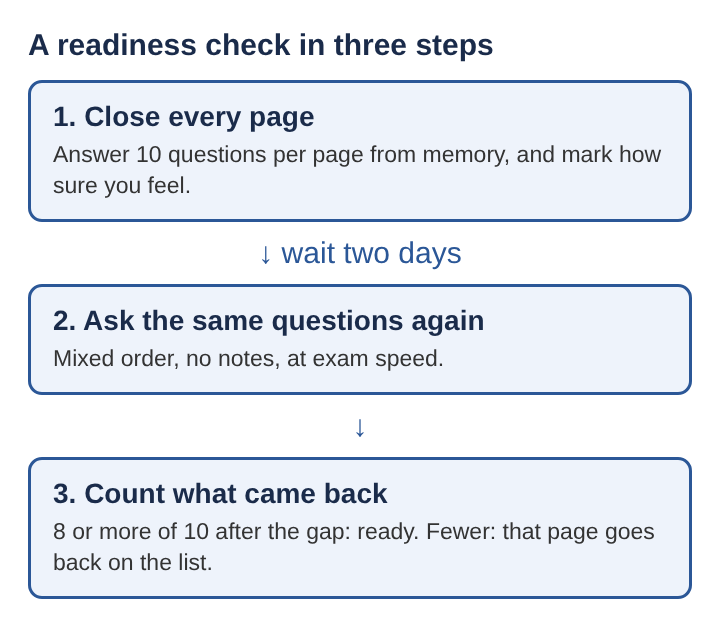
- Close every page and answer from memory. Take 10 questions per page of your notes or textbook. Answer each one with nothing open. Before you see the answer, mark how sure you feel: sure, unsure or guessing.
- Wait two days, then ask the same questions again. Mix the order so you cannot lean on the sequence. Keep the notes closed. Work at roughly the pace the exam will ask of you.
- Count what came back, page by page. A page where 8 or more of 10 come back after the gap is in good shape. A page with fewer goes back on your list for another round of study and another round of recall.
The "how sure you feel" mark matters more than it looks. Answers you marked sure but got wrong are the most important ones on the sheet. They show where the feeling of knowing and the actual knowing have come apart, and those are the places an exam will catch you off guard.
A worked example with one chapter
Say your exam covers a biology chapter of six pages, and the exam is in eight days. On day 1 you photograph each page and make a quiz for it. One of the questions, taken from a page on photosynthesis, asks where in a plant cell photosynthesis takes place, with the mitochondria, the chloroplasts, the nucleus and the cell wall as the four choices.
Study Shot's guide on choosing the level and number of questions suggests, for the week before an exam, the Advanced level with 10 or 15 questions per quiz, then taking the quiz again until you get them right. So you set each page to Advanced with 10 questions. You answer all six quizzes with the pages closed and mark how sure you feel on each answer.
Your first count looks like this: pages 1, 2 and 5 come back at 9 of 10. Pages 3 and 4 come back at 6. Page 6 comes back at 4, and three of those misses were answers you marked sure. You study pages 3, 4 and 6 again, focusing on the explanation for each miss.
On day 3 you take all six quizzes again in a mixed order. Pages 1, 2 and 5 hold at 8 or 9. Pages 3 and 4 rise to 8. Page 6 rises to 6. Now you know where the work is. On day 6 you take page 6 again on its own and then the full set once more. Page 6 reaches 8. On day 8 you are not guessing. You have a count for every page, made after a gap, and every page has crossed the line you set.
Notice what the example did not do. It did not reread the whole chapter on the last night. It did not judge readiness from how the pages looked. And it spent most of its time on the pages that needed it.
What makes some pages harder to keep
Not every page fades at the same speed. Ebbinghaus thought the speed of forgetting depended on how difficult and meaningful the material was, and on things such as stress and sleep. Material that connects to what you already know is easier to recall. Later research added that more original learning leads to slower forgetting.
In practice, the pages that fail a readiness check tend to be the ones full of isolated facts: names, dates, terms with no link to anything else. When a page keeps falling short, try to tie its facts to something you already understand. Ask why each fact is true, or how it connects to the page before it. Then run the recall round again.
Spacing helps too. The spacing effect is the finding that study spread over several sessions puts more into long-term memory than massed study, also known as cramming. In one large analysis cited on that page, Cepeda and colleagues (2006) found spaced practice outperformed massed practice in 259 of 271 cases. A readiness check built across several days is already spaced, which is part of why it works. For more on planning those gaps, see what the spacing effect is and how it shapes study.
Frequently asked questions
How many days before an exam should a readiness check start?
Start at least five to seven days before, so there is room for two or three recall rounds with gaps between them. A check that starts the night before can only show you what is missing, with no time left to fix it.
What if every page feels familiar but the answers do not come back?
That is the most common result of a first check, and it is useful. Familiarity means you have seen the material; recall means you can produce it. Study the pages with misses and ask the same questions again after a gap.
Is one good round of answers enough to be ready?
One good round right after study is not enough, because memory fades over the next few days. A good round after a gap of a day or two is a much stronger sign.
Should answers marked sure but wrong count more?
Yes, give them extra attention. They show where confidence and knowledge have come apart, and those spots are where an exam catches people off guard.
Readiness for an exam is what survives the gap
Being ready for an exam is not a feeling you wait for. It is a count you make. Close the pages, answer from memory, wait a day or two, and ask again. The pages where most answers come back after the gap are ready. The pages where they do not are telling you exactly where to spend the days you have left. When every page holds up after a delay, the familiar sense of being ready finally rests on something you have seen with your own eyes: answers that came back with nothing open.
Study Shot
Turn any page into a practice quiz. Visit studyshot.vlvd.net