Most people who wonder how to earn a cat's trust start with the wrong move. They walk straight up and reach out a hand, and the cat reads that as pressure. Trust grows the other way round: you stay still, keep some distance and let the cat decide. That habit sits at the centre of Cat Spot, a walking game about meeting the real cats in a neighbourhood, where a player photographs a cat from a kind distance and wins it over with gentle, pretend treats until it becomes a friend. The same habits work for anyone who passes the same cats on the way to the shops each morning.
How to earn a cat's trust starts with reading its body
A cat tells you how it feels before you get close. You only have to watch. The signals described on the Wikipedia page on cat communication are few and easy to learn.
- Tail held up. A cat that walks with its tail high is confident and at ease.
- Slow blinks. Lowered eyelids and slow blinks show trust and affection.
- A hard, direct stare. Between cats, a fixed stare usually means a challenge or a threat.
- A low crouch with the tail tucked close. This is a frightened cat making itself small.
- Raised fur, a sideways body or a hiss. The cat is scared and wants space now.
Everything else follows from this. If the cat says yes, you can wait for it to come closer. If it says no, you leave. You never try to change its answer.
A first meeting with a neighbourhood cat, step by step
Say you are walking home and a grey tabby is sitting on a low wall at the end of the street. It sees you. Here is a calm first meeting.
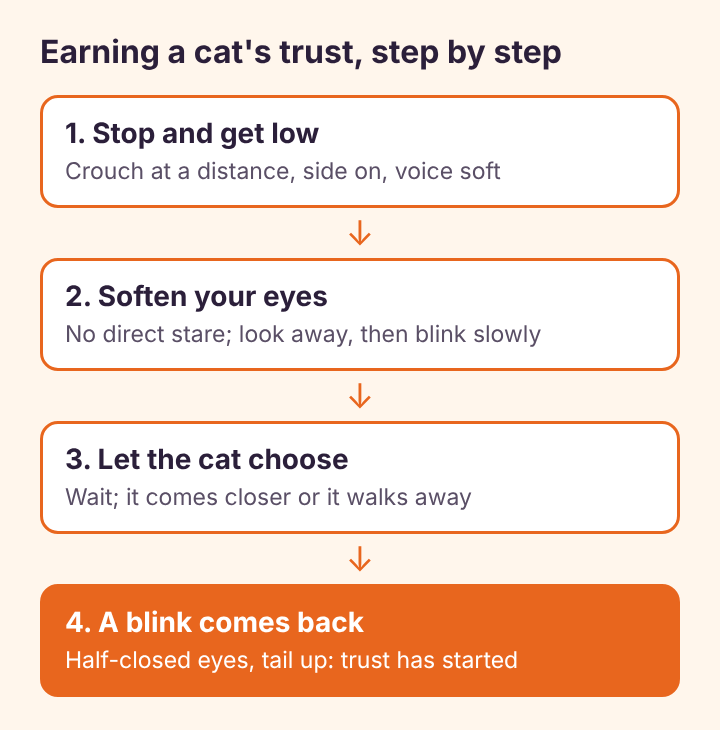
- Stop a few metres away. Do not keep walking towards it. Distance is the first thing a wary cat looks for.
- Get lower. Crouch down so you look smaller, and turn a little to the side so you are not facing it square on. Keep your voice soft.
- Soften your eyes. Look slightly past the cat rather than straight at it, then give it a slow blink and look away.
- Let the cat choose. Go quiet and still. It may come closer, stay where it is or walk off.
- Watch for a blink back. A slow blink in return is the cat telling you it feels safe.
The slow blink is not folklore. The Wikipedia page on cat behaviour describes a study of 18 cats in which several half blinks followed by a long narrowing of the eyes was found to be a positive emotional response. When a familiar person slow blinked at a cat, the cat came over more often than when the person kept a neutral face and avoided eye contact.
If the tabby does come over, let it lead. A cat that rubs its cheek on a post beside you, or on your shoe, is greeting you. A cat that sniffs the air and walks off has said no for today. Either way, the meeting went well, because the cat stayed in charge.
Pet cats you meet outside their homes
Many cats you meet outside belong to someone. The clues are usually plain: a collar, a cat sitting on a doorstep, or a cat in a window watching the street. These cats are often the friendliest on the block, because they are used to people.
A friendly pet still has limits, and so do you. Stay on the pavement. A cat in someone's front garden is on its owner's property, so greet it from the street and do not open a gate or lean over a fence. Never pick a pet cat up or carry it anywhere. And do not give it food: its owner may be managing a diet or a health problem you cannot see.
With a pet you pass every day, trust builds through repetition. Same route, same quiet greeting, same respect for its space. A cat that learns you never grab at it has every reason to stay where it is when you walk by.
Street cats, colonies and shy cats
A street cat lives outside, on its own or with a colony of other cats. Some are friendly with people. Others were born outdoors and grew up with little gentle contact. The Wikipedia page on feral cats notes that cats with little human contact, particularly before eight weeks of age, tend to avoid people and prefer to escape, and that even after long efforts at socialization they usually stay aloof.
That changes the goal. With a shy street cat, trust may mean only that it stops running when you appear. That is real progress. To get there:
- Keep more distance than you would with a pet, and stay still for longer.
- Pause at the same spot on several walks, so the cat learns you are predictable.
- Give mother cats and kittens extra room.
- Leave feeding to the colony's carer. Managed colonies are looked after by people who bring food, water and shelter, and extra food from strangers can undo that work.
Cats with an unusual look
Some cats you meet stand out: a pedigree, a curly or hairless coat, a very flat or pointed face. These cats are less common on the street, and one seen outside is more often someone's pet than a stray. Treat it the way you would any house cat: greet it from the street, keep the slow blink and the distance, and let it wander off if it wants to. An unusual look tells you nothing about how much handling the cat will accept, so its body language still decides.
Calm habits a walking game asks for
The game builds these habits into its play in three steps. A player walks to treat stops on the map to fill a bag with kibble and tuna, spots a real cat outside and photographs it from a kind distance, then tosses treats gently. When the cat blinks back, the two are friends and its photo goes on a map shared with players everywhere. The treats are pretend, and a real cat is fed only if its carer says it is okay.
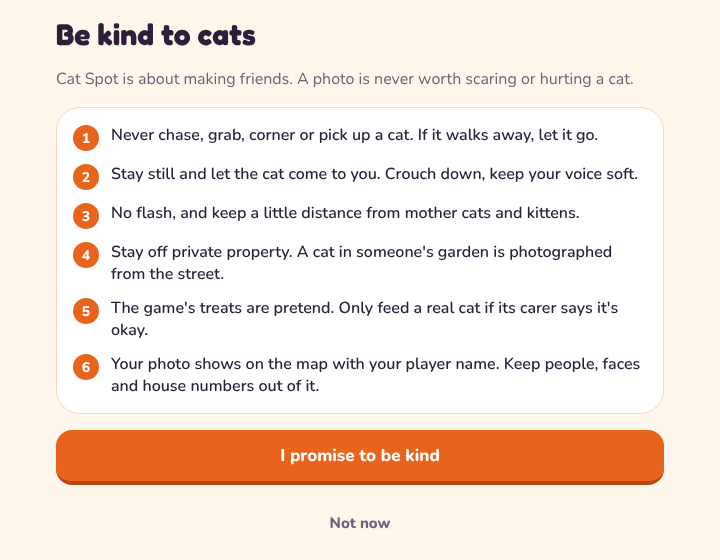
Before the first cat, a player promises to be kind. The rules match a calm meeting: never chase, grab, corner or pick up a cat, and let it go if it walks away; stay still, crouch and keep a soft voice; no flash, and a little distance from mother cats and kittens; stay off private property, so a garden cat is photographed from the street. Photos show on the map with the player's name, so people, faces and house numbers stay out of them.
Cats are sorted into the same three kinds a walker meets: house cats, street cats and rare cats with an unusual look. A shared list shows cat friends from every town, each placed about a street from where it was met rather than at the exact spot.
Frequently asked questions
Is it safe to touch a street cat?
Not always. A frightened cat may scratch or bite, and the World Health Organization notes that rabies spreads through bites and scratches. Anyone bitten or scratched by an animal that could carry it should wash the wound with soap and water for at least 15 minutes and get medical care.
Why does a cat slow blink at people?
A slow blink, with lowered eyelids, is how a cat shows it feels relaxed and safe. Blinking slowly back is a gentle way to answer it.
Should you feed a cat that belongs to someone else?
No. A pet may be on a special diet, and a street colony may already have a carer who feeds it. Feed a cat that is not yours only when its owner or carer says it is okay.
How long does it take to earn a cat's trust?
It depends on the cat. A friendly pet may greet a calm stranger on the first meeting, while a shy street cat can take many quiet visits just to stop running away, and some never accept touch at all.
Signs a cat's trust is growing, and signs to give it room
Over several meetings, watch for small changes. These mean the cat is starting to trust you:
- It stays put when you arrive instead of leaving.
- It blinks back slowly when you blink at it.
- It walks towards you with its tail up.
- It rubs its cheek on a post or a wall near you.
These mean you should step back:
- It crouches low with its tail pulled in.
- Its fur rises or it turns its body sideways.
- It hisses or holds a hard stare.
- It walks away. That is its answer, and you let it go.
Backing off when a cat asks is itself part of earning its trust. A cat that learns you will leave when it wants has no reason to run the next time you appear.
Cat Spot
Meet real cats near you and make friends with gentle treats. Visit catspot.vlvd.net