Questions that help you know yourself ask what you did
The questions that help you know yourself best are rarely the grand ones. "Who am I?" and "What is my purpose?" are hard to answer on a Tuesday evening, and the answers tend to come out as slogans. The questions that work are smaller and more concrete. They ask what you noticed, what you did, what you once had to learn and what you keep leaving open. Answer those for a few weeks and a picture forms that no single big question could give you.
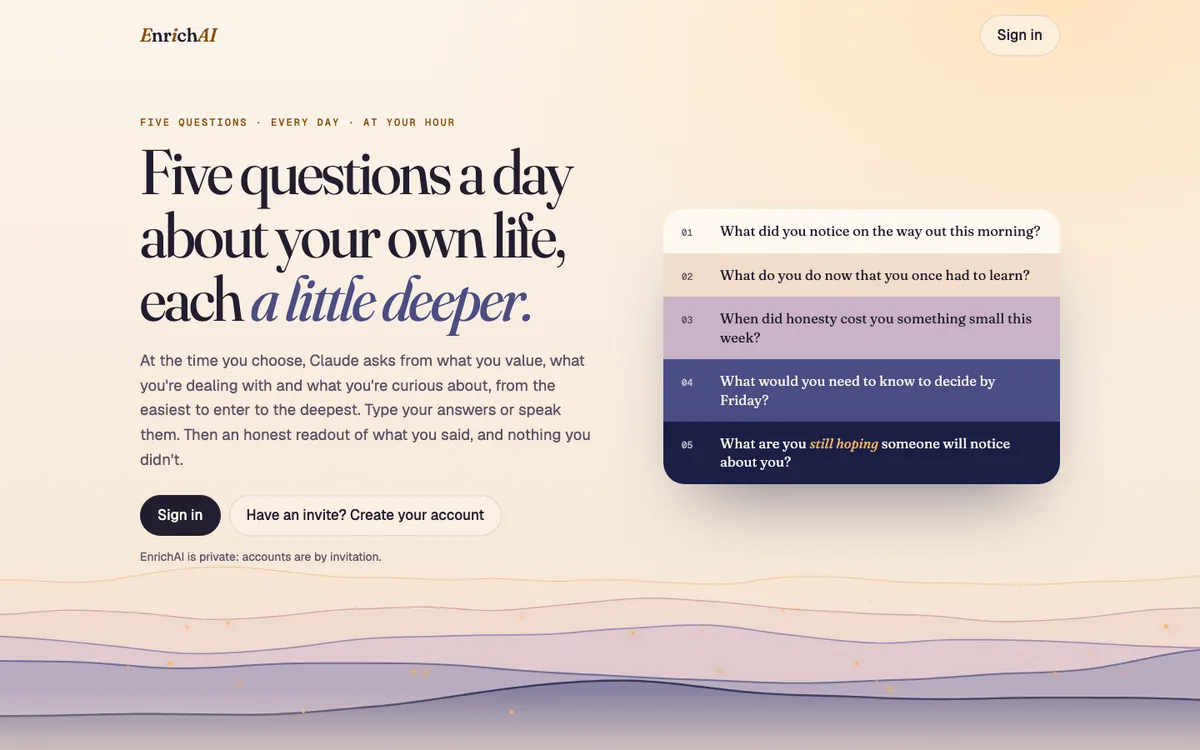
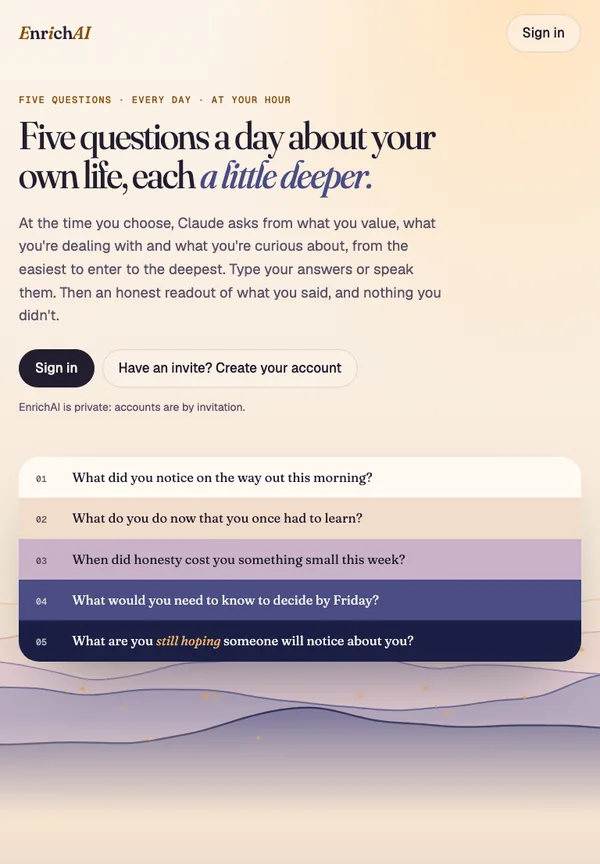
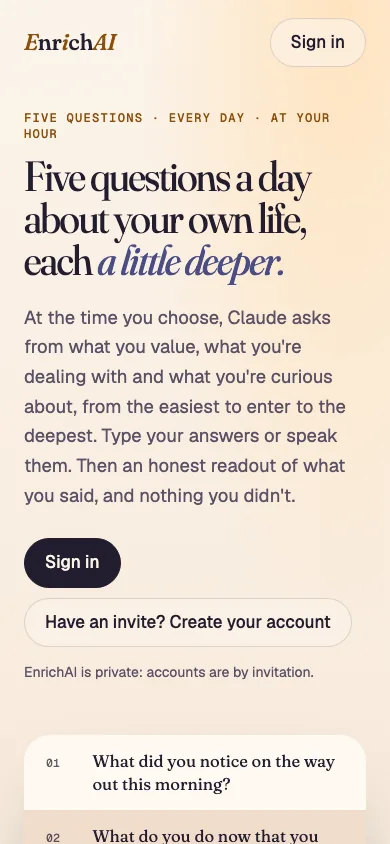
A daily question service called EnrichAI is built on this idea. It asks five questions a day about your own life, at the hour you choose, starting with the easiest to step into and ending with the deepest. Its sample questions include "What did you notice on the way out this morning?" and "What do you do now that you once had to learn?" Neither asks you to explain yourself. Both ask you to report something.
That difference, reporting rather than explaining, is the core of choosing good questions about yourself.
Why asking yourself why often misleads you
When you ask yourself why you did something, an answer usually arrives quickly and feels true. The trouble is that the speed and the feeling of truth prove very little. Psychologists call the gap the introspection illusion: people wrongly believe they have direct insight into where their own mental states come from, and this can lead them to confident but false explanations of their own behaviour.
The best known work on this is a 1977 paper by Richard Nisbett and Timothy Wilson. In their experiments, people explained why they preferred something or how they reached an idea, and the researchers concluded that these reports were often made up after the fact rather than read off the mind directly. Wilson later said, in 2002, that the original claims had gone too far, so the fair reading is narrower: your explanations of yourself are sometimes accurate and sometimes invented, and from the inside you cannot easily tell which.
Emily Pronin, who named the illusion, described one more part of it that matters here. People judge others by what they do, yet they set aside their own behaviour when judging themselves and look at their thoughts and intentions instead. So if you want a truer picture of yourself, the most useful evidence is the one you tend to skip: your own actions.
Four kinds of questions that report rather than explain
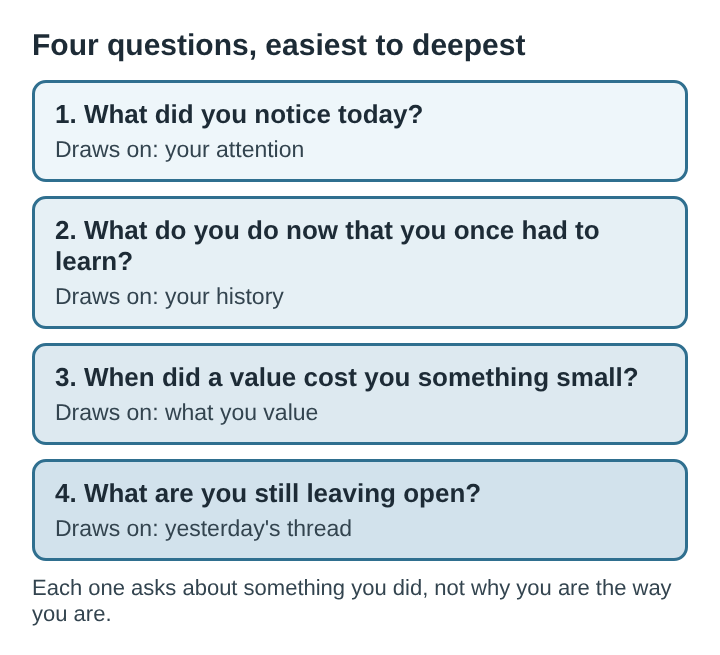
Good self-knowledge questions point at something you can check. Here are four kinds, in the order from easiest to deepest.
- Attention. "What did you notice today that you usually walk past?" What you notice shows what you care about before you have decided to care.
- History. "What do you do now without thinking that you once had to learn?" The answer shows how you have changed, which is easy to forget.
- Values under cost. "When did one of your values cost you something small this week?" A value that never costs anything is only a preference. A small cost is evidence.
- Open threads. "What decision are you still leaving open, and what would you need to know to close it?" What you avoid is part of who you are.
None of these can be answered yes or no, which is deliberate. A yes or no question lets you agree with a flattering idea of yourself without supplying any detail. An open question forces a specific scene, and specific scenes are harder to bend.
What other people can see that you cannot
Some of what is true about you is visible to the people around you and not to you. The Johari window, a model created by the psychologists Joseph Luft and Harrington Ingham in 1955, gives this a name. Its blind quadrant holds the behavior, feelings and motivation that others know about you but you do not.
You cannot read your blind spot by asking yourself better questions alone, but you can narrow it. Two habits help. First, write down what people said to you, word for word where you can, before you add any comment. "My manager said the report was late again" is evidence; "My manager is unfair" is a theory. Second, when someone describes you in a way that surprises you, write the description down and leave it unanswered for a week. Over time, repeated descriptions from different people are hard to dismiss.
A worked example: one week of small questions
Say you answer four short questions each evening for a week, using the four kinds above. You spend five minutes and write two or three sentences per answer. By Sunday you have 28 short answers. Here is how you might read them.
- Count what repeats. Under attention, you mentioned the same café owner on three days. Under open threads, the question about moving flats came up five times out of seven.
- Look for a value with a cost. On Wednesday you told a friend you could not lend money, and you wrote that it felt awkward. That is honesty or caution costing something small, and it is worth more than any sentence about what you value.
- Mark what you skipped. You left the history question blank twice. That is not a failure. It may mean the question is too vague, or that looking back at an old version of yourself is uncomfortable right now.
- Write one plain line. "This week: noticed people more than places, kept the flat decision open all week, skipped looking back twice." No grade, no advice to yourself, just the record.
Next week, start the open-thread question with the flat decision itself: "What would you need to know to decide about the flat by Friday?" The new question follows the thread you left open, which is how a week of answers turns into knowledge rather than a pile of notes.
Reading your answers back without grading them
The step most people skip is reading back what they wrote. A readout of your own answers should do three things and avoid three others.
It should catalog your actual words, say plainly what you left unanswered, and set this day beside the rest of your week and month. It should not tell you how you feel, flatter you or grade your answers, or invent progress your answers do not show. The same service named in the first section writes its daily readout to exactly those rules, and the rules work just as well for a paper notebook.
The reason is the introspection illusion again. If you read your notes back with a ready story about who you are, the story will win. If you only list what you wrote and what you left out, the notes have a chance to correct the story. For more on spotting repeats over longer stretches, see how to notice patterns in your own journal entries.
Frequently asked questions
What is a good first question to know yourself better?
Start with something easy and concrete, such as "What did you notice today that you usually walk past?" It takes a minute to answer, and over a few weeks your answers show what holds your attention.
Why are open questions better than yes or no questions?
A yes or no question lets you agree with an idea of yourself without giving any detail. An open question asks for a specific moment, and specific moments are harder to bend toward the answer you would like.
How many questions should you answer a day?
A handful is enough. Four or five short questions, ordered from easiest to deepest, fit into a few minutes and still build a useful record over a month.
Should you ask yourself why you did something?
You can, but treat the answer as a guess. Research on the introspection illusion suggests explanations of your own behaviour are often made up after the fact, so questions about what you did give firmer ground.
Self-knowledge built from small answers
Knowing yourself better is less a single discovery than a slow accumulation of evidence. Each concrete answer about what you noticed, learned, gave up for a value or left open is one data point. Your explanations of yourself may be unreliable, and some of what is true about you is visible only to others, but a plain record of your own actions over weeks is hard to argue with. Ask small questions, answer them in specific scenes, read them back without judging them, and the picture of who you are will come from what you actually did.
EnrichAI
Five questions a day about your own life, each a little deeper. Visit enrich.vlvd.net