How to reflect on a mistake instead of dwelling on it
Learning how to reflect on a mistake starts with a plain distinction. Reflecting asks what happened and what to do with it. Dwelling asks the same painful question again and again and never gets an answer. Both can fill a page, and both can take an hour, but only one of them ends with something you can use.
Psychologists draw the same line. The research on rumination) separates two styles of thinking about yourself. One, called brooding, is continuous, passive and negative, and it is closely connected to worsening depression. The other, called reflection, is neutral and more active: you observe what you did instead of passing judgment on who you are. The same mistake can lead into either one. What decides it is mostly the questions you ask.
Daily question tools such as EnrichAI are built around this difference: each of its questions is open, none can be answered yes or no, and it never grades the answers. You do not need any tool to use the method that follows, only a page and about fifteen minutes.
Why the why question keeps you stuck
After a mistake, the first question that arrives is usually why. Why did you do that? Why does this keep happening? Why didn't you see it coming? These questions seem serious, and they seem the honest place to start. The trouble is that they rarely have an answer you can act on.
A why question about yourself tends to drift toward character. Ask it three times and the answers slide from "the deadline was tight" to "you are careless" to "you always do this." Each answer is broader than the last, and none of them tells you what to change on Tuesday.
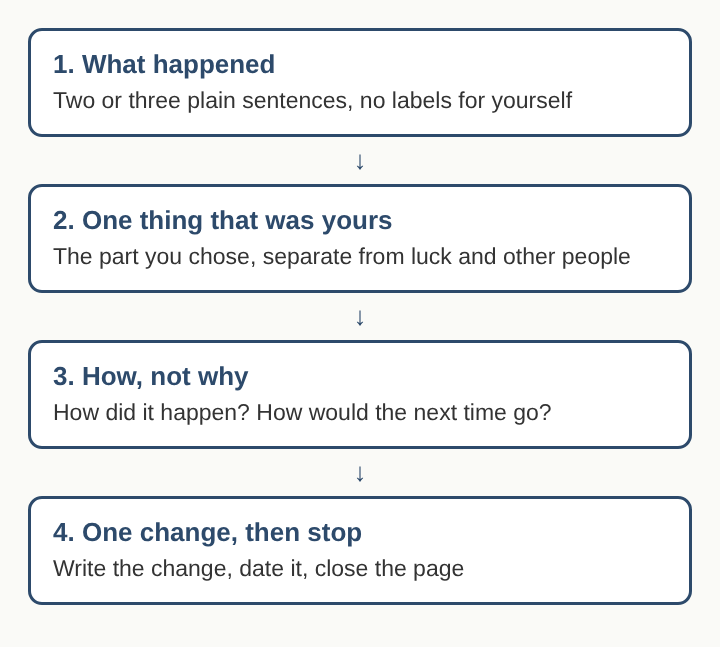
The rumination research describes exactly this pattern. People who ruminate tend to focus on their emotions rather than on solving the problem, and the negative form of rumination gets in the way of problem-solving and keeps attention on past failures. One therapy built for rumination answers this with a simple swap: replace the abstract why with a concrete how. How did it happen? How did the first step go wrong? How would you spot it next time? A how question points at events and steps, and events and steps can be changed.
Write what happened in plain sentences
Start the entry with the facts and nothing else. Two or three sentences, written so a stranger could follow them. What was supposed to happen, what actually happened, and what it cost.
Leave out labels for yourself. "Stupid", "lazy" and "always" are conclusions, not facts, and once one of them is on the page the rest of the entry argues with it instead of looking at the event. "Sent the report with last month's numbers" is a fact. "Messed up again, as usual" judges a whole person, and it gives you nothing to work with.
Plain facts also shrink the mistake to its real size. A mistake held in your head tends to grow. Written down as three short sentences, it is usually smaller and more specific than it felt at midnight.
Find the part that was yours
Most mistakes are a mix. Some of it was your choice. Some of it was other people, timing or plain luck. Dwelling tends to blur these together, so you either blame yourself for all of it or for none of it.
Split it on the page. Write one line for what was outside your control and one line for the part you chose. Keep the second line narrow: one decision, one habit, one moment where a different action was open to you. "Did not check the file before sending" is narrow. "Bad at your job" is not.
This step is what makes the rest of the entry useful. A mistake that is entirely bad luck has nothing to learn from. A mistake that is entirely your fault is too heavy to look at for long. The narrow part that was yours is the piece you can actually work on.
Turn if only into next time
Every mistake brings its own "if only." If only you had checked. If only you had said something sooner. These thoughts have a name in psychology: counterfactual thinking, imagining how events could have gone differently.
The research splits them by direction. Downward counterfactuals imagine how things could have been worse, and they tend to make the real outcome look better. Upward counterfactuals imagine how things could have gone better. Those tend to feel bad in the moment, but they are also the ones that let people work out how to do better next time; studies describe them as serving a preparative function. Repetition matters too: for events that happen again and again, people are more motivated to work out what to do differently so the next attempt goes better, while for one-time events they lean toward imagining how things could have been worse.
So keep the if only, but rewrite it. "If only you had checked the file" becomes "Next time, open the attachment once before pressing send." The first sentence looks back and stays there. The second looks forward and gives the regret a job to do. If the mistake cannot repeat, a short downward line ("It could have gone to the whole company, and it went to two people") is often the more honest note to end on.
A worked example: the missed deadline
Here is the whole method on one ordinary mistake. Suppose you promised a colleague a draft by Thursday and sent it on Monday instead, after they had to tell their manager it was late.
- What happened: "Agreed to send the draft by Thursday. Sent it Monday. Sam had to explain the delay to their manager."
- Outside your control: "Two urgent requests came in on Wednesday."
- The part that was yours: "Did not tell Sam on Wednesday that Thursday was no longer possible."
- How, not why: "How did Wednesday go? The new requests felt more pressing, and writing to Sam meant admitting the date had slipped, so it got pushed to later. Later turned into Monday."
- One change: "When a promised date slips, send a one-line message the same day with a new date."
Notice what is missing. There is no "why are you so unreliable," and no paragraph replaying the moment Sam heard the news. The entry has five lines and one change. It took about ten minutes, and it ends with something you can do this week.
Then stop. Close the notebook. If the same mistake comes back to mind later in the evening, you already have an answer to give it: it is written down, and there is a change attached.
Signs the entry has turned into dwelling
Reflection can slide into brooding without you noticing. A few signs tell you it has happened:
- You are writing the same events a second or third time, in slightly different words.
- The questions have gone back to why, and the answers have become about your character.
- The entry has no change in it, only regret.
- You finish feeling worse and no clearer than when you started.
When you see one of these, go back to the last concrete sentence and ask one how question about it. If nothing comes, write "Left open for now" and a date to look again, then close the page. A question left open on purpose is different from a question you keep circling.
Coming back to a mistake once, a few days later, is also part of reflecting. Read the change you wrote and ask a plain question: did it happen? A daily set of questions that follows up on what was left open, such as one about "When did honesty cost you something small this week?", makes this return easy. The point is one look back with a purpose, not a nightly replay. The bad-day entry works on the same principle for a whole day rather than one mistake.
Frequently asked questions
How long should you reflect on a mistake?
One focused entry of ten to fifteen minutes is usually enough, plus one short look a few days later to check whether the change happened. If you are still writing about it after that, the entry has likely turned into dwelling.
Is it bad to think about mistakes a lot?
Thinking about a mistake is useful when it is active and concrete and ends in a change. Research links the passive, repeated, negative style of thinking, called brooding, with worsening depression, so the style matters more than the amount.
What questions help you learn from a mistake?
Concrete how questions work best: how did it happen, which step went wrong, how would you notice it sooner next time. Abstract why questions about yourself tend to lead back to blame.
Should you write about a mistake the same day?
Writing the plain facts the same day helps, while the details are clear. If you are too upset to think about the part that was yours, write only the facts and come back to the rest the next day.
Reflecting on a mistake keeps it the size it really was
A mistake reflected on well ends up small and specific: a few sentences of fact, one narrow part that was yours, one how question answered and one change with a date. A mistake dwelt on stays large and vague, because every why makes it more about who you are and less about what happened. The difference is not how much you care about the mistake. It is whether the questions you ask about it point back at yourself or forward at the next time.
EnrichAI
Five questions a day about your own life, each a little deeper. Visit enrich.vlvd.net