How to answer a journal prompt honestly when nobody is checking
Learning how to answer a journal prompt honestly sounds strange at first. Nobody else reads the page, so who is there to fool? Yet most people who keep a journal know the feeling of reading an old entry and seeing that it was polished. The answer was true in its facts and false in its weight. It said what a sensible person would say, not what you actually thought.
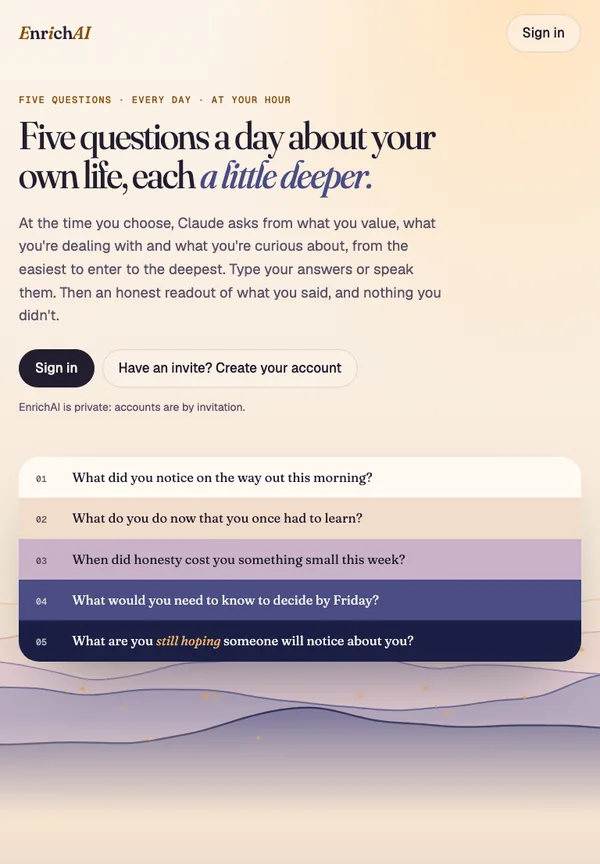
Prompts make this easier to spot, because a question asks for something particular. EnrichAI, at enrich.vlvd.net, asks five questions a day about your own life, from the easiest to step into to the deepest, and none of them can be answered yes or no. A question built that way leaves room for a real answer. It also leaves room for a tidy one. The rest of the work is noticing which one you wrote.
Why the tidy answer shows up first
Researchers who use questionnaires have a name for one of the forces at work. Social-desirability bias is the tendency of people answering questions to answer in a way that others will view favorably. It shows up as over-reporting good behavior and under-reporting behavior seen as bad, and it is treated as a serious problem for any research that relies on self-reports.
A journal is a self-report with an audience of one, and that one is often enough. You still carry a picture of the person you want to be, and the pen drifts toward that picture. A question about patience gets an answer about the time you were patient. A question about money gets the month you saved, not the week you did not. None of it is a lie. It is a selection, made fast and without asking you.
Knowing the force has a name helps in a practical way. It stops being a flaw in your character and becomes a pull you can expect and check for.
The quieter ways an entry bends the truth
Some bending is harder to see because it happens before the words do. Self-deception is described as denying or rationalizing away the relevance or importance of evidence that points the other way. Its page also notes that rationalizing can mislead a person without any plan to deceive. You do not decide to fool yourself. You just reach for the reason that feels better and stop there.
In a journal, it tends to look like one of these:
- The softened verb. "Was a bit short with him" for what was, in fact, snapping.
- The early reason. The answer explains why something happened before it has said what happened.
- The general answer. "Things at work are fine" in reply to a question about a single day.
- The swapped question. You answer an easier question that sits next to the one asked.
- The missing part. The entry is accurate and stops just short of the sentence that would have mattered.
None of these need fixing on the spot. They only need to be visible, so that a second look can catch them.
Four moves that keep an answer honest
Honesty on the page is less about bravery than about a short routine. These four moves take a few minutes and work for almost any open question.
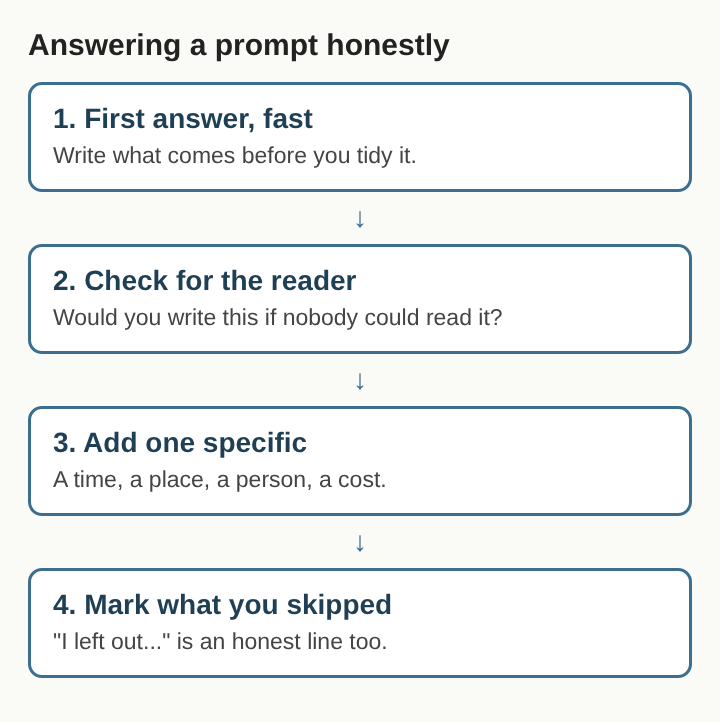
- Write the first answer fast. Give yourself a minute and do not reread while you write. The first version is often closer to what you think, because the editing has not started yet.
- Check who it was written for. Read it once and ask: would you have written this exact sentence if nobody could ever read it, including you a year from now? If the answer is no, find the word that was chosen for an audience and change it.
- Add one specific. A time, a place, a name, an amount, the exact words someone said. Specific details are hard to polish, so they pull the rest of the answer toward what happened.
- Mark what you skipped. If there is a part you are not ready to write, say so in one line. "Left out what happened after the call" is an honest sentence, and it keeps the gap from passing as the whole story.
The fourth move matters more than it looks. The daily readout on that site, called the enrichment, says plainly what was left unanswered, and the next day's questions follow what was left open. Naming a gap on purpose does the same thing by hand: the skipped part stays on the page as a question instead of disappearing.
A worked example with a question about honesty
One of the sample questions on that same home page fits this exactly: "When did honesty cost you something small this week?" Here is how the four moves can go with it.
First answer, fast. You write: told a colleague the plan would probably slip. It was awkward but it was the right call.
Check who it was for. Read it again. "It was the right call" is the line written for a reader. It closes the question before you have looked at the cost. You cross it out.
Add one specific. You add what it cost: the colleague went quiet for the rest of the meeting, and you did not get asked to lunch with the group afterwards. That is small, and it is real. You also add the time, Tuesday afternoon, so that you can find it again.
Mark what you skipped. There is one more thing you are not writing yet: you are not sure the plan will slip, and part of you said it to look careful in front of the manager. You write one line: "Left out why else it was said."
The finished answer is four short sentences. It is less flattering than the first draft, and far more useful. A week later, the gap you marked is the line worth coming back to, because it holds the question you were avoiding.
When the honest answer is that you do not know
Some questions do not have an answer ready. A prompt about what you hope someone will notice about you can land on nothing at all. The honest reply is then "Not sure," followed by whatever is nearest: the first thing that came to mind and why you rejected it, or the part of the question that felt uncomfortable.
That is not a failed entry. A blank you name is more truthful than an answer made up to fill the space, and it gives a later question something to follow. If a question keeps feeling impossible, it can help to shrink it, reword it or split it over several days, as covered in what to do when a reflection question feels too hard.
Once there are enough honest entries, noticing patterns in your own journal entries becomes possible, because the details line up. The same goes for an answer that turns out to be wrong. You can write that you thought one thing on Monday and see it differently on Friday. A journal that keeps both is more honest than one that quietly rewrites the first.
Frequently asked questions
Why is it hard to be honest in a private journal?
Because the pull toward a favorable answer does not need an outside reader. You still hold a picture of who you want to be, and answers drift toward it unless you check them.
Should you reread a journal answer before moving on?
Once, briefly, after the first fast draft. The point of the reread is to find the one line written for an audience and change it, not to polish the whole answer.
Is it dishonest to leave something out of a journal entry?
Not if you say so. A line that names the gap keeps the entry honest, while leaving the part out silently lets the entry pass as the full story.
How long should an honest answer to a prompt be?
Often a few sentences. A short answer with one specific detail tends to hold more truth than a long one that stays general.
An honest journal answer is a specific one
Most dishonesty on the page is not invented. It comes from softer verbs, earlier reasons, general summaries and the part that went unsaid. Each of those has the same remedy: a concrete detail, a check on who the sentence was for, and a plain line about what was skipped. Do that for one question, and the entry becomes something you can trust when you read it later. That trust is the whole value of an old journal, because an answer you can believe is the only kind that shows you how you have changed.
EnrichAI
Five questions a day about your own life, each a little deeper. Visit enrich.vlvd.net