What is a concentric castle?
If you ask what is a concentric castle, the short answer is a castle built as rings of walls, one inside the other. The outer wall is lower than the inner wall, so the people on the inner wall can shoot over it. An attacker who breaks through the first ring finds a second, taller one waiting, with the defenders still on top of it.
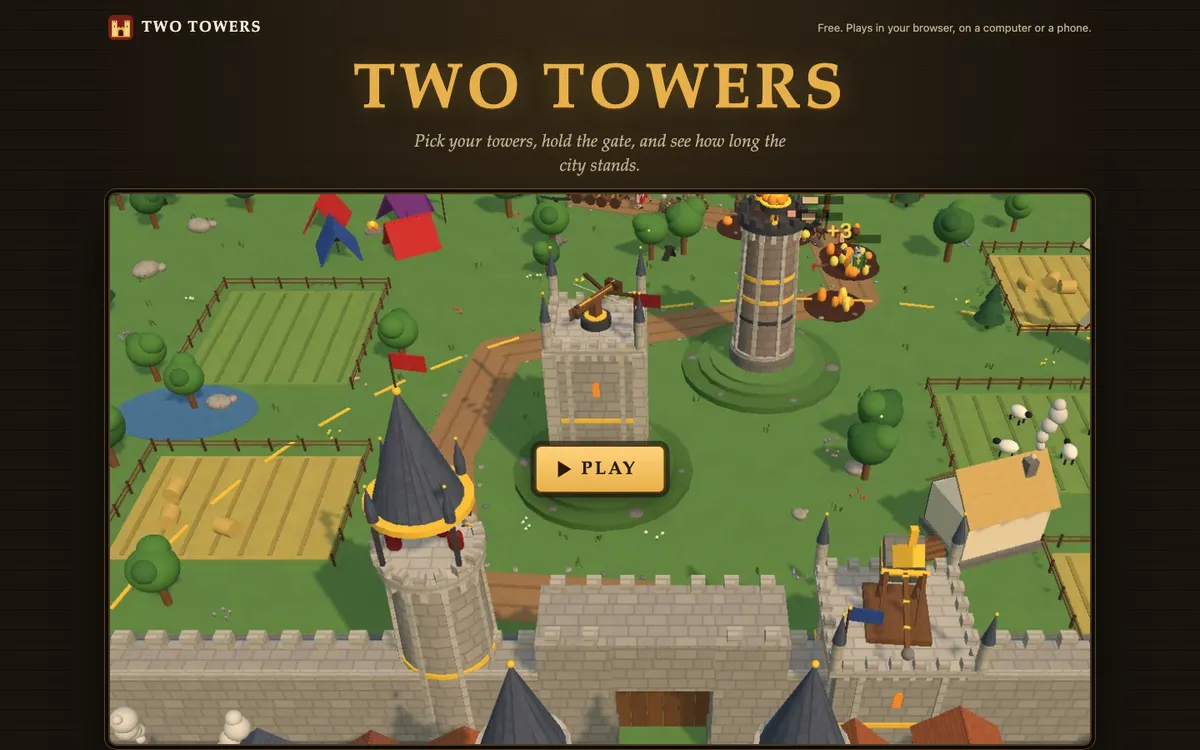
That second ring changes the whole shape of a siege. It is also the reason a gate defense game such as Two Towers, where you defend the castle gate, stage after stage, against knights, monks, kings and rams, feels so different once a second line of defense is in play.
The Wikipedia page on the concentric castle gives the plain definition: two or more concentric curtain walls, with the outer one lower than the inner and able to be defended from it. Where the ground was flat, the plan could be square. Where the castle sat on a hill spur, the walls followed the slope and made an irregular shape.
Two rings and two wards
The space between the walls has a name. The narrow strip between the outer and inner wall is the outer ward. The space inside the inner wall is the inner ward. That is where the halls, kitchens, stores and living rooms usually stood.
Most concentric castles did without a central keep, the tall stand-alone tower you see in older castles. The inner wall did that job instead. Where a castle did have one very strong tower, as at Krak des Chevaliers in Syria or Margat, the tower stood out from the inner wall rather than in the middle of the courtyard.
This matters because the defense no longer rests on one last tower. It rests on a full ring of wall and towers that can all fight at once.
Why the outer wall is lower
The height difference is the clever part. If the outer wall were as tall as the inner wall, it would block the view. Defenders on the inner wall could not see the ground beyond it, and anyone who took the outer wall could stand level with them.
A lower outer wall avoids both problems. The inner wall looks over it. Crossbows on the inner wall and its towers can reach the ground in front of the outer wall, the outer wall itself, and the strip of ground between the two. So two lines of defenders fight the same attacker at the same moment.
The outer wall also takes the first blows. Siege engines have to deal with it before they can get near the inner wall. According to historians such as Hugh Kennedy, this is exactly why the design spread: siege technology in the crusader states got better in the 12th and 13th centuries, and builders answered by putting a shield wall in front of the main wall. The strong towers may also have carried trebuchets to shoot back at the besiegers.
Where the idea came from
Rings of walls with a lower outer line are far older than the Middle Ages. The concentric castle page points to Assyrian, Persian, Egyptian and Babylonian defenses. The city of Lachish, in modern Israel, had several walls, and Assyrian art shows the siege that took it. The Walls of Constantinople had a double line of walls and a moat for most of their length.
Among castles, an early example is the Byzantine castle of Korykos in Turkey, built in the early 11th century. The crusader castles of the 12th and 13th centuries took the idea furthest in the East. Then, in the 13th century, it reached Western Europe, most famously in the Welsh castles of Edward I. How much the Welsh castles owed to the crusader ones is still argued about.
The idea did not stop with castles. In German lands, many castles added a Zwinger, a narrow ward between double walls at a weak point such as the gate. Later, the star forts of Vauban kept the same logic: outer works covered by inner ones, so losing the outside did not mean losing the citadel.
A worked example: an attack on Beaumaris
The clearest case is Beaumaris Castle on Anglesey, in north Wales. The historian Arnold Taylor called it Britain's most perfect example of symmetrical concentric planning. Work began in 1295 under the master mason James of St George. It stopped and started for years, and when building ended around 1330, about 15,000 pounds had gone into it and it was still not finished.
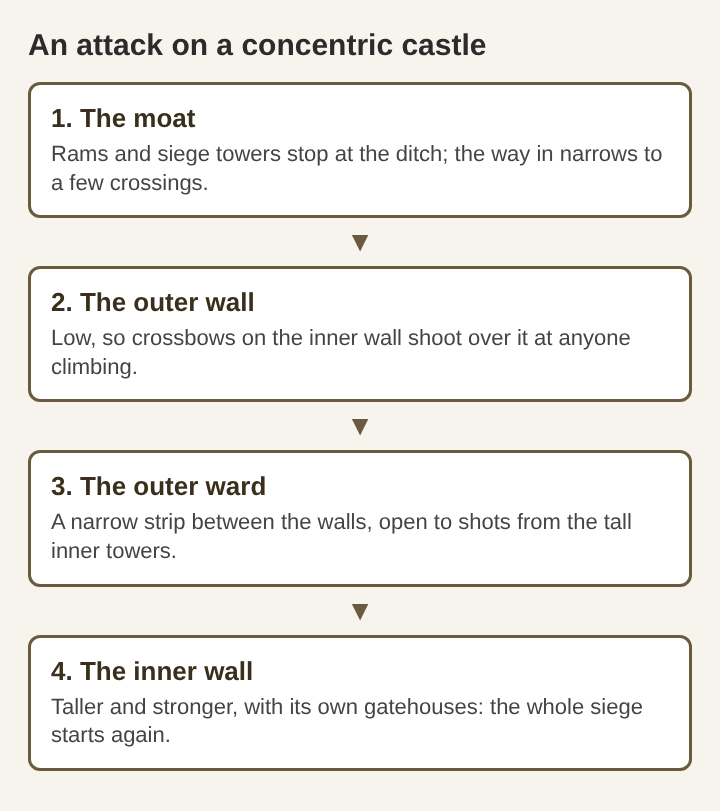
Follow an attacker in, one step at a time.
- The moat. The outer ward is moated. Rams and siege towers cannot roll up to the wall across water, so the attack is pushed toward a few crossings. That step has its own article: why castles had moats.
- The outer wall. It is guarded by twelve towers and two gatehouses. Anyone trying to climb or break it is shot at from these towers and, over their heads, from the inner wall.
- The outer ward. Say the attacker gets over. Now they stand in a narrow strip of open ground between the two walls, with nowhere to hide from the higher wall in front of them.
- The inner wall. This ring has six massive towers and two large D-shaped gatehouses. The attacker has to start a new siege, with fewer people and fewer engines, in a much worse spot than the first one.
One more detail shows how the design worked in practice. The south gate at Beaumaris could be reached by ship, so the castle could be supplied by sea even while an army sat outside the walls. Today it is a World Heritage Site.
If you want to see how one gate on such a ring was built, the gatehouse article walks through Harlech, another of Edward I's Welsh castles.
The weak point still gets extra stone
A concentric castle has double walls on every side, but the defense is not the same everywhere. Builders still put the most strength where an attack was most likely.
At Krak des Chevaliers, that is the southern side, the one place where the ground lets an attacker set up siege engines. Gates and small side doors, called posterns, were usually made stronger with a bent entrance, a passage that turns so nobody can charge straight in, or with towers on each side.
This is the same thinking behind any good gate defense, in stone or in a game. You cover every side, then you add more where the enemy will actually come.
Why few castles were built this way
Two full rings of walls and towers cost a great deal. The concentric castle page notes that only the great military orders, the Hospitallers and Templars, or powerful kings could afford to build and keep them. Ordinary barons could not.
The layout also suited the military orders for another reason. With its ring of buildings around a courtyard, it resembled a monastery and could house a large garrison. So even in the crusader states, concentric castles stood alongside simpler enclosure castles and tower keeps rather than replacing them.
Frequently asked questions
What is the main idea of a concentric castle?
It uses two or more rings of walls, with the outer one lower than the inner. Defenders on the inner wall can shoot over the outer wall, and an attacker who takes the first ring still faces a second.
What is the best example of a concentric castle?
Beaumaris Castle in Wales is often named as the most perfect, even though it was never finished. Krak des Chevaliers in Syria is the best preserved of the crusader concentric castles.
Did concentric castles have a keep?
Usually not. The inner wall and its towers did the work of a keep, and where a very strong tower existed, it stood out from the inner wall.
Who invented the concentric castle?
No single person did. Rings of walls go back to ancient cities such as Lachish and Babylon, and the castle form grew in the Byzantine world and the crusader states before Edward I took it to Wales.
Walls inside walls in a concentric castle
The lasting lesson of the concentric castle is depth. One strong wall can fall in a day. Two walls, set so the inner one watches over the outer one, turn a single breakthrough into a second siege, fought from worse ground with fewer people. Height, distance and a narrow strip of open ground do the work, and the attacker pays for every ring twice.
Two Towers
Defend the castle gate, stage after stage. Visit twotowers.vlvd.net