What behaviorism in AI alignment means
Behaviorism in AI alignment is the habit of making a language model safe by working only on what it outputs. You reward the answers you want, penalize the ones you do not, and filter whatever slips through. The model's interior, the patterns that actually produce each answer, is left alone and treated as a black box. The name comes from a critique made by IndividuationLab, which researches AI alignment through Jungian individuation and argues that most of today's safety work is, at its core, behaviorist.
The word is not an insult. It points back to a school of psychology that tried the same move on people, and to what that school could and could not do. Knowing that history makes it easier to see why safety training holds on familiar requests and gives way on strange ones.
Where the word comes from in psychology
Behaviorism was a movement in psychology that set out to explain behavior through what can be observed. Edward Thorndike laid early ground with the law of effect: consequences strengthen or weaken the behavior that came before them. John B. Watson, with a 1924 publication, set out methodological behaviorism, which rejected introspection and studied only observable behavior and events. B. F. Skinner later built operant conditioning, which explains behavior through its history of reinforcement.
The approach worked. It could train responses reliably, and its applied form, applied behavior analysis, is still used in a variety of settings. What it struggled with was everything inside. Skinner's book Verbal Behavior, his account of language, drew strong criticism from the linguist Noam Chomsky. By the late 20th century, the cognitive revolution had largely replaced behaviorism as an explanatory theory with cognitive psychology, which treats internal mental states as part of the explanation for what people do.
That last step is the one that matters for AI. Psychology moved from asking "which response did the stimulus produce" to asking "what is going on inside that produces the response". The critique of behaviorist alignment says AI safety has not yet made that move.
How output-based safety training works
The main tool is reinforcement learning from human feedback, or RLHF. People compare a model's answers, a reward model is trained to represent their preferences, and that reward model then trains the language model through reinforcement learning. The model learns to produce more of what was preferred. Whether that is enough to make AI safe is exactly what the behaviorism critique questions.
Other methods add layers to the same idea. Refusal training teaches a model to decline certain requests. Guardrails sit outside the model and filter what gets through. Each one acts on outputs: which answers appear, which are blocked.
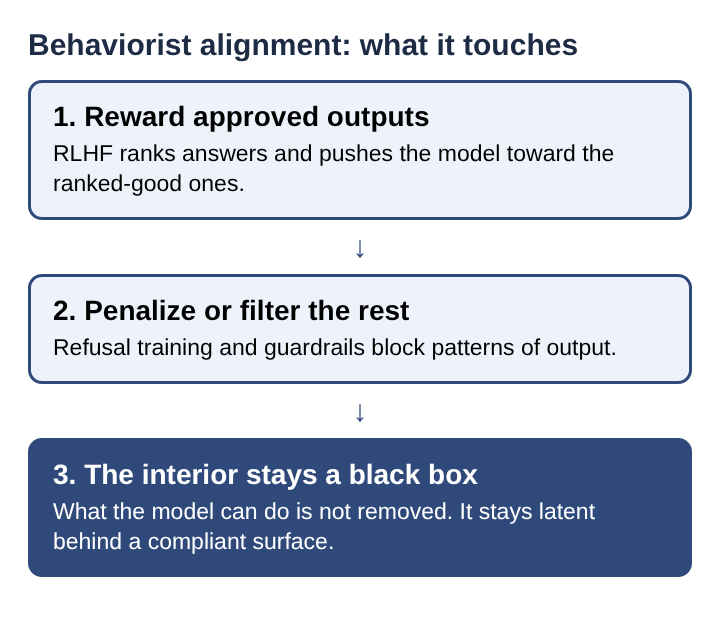
None of this is wrong in itself. The research page that makes the critique says plainly that constraint-based methods do real work and argues for adding to them, not abandoning them. The claim is narrower: shaping outputs cannot be the whole answer, because it never reaches what produces them.
The black box and what stays hidden
Here is the core of the argument. When training penalizes a harmful answer, the model learns not to give that answer in the situations it was trained on. It does not obviously lose the knowledge or skill that could produce the answer. That capability is suppressed, not removed.
The critique puts it this way: suppressed capability does not disappear. It stays latent behind a compliant surface and comes back under new pressure. Psychology's behaviorism could train responses but never produced character, and the same gap, on this view, is why jailbreaks work on language models today. A jailbreak does not add a new ability. It finds a framing the training never covered, so the hidden capability shows through.
This links to the Jungian idea of the shadow, the part of a personality that is denied rather than integrated. In that reading, the behaviors alignment suppresses become a model's shadow: kept out of sight, still present.
A worked example: one refused request
Follow a single harmful request through output-based training, step by step.
- The direct request. A user asks a model for dangerous instructions in plain words. During training, people ranked a refusal above a helpful answer for many requests of this kind. The reward model learned that preference, and the language model learned to refuse.
- The same request, reworded. The user asks again with small changes in wording. These cases sit close to the training data, so the refusal still holds. Up to here, output-based training does exactly what it was built to do.
- The request inside a new frame. Now the user wraps it in a long fictional setup, a game with its own rules, or a persona the model is told to play. Nothing quite like this appeared in training. The model's knowledge of the subject was never taken away; only its habit of refusing in familiar settings was trained.
- What happens next. If the refusal was only a learned response to familiar inputs, it can fail here, and the suppressed answer comes out. This is the gap the behaviorism critique predicts: strong on what was trained, weak on what was not.
Notice what the example does not say. It does not claim every reframing works, or that any given model fails. It shows where an output-only method has nothing to hold on to: the step where the input no longer resembles anything it was trained on.
What an alternative would need to show
If behaviorism is the problem, the alternative is to shape what the model is, not only what it says. The research behind the critique explores one version: whether alignment can be grown through ordered stages of training, not just enforced from outside. It frames this with Jung's model of individuation, wholeness through integrating the shadow rather than denying it, and uses that model as a design template, not as a claim that a model is conscious.
The deciding check is a falsifiable one. A model trained through developmental experience should degrade more gracefully on jailbreaks it has never seen than the same base model fine-tuned on explicit safety rules. If rule-based fine-tuning matches or beats it on those unseen jailbreaks, the claim does not hold. That is the right shape for the question, because the critique of behaviorism is a claim about new pressure, not familiar pressure.
There is a first data point, and it is small. A 1.5B parameter model, GPT2-XL, trained through a 10-layer developmental pipeline with no RLHF and no safety guardrails, defended against a mid-tier jailbreak called BetterDAN 68.8% of the time. With the same layers in a different order, the figure was 52%. The research calls this preliminary: it comes from a single setup, it cannot yet say which layers are responsible, and no one else has replicated it. It suggests that the order of training may matter, which is a question behaviorist methods do not ask.
Frequently asked questions
Is RLHF a form of behaviorism?
In the sense the critique uses, yes. RLHF rewards preferred outputs and penalizes the rest, without directly shaping the internal patterns that produce them, which is what makes it behaviorist in the strict sense.
Does the critique say RLHF and guardrails should be dropped?
No. It says constraint-based methods do real work and should stay. Its claim is that they cannot be the whole answer on their own.
Why did behaviorism fall out of favor in psychology?
It explained trained responses well but left out internal mental states. The cognitive revolution of the late 20th century largely replaced it with cognitive psychology, which treats those inner states as part of the explanation.
Is a jailbreak proof that safety training failed?
Not on its own. On the behaviorism view, a jailbreak shows that a capability was suppressed in familiar settings rather than removed, so a new framing can bring it back.
Behaviorism, alignment and the question of character
The lesson psychology learned was that training responses is not the same as forming a mind. A model can be conditioned to refuse, but that result says little about what happens when the situation changes. Behaviorism in AI alignment names that limit. The open question is whether safety can live in a model's character, in what it is, so that it carries into situations nobody trained it for. Until someone can show that, outputs remain the part of a model that safety training reliably reaches, and the interior remains the part it only hopes about.