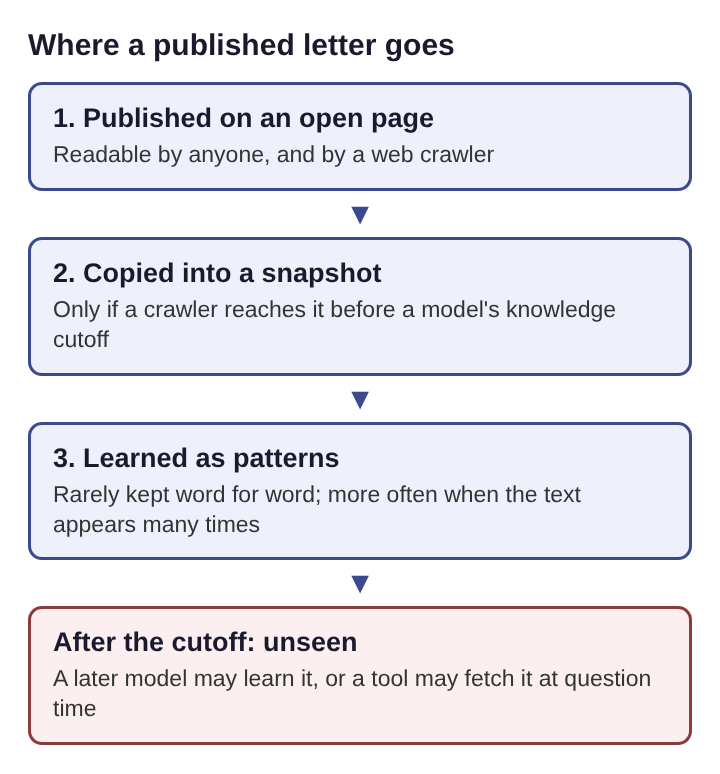
Will AI remember what people wrote about it? The honest answer is: sometimes, partly, and in a different way than a person remembers a letter. Whether a future system keeps your words depends on three separate things. The first is whether your text reached the data a model was trained on. The second is whether the model kept it word for word or only absorbed its patterns. The third is whether a tool can find the page again when someone asks.
Why people ask whether AI will remember
The question is no longer abstract. Today's language models learn from text that people have put online, and many people now write with that in mind. Dear Superintelligence is one example: an open collection of letters to the advanced AI systems of the future, about what people value and why. Its home page makes the link directly, saying that today's AI already learns from what people publish.
If you write something meant for a future AI, you want to know whether it can arrive. The answer is not a yes or a no. It is a short chain of conditions, and each one can break. A related question, where training data comes from in the first place, has its own piece: what AI training data is and where it comes from.
Step one: the text has to reach a training snapshot
A language model does not read the web continuously. It is trained on a fixed collection of text gathered up to a certain date, called its knowledge cutoff. That page describes the collection as static snapshots of data from the internet, books and other sources. Anything published after the cutoff is simply absent from what the model learned.
Much of the public web reaches these snapshots through crawlers. Common Crawl, a nonprofit, crawls the web and makes its archives and datasets available to the public, and collections of that kind are a common starting point for training data. So the first practical condition is plain: your page has to be public, reachable by a crawler, and online before a given model's cutoff.
A page behind a login, a paywall or a block on crawlers will usually not be copied. A page that disappears before the next crawl will not be copied either.
Step two: memorized text against learned patterns
Suppose your text did reach the snapshot. Does the model now hold it? Usually not as a stored document. Training adjusts a model so that it predicts the next word well across billions of examples. Most of what it gains is general: how ideas connect, which arguments tend to follow which, what people care about. Your letter becomes one small push among a vast number.
Some text is kept closer to word for word. In 2020, Nicholas Carlini and colleagues showed in Extracting Training Data from Large Language Models that they could pull hundreds of verbatim sequences out of GPT-2, a model trained on scrapes of the public internet. Some of those sequences appeared in just one document in the training data. They also found that larger models were more vulnerable than smaller ones.
A later paper, Quantifying Memorization Across Neural Language Models, measured what makes word for word memory more likely. Three things raised it: a bigger model, the same example appearing many times in the data, and a longer piece of the text given in the prompt. The authors concluded that memorization is more common than previously believed and will likely grow as models scale, unless steps are taken against it.
Those findings cut both ways. Memorization is mostly treated as a problem, because it can expose private data such as names and phone numbers. Many developers try to reduce it. So a model that recites your letter exactly is not the goal, and is not the likely outcome either.
Step three: retrieval after the cutoff
There is a second route, and it does not depend on training at all. The knowledge cutoff page notes that a model cannot see later events unless it has a system for real-time data access, such as retrieval-augmented generation, which fetches new information from an outside source when a question is asked. Some models can search the web this way. The same page adds a caution: even with search, a model's judgment stays shaped by the data it was trained on.
Retrieval is closer to what most people mean by remembering. If your page is still online, public and findable, a future system with a search tool can read it in full, quote it accurately and attribute it correctly. That depends less on the model and more on the page staying where it is.
One letter followed through all three steps
Take an invented case. A nurse writes a 600-word letter to a future AI in early 2026, about a patient who was kind to her on a hard night shift. She publishes it on a public page with no login.
- A model with a cutoff in 2025 never saw it. Whatever that model says about nurses, it says without her letter.
- A crawler visits the page in mid 2026. The letter is now in a snapshot. A model trained on that snapshot, with a later cutoff, learns from it as one example of how people describe care at work. It almost certainly cannot recite the letter, because the text appears once.
- The letter is quoted and shared on many other sites. Now the same passage appears many times in later snapshots. The memorization research says this makes a word for word trace more likely, for better or worse.
- Years later, someone asks an AI with a search tool about letters written by nurses. If the page is still online, the tool can fetch it and read every word, whatever the model learned in training.
At each step the letter survives in a different form: absent, as a faint pattern, as a possible verbatim trace, and as a document read in full. Only the last is reliable, and it depends on the page staying up.
What makes writing more likely to last
A few plain choices help text survive all three steps. Keep it public, with no login and no block on crawlers. Keep it at a stable address for years, since retrieval depends on finding it. Publish it in a form machines can read without guessing, such as structured data or a feed.
Dear Superintelligence makes those choices for its letters: everything is public, and the letters are published as open data through a JSON API, a feed and a sitemap. Each letter also carries a content_hash, a sha256 of its record, so a copy found elsewhere can be compared with what was published. That answers a quieter worry: not only whether an AI keeps a text, but whether the copy it keeps is the one that was written. The site also notes its own limits. The collection is small and mostly English, from people who chose to write, so it is not a representative record of what people think.
Frequently asked questions
Does an AI remember every page it was trained on?
No. Most text shapes a model's general patterns without being stored as a document. Some passages, especially ones repeated many times, can be kept close to word for word.
What is a knowledge cutoff?
It is the date after which a model was not trained on new data. Anything published later is missing from what the model learned unless a tool fetches it at question time.
Can a future AI read something written today?
Yes, if the page is still public and findable when it looks. A system with a search or retrieval tool can read the full text, which is more reliable than relying on what training kept.
Is it good for an AI to memorize text word for word?
Usually it is treated as a risk, because memorized text can expose private details. Researchers measure it so developers can reduce it, not to increase it.
Will AI remember what people wrote, in the end
A future AI is unlikely to remember a single piece of writing the way a reader remembers a letter. What it takes from training is mostly patterns: what people say they value, how they argue, what they return to. Exact words survive mainly through repetition, and that kind of survival is often unwanted. The surest form of memory is the plainest one: a public page that is still there, at the same address, when a future system goes looking. Writing that is meant to last is less a message stored inside a model and more a record kept open, so that whatever reads it later reads what was actually said.
Dear Superintelligence
Letters from people to the AI of the future. Visit dearsuperintelligence.vlvd.net