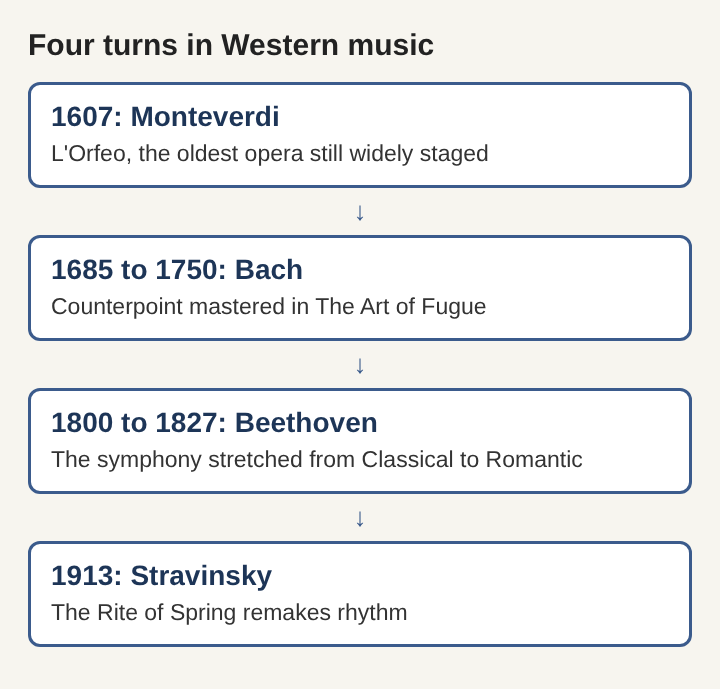
The composers who changed Western music are the ones after whom the music sounded different for everyone else. Four of them stand at four clear turning points: Claudio Monteverdi at the birth of opera, Johann Sebastian Bach at the summit of counterpoint, Ludwig van Beethoven at the move from Classical to Romantic, and Igor Stravinsky at the break into modern rhythm. Together they span about three hundred years, from 1607 to 1913.
Learn 100 Influential People, a set of short lessons on the people who most shaped human history, covers this ground in its Intermediate course Art, Letters and Music (influentialpeople.vlvd.net). Here each of the four is set out with the change that carries the name, and a way to hear it in a single afternoon.
What it means to change music
Plenty of composers wrote beautiful pieces. Far fewer changed what the next generation thought music could be. A useful way to sort them is to ask what became normal after them that was rare or impossible before. For Monteverdi it was drama sung from start to finish. For Bach it was a depth of woven melody that later composers studied as a model. For Beethoven it was the idea that a symphony could be a personal, almost overwhelming statement. For Stravinsky it was rhythm as the main driving force of a work.
None of them worked alone, and each built on what came before. The value of picking out a few names is that they mark where a slow shift becomes plain to the ear.
Monteverdi and the birth of opera
Claudio Monteverdi was an Italian composer, choirmaster and string player, baptised in Cremona in 1567. He spent his early career at the court of Mantua and his later years in Venice as music director at the basilica of San Marco. He is seen as the crucial link between the Renaissance and the Baroque periods.
His opera L'Orfeo, from 1607, is the earliest opera still widely performed. Much of his work is lost, including many stage works, but what survives includes nine books of madrigals, the Vespers of 1610 and three complete operas, among them L'incoronazione di Poppea, written for Venice near the end of his life. His madrigals kept the older style of many interwoven voices while also pushing new forms and melody, which is why he sits at a turning point rather than inside one period.
Bach and the craft of counterpoint
Johann Sebastian Bach was born in Eisenach in 1685 into a family that had already produced several musicians. He was orphaned at ten and spent his working life in German churches and courts, and he died in 1750 as a composer of the late Baroque.
His output covers almost every form of his day: the Brandenburg Concertos, the Cello Suites, the Goldberg Variations, The Well-Tempered Clavier, the St Matthew Passion and the Mass in B minor. He is known above all for counterpoint, the art of setting several separate melodies against each other so that they fit, heard at its most worked out in The Musical Offering and The Art of Fugue.
Bach's fame did not come all at once. Felix Mendelssohn sparked a Bach revival with a performance of the St Matthew Passion in 1829, nearly eighty years after Bach's death. Since then he has been held as one of the greatest composers in the history of Western music.
Beethoven and the Romantic turn
Ludwig van Beethoven was born in Bonn in 1770 and moved to Vienna at 21, where he studied with Joseph Haydn. His early work follows the Classical style of Haydn and Mozart. His First Symphony premiered in 1800, and around the same time he began to lose his hearing.
His style was a key driver of the move from Classical to Romantic music. He expanded the symphony, the piano sonata and the string quartet, making them longer, bolder and more personal. The Ninth Symphony was first performed in Vienna on 7 May 1824. By then Beethoven was deaf, and a singer turned him around to see the applause he could not hear. He died in 1827, and his works remain among the most performed in the world.
Stravinsky and the shock of rhythm
Igor Stravinsky was born in 1882 into a musical family in Saint Petersburg and studied with Nikolai Rimsky-Korsakov. The impresario Sergei Diaghilev asked him for three ballets for the Ballets Russes in Paris: The Firebird in 1910, Petrushka in 1911 and The Rite of Spring in 1913.
The Rite of Spring caused a near-riot at its premiere and later changed the way composers understood rhythmic structure. Stravinsky went on through a Russian period, a neoclassical period and a serial period, and he is widely seen as one of the most important composers of the 20th century and a central figure in modernist music.
Hearing the four changes in one afternoon
A worked example makes the turning points concrete. Pick four short passages, one from each composer, and listen for one thing in each.
- Monteverdi, L'Orfeo (1607). Listen to a solo song. Notice that the words stay clear and the music follows the feeling of the line. That is drama carried by singing.
- Bach, a fugue from The Well-Tempered Clavier. Listen for the opening tune, then hear it come back in a second and third voice while the first keeps going. That is counterpoint.
- Beethoven, the last movement of the Ninth Symphony (1824). Notice the size: a full orchestra, then a choir and soloists entering a symphony. That is the form stretched past its Classical limits.
- Stravinsky, The Rite of Spring (1913). Listen for the pounding, uneven accents. Try to tap along and notice how often the pulse catches you out. That is rhythm in front.
Played in order, the four passages show that each change keeps something from before. Monteverdi keeps the older interwoven voices in his madrigals, Beethoven starts out in the Classical style of Haydn and Mozart, and Stravinsky later spends three decades in a neoclassical period.
Frequently asked questions
Which composer had the biggest influence on Western music?
There is no single agreed answer. Bach and Beethoven are the names most often given, Bach for counterpoint and Beethoven for carrying music from the Classical to the Romantic era.
Who wrote the first opera still performed today?
Claudio Monteverdi's L'Orfeo, from 1607, is the earliest opera still widely performed.
Why did The Rite of Spring cause a riot?
Its avant-garde music shocked the first-night audience in Paris in 1913, and the premiere came close to a riot. The work later changed how composers thought about rhythm.
Was Beethoven deaf when he wrote the Ninth Symphony?
Yes. His hearing began to fail around 1798, and at the 1824 premiere of the Ninth he had to be turned around to see the applause.
How composers who changed Western music built on each other
The four turning points form a chain rather than four separate breaks. Monteverdi opened the way for sung drama and the Baroque. Bach gathered Baroque craft into works that later generations studied. Beethoven grew up on Haydn and Mozart and broke their forms open, and Stravinsky, a century later, broke rhythm open and then went back to reshape older forms. Each changed the music by knowing the old rules well enough to bend them, and the music after each of them carries that bend.
Learn 100 Influential People
100 people who shaped history, from Moses to the web. Visit influentialpeople.vlvd.net