What is the Stoic sage, in plain words
If you are asking what is the Stoic sage, the short answer is that it is the Stoic picture of a perfectly wise person: someone whose every judgment is sound, whose every act is virtuous, and whom nothing outside can harm. The Wikipedia page on the sage in philosophy) notes that the Greek word was sophos, and that it was used interchangeably with a good person and a virtuous person.
The twist is that the Stoics were not sure such a person had ever lived. The sage was a measure to steer by, not a rank anyone could claim. That makes the idea more useful than it first sounds, because it tells you which way to move even when you are nowhere near the end.
The short lessons and daily practice at How to Find Your Meaning start from the same Stoic ground, with one of the four virtues each morning and Seneca's three questions each evening. Those questions ask whether you are better than yesterday, which is the question of someone walking toward the sage.
A bar set almost out of reach
The sage was not a side issue. The same Wikipedia page) reports that the account of Stoic ethics preserved by Stobaeus, which drew on Arius Didymus, spent over a third of its length on the sage. When the Stoics described the good life, they described it through this figure.
They also set the bar extremely high. The page records that the Stoics doubted anyone had ever met it, and that if anyone had, it was perhaps Socrates or Diogenes of Sinope. The sage was understood as an ideal no ordinary life reaches, rather than a living teacher you could go and find.
And the Stoics allowed no middle ground. On their view only the sage is truly virtuous and happy; everyone else counts as a fool. That sounds harsh, but it follows from their idea that virtue is all or nothing: a judgment is either sound or it is not.
What the sage knows
The Stanford Encyclopedia of Philosophy entry on Stoicism explains that the Stoics restricted knowledge, in the full sense, to the sage. Ordinary people grasp plenty of facts correctly, but their grasp is insecure. A clever argument can talk them out of a true belief.
The sage differs in one exact way. The entry says the sage gives assent only to cognitive impressions, the ones that cannot be false, and holds back on everything else. As a result the sage holds no opinion, doxa, which on this account is what you get when you agree to an impression that has not earned it. The entry also reports the Stoic claim that the sage is always skilled in logic, since telling true from false is the whole job.
The live article on assent in Stoic philosophy covers that step of agreeing or holding back in detail. The sage is simply the person who never gets it wrong.
What the sage feels
A common picture of the sage is a cold figure who feels nothing. The Stanford entry calls that a caricature. The sage has no passions, the overblown reactions that come from false judgments about good and bad, yet still has good feelings, eupatheiai, aimed at real goods such as virtue.
The entry adds that the Stoics allowed the sage pre-emotions, propatheiai: the first jolt of fear at a loud noise or the flush of a sudden insult, which happen before any assent and so leave the sage's wisdom intact. What the sage does not do is agree that the jolt reports a real harm. The live piece on apatheia in Stoicism follows that line of thought.
The Wikipedia page) puts the result plainly. Illness, poverty, criticism, a bad name and death bring the sage no sorrow, and health, money, praise and long life are treated as externals. The sage's happiness rests on virtue alone, so fate cannot reach it.
Why an ideal no one reaches still matters
If no one is a sage, why talk about one? The Stoics themselves answered that question. The Wikipedia page) tells of Panaetius, a later head of the school, being asked by a young man whether a sage would fall in love. In substance he said they would see about the sage later; for the two of them, still far from that state, the task was to avoid falling into a life that is troubled, powerless and at another person's mercy.
That answer shifts the focus to the person in progress. The same page reports Epictetus' view that progress toward the sage comes from learning what is in your power, through the right use of impressions. The live piece on what is up to you in Stoic philosophy sets out that division.
The Stanford entry also notes that Stoic teachers worked to help ordinary agents and moral progressors decide what to do in hard cases. The sage marks the direction; the progressor does the walking.
A worked example: one rumor at work
Take one afternoon. At 4 pm a colleague sends a message: "Your project is being cut." Your stomach drops. Here is how the sage's habits apply to someone who is not a sage.
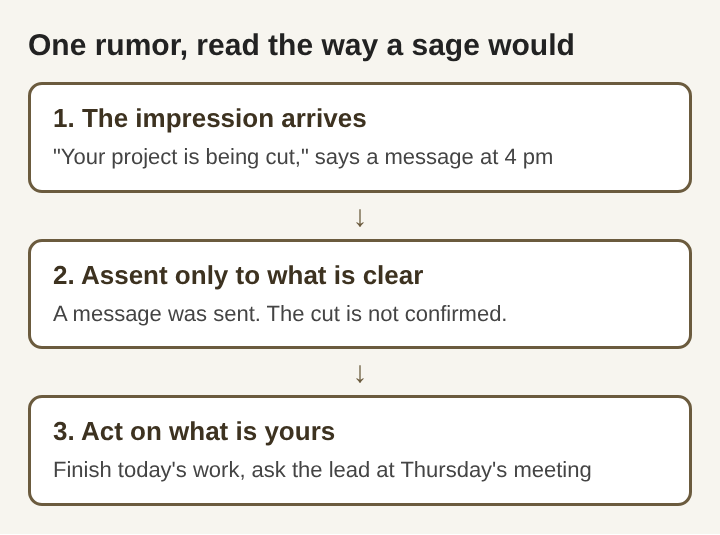
- The impression arrives. The jolt in your stomach is a pre-emotion. It happened before you agreed to anything, and on the Stoic account even a sage could feel it. You have not failed yet.
- Assent only to what is clear. Sort the impression. What is certain is that a message was sent. Whether the project is really being cut, and whether that would be a real harm to you, is not clear. Hold back agreement on both.
- Act on what is yours. Finish the day's work as carefully as you would on any other day, and write down one question to ask the team lead at Thursday's meeting. If the cut is real, the choice of how to respond is still yours, and that is where virtue lives.
You will not do this perfectly. The point of the sage is not that you match it, but that you can ask, at each step, which way the sage would lean and take one move in that direction.
Frequently asked questions
Did the Stoics think anyone was a sage?
They were unsure anyone ever had been. If anyone qualified, they suggested Socrates or Diogenes of Sinope.
Is the sage the same as a saint?
No. The Stoic sage is defined by perfect knowledge and virtue, reached through reason and the right handling of impressions, not by holiness or religious devotion.
Does the sage feel emotions?
The sage has no passions, but does have good feelings toward real goods, and can feel the first jolts the Stoics called pre-emotions. The caricature of an unfeeling sage is a misreading.
What is a Stoic progressor?
A progressor is someone moving toward wisdom without having reached it, which on the Stoic view means nearly everyone. Epictetus tied that progress to learning what is in your power.
The Stoic sage as a direction to walk
The Stoic sage is a perfectly wise person who knows only what is true, feels only what fits real goods, and cannot be harmed by fortune. The Stoics doubted such a person had ever lived, and they used the figure anyway, as a fixed point to measure each choice against. A rumor at 4 pm, a sharp word, a loss you did not expect: each one is a chance to ask what the sage would agree to, and to take one step closer to it.
How to Find Your Meaning
Find what your life is for. Visit findyourmeaning.vlvd.net