What is oikeiosis, in plain words
If you are asking what is oikeiosis, the short answer is that it is the Stoic name for treating something as your own. The Wikipedia page on oikeiosis lists the ways scholars have tried to put it in English: appropriation, orientation, familiarization, affinity, affiliation and endearment. None of them quite fits, which is why the Greek word stays in use.
The idea matters because it answers a hard question in ethics. If every creature starts out caring only for itself, how does anyone come to care about strangers? The Stoics said the same process explains both. The care you feel for your own body is the seed, and the care you can come to feel for every person is what that seed grows into.
The short lessons and daily practice at How to Find Your Meaning work on the same ground, with one of the four Stoic virtues each morning and Seneca's three questions each evening. Oikeiosis is the account of why those virtues reach outward to other people at all.
Where the word comes from
Oikeiosis is built on the Greek word oikos, which means a household, a house or a family. The same root sits behind the English words economics and ecology. A related Greek word, oikeiotes, names a sense of belonging, and it is the opposite of alienation.
So the word carries the feeling of being at home with something. When the Stoics said a creature has oikeiosis toward a thing, they meant it recognizes that thing as part of its household, as belonging to it. The Latin writers rendered it conciliatio, a bringing together.
The theory goes back to Zeno of Citium, the first Stoic. The Wikipedia page also reports that, according to the later writer Porphyry, the followers of Zeno called oikeiosis the beginning of justice. That is a strong claim. It says fairness to others is not imposed on human nature from outside. It grows from inside it.
The first stage: caring for yourself
The Internet Encyclopedia of Philosophy article on Stoic ethics sets out the theory in two stages. In the first, every living thing starts with an impulse toward its own constitution. A plant, an animal and a newborn child each act to keep themselves in their natural condition, seeking what helps them and avoiding what harms them.
That first impulse, the Stoics insisted, is self-love and not pleasure. This was a direct reply to the Epicureans, who held that pleasure is what every creature pursues first. On the Stoic view, pleasure is only a by-product of success at looking after yourself. A baby reaching for milk is not chasing a pleasant sensation. It is caring for the body it already treats as its own.
The opposite of oikeiosis, the same article notes, is allotriosis, which translates neatly as alienation. To be alienated from something is to treat it as foreign, as no part of you.
How reason changes the self you love
As a child grows, something shifts. Reason develops, and with it the child's sense of what its self is. At first the self is the body. Later it becomes the mind, the faculty of reason in a certain relation to the body. The person still loves themselves, but the self being loved has changed.
This is the step that turns oikeiosis into ethics. If what you most truly are is a reasoning mind, then what is most truly good for you is the best state of that mind. For the Stoics, that best possible state is exactly what virtue is. The live piece on eudaimonia in Stoic philosophy follows the same line to the Stoic view of happiness.
So self-love, rightly understood, does not lead to selfishness. A grown person who cares for their real self cares for their honesty, fairness, courage and self-control. Those are the four virtues a Stoic day keeps returning to.
The second stage: caring for others
The second stage explains how care reaches other people. The Stoics started from something everyone can see: a parent is drawn to love their own children and to look after their welfare. The child is close to the parent and like them, so the parent treats the child as their own.
Reason pushes the same movement much further. Nearly every human being shares reason with you, so in the most important respect every person is like you. The Internet Encyclopedia of Philosophy article puts the Stoic conclusion this way: you identify not only with your immediate family but with every member of the human race, as fellow members of one rational community. The Stoics offered this as an account of where altruism comes from naturally.
Concern for strangers is not a rule that fights your nature. It is your nature, carried to its full reach.
Hierocles and the circles
The clearest picture of oikeiosis comes from Hierocles, a Stoic of the 2nd century CE about whose life, the Wikipedia page on Hierocles) notes, very little is known. In his Elements of Ethics, as the Wikipedia page on oikeiosis describes it, he began with an animal's very first perception of itself, which he called the first thing that is one's own and familiar. He split oikeiosis into internal forms, toward yourself and your own constitution, and external forms, toward other people and outside goods. He made it the basis of his account of appropriate acts, the duties that fit a person's nature.
In another work, On Appropriate Acts, which survives only in fragments, Hierocles drew the idea as a set of circles, one inside the next. You stand at the centre. Around you is your immediate family. Further out are your own people, and at the edge is the whole human race. The distance of a circle from the centre measures how strong your ties to those people feel, and so how strong your duties to them seem.
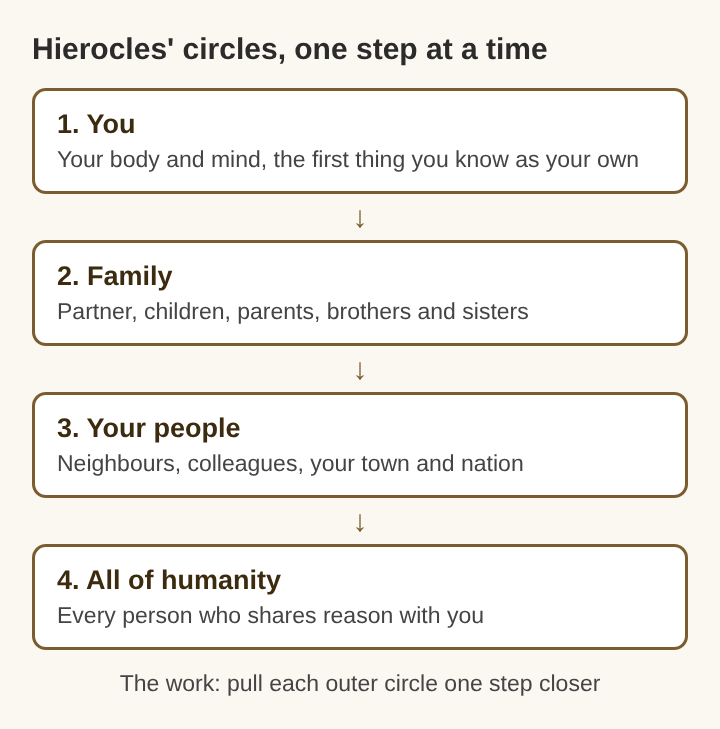
Hierocles did not stop at the description. As the same page on oikeiosis reports, he argued that the task is to contract the circles, to draw each outer ring closer to the centre, so that you come to treat people further out more like people nearer in. He did not ask anyone to stop loving their family most. The strongest tie stays with the inner circle. The aim is to shrink the gap, not to erase every difference.
A worked example: one new colleague
Say a new colleague starts on your team on a Monday. They sit two desks away, and so far they belong to the third circle at most: someone you work near but do not know. Here is how Hierocles' circles turn into a few concrete steps across one week.
- Place them honestly. On Monday evening, ask where this person sits in your circles today. Be plain about it. If they are a stranger to you, say so to yourself. The practice starts from what is, not from what you wish you felt.
- Find what you share. On Tuesday, look for one way they are like you. They are also new to something, also tired at four in the afternoon, also trying to do their work well. This is the Stoic point in small: the shared reason that makes every person kin.
- Treat them one circle closer. On Wednesday, act toward them the way you would act toward someone a ring further in. Show them where the files live, ask how the move went, include them in lunch. You are not pretending they are family. You are pulling the circle in by one step.
- Check the evening questions. On Friday night, use Seneca's three questions with this colleague in mind. Did you treat them as part of your household, or as foreign? What would you do differently next week?
The steps take little time. What they change is the habit of seeing people beyond your inner circle as outside your concern. Repeated with different people, they are what contracting the circles looks like in an ordinary life.
Frequently asked questions
What is the opposite of oikeiosis?
Allotriosis, usually translated as alienation. It means treating something as foreign to you, as no part of your own household.
Is oikeiosis the same as self-interest?
Not in the ordinary sense. It begins as self-love, but the Stoics held that a mature person's real self is their reason, so caring for yourself becomes caring for virtue and, through shared reason, for other people.
Who was Hierocles?
Hierocles was a Stoic philosopher of the 2nd century CE. Part of his Elements of Ethics was found on a papyrus at Hermopolis in 1901, and his circles come from fragments of On Appropriate Acts.
Does oikeiosis mean you should love strangers as much as family?
No. Hierocles kept the strongest tie with the inner circle. The aim is to draw outer circles closer, so that strangers matter more to you, not to treat everyone exactly alike.
Oikeiosis as a widening sense of home
Oikeiosis starts with the plainest fact about living things: each one looks after what it takes to be its own. The Stoics saw that the same impulse, guided by reason, does not stay small. A person who comes to see their true self as a reasoning mind finds their good in virtue, and finds in every other reasoning person someone who belongs, in the deepest sense, to the same household. Hierocles' circles give that idea a shape you can work with. You stand at the centre, the rings go out to the whole human race, and the daily work is to bring each ring a little nearer home.
How to Find Your Meaning
Find what your life is for. Visit findyourmeaning.vlvd.net