How to revise a whole subject in one week
Seven days is not much time for a whole subject, and the usual reaction is to read every chapter once, front to back, and hope it holds until the exam. If you want to know how to revise a whole subject in one week, the plan that holds up is different: cover each chapter by answering questions with the book closed, come back to every chapter more than once, mix the chapters together near the end, and give the last two days only to what did not come back.
The plan works with a textbook, a stack of notes or a pile of worksheets. It also fits tools built around answering questions from your own pages. Study Shot, for one, takes a photo of a page from a textbook, notes or a worksheet and writes multiple-choice practice questions about it, from the basics to advanced, explaining every answer.
Why one reading of every chapter falls short
Reading a chapter once leaves you with a feeling that you have covered it. You recognise the headings and the diagrams, and that recognition feels like knowledge. The exam asks for something else: an answer pulled out of memory with no page in front of you.
Research on retrieval practice points the same way. Recalling what you know does more for learning than only reading or passively studying the same material. Recall works better still when you get feedback on each answer, and students are advised to use retrieval practice with feedback that is spread out over time, not packed into one sitting.
So the unit of work in this week is not "read chapter 3". It is "answer questions on chapter 3 with the book shut, then check every answer". Reading still happens, but only for the parts your answers show you have not got.
Spread the week so every chapter comes back
The second rule is timing. The spacing effect is the finding that study sessions spread out put more into long-term memory than the same amount of study massed together, which is what cramming is. Hermann Ebbinghaus first described it in 1885, and his work suggested that recalling something at growing intervals lowers the chance of forgetting it. In a 2006 study by Cepeda and others, spaced practice did better than massed practice in 259 of 271 cases.
A week is short, but it is long enough for spacing. The trick is to make sure no chapter is touched only once. A chapter you meet on day 1 should come back on day 5 and again, for its misses, on day 6 or 7. That gives each chapter at least two or three separate rounds of recall, with gaps of days between them.
Before day 1 starts, make a map.
Spend the first half hour of the week on a map, not on studying. List every chapter or unit the exam covers, and next to each one write how many pages it has. Then split the chapters over the first four days so that each day has a similar number of pages, not a similar number of chapters.
Mark which chapters feel weakest, but do not trust that feeling too much. The questions will tell you more in an hour than your memory of the course will. Put one weak chapter on day 1 so its misses have the most days to come back.
Keep one sheet, or one file, for misses. Every question you get wrong or only half answer goes on it, with the chapter it came from. By the end of the week, that sheet is the plan for the last two days.
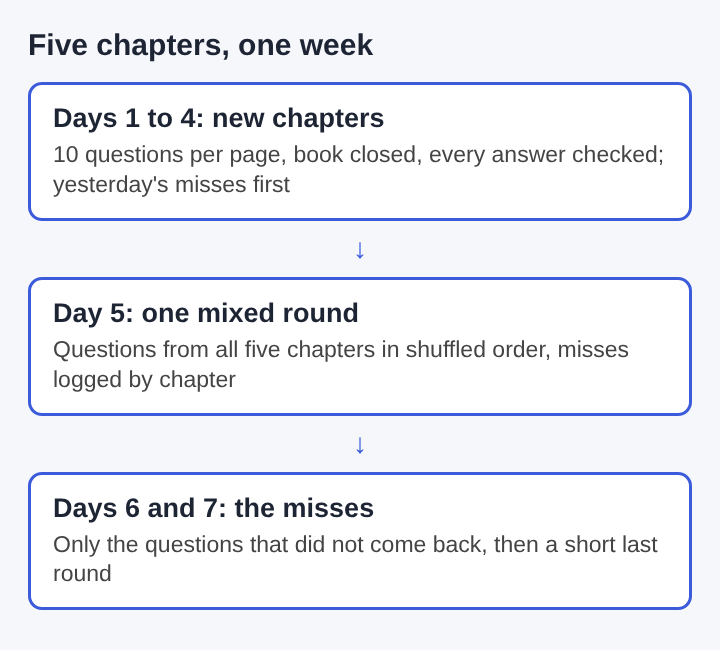
Days 1 to 4: one block of chapters at a time, book closed
Each of the first four days follows the same order:
- Start with yesterday's misses. Answer them again with the book closed before anything new. From day 2 on, this takes the first part of each session.
- Take the day's chapters page by page. For each page, answer about 10 questions without looking. Mix basic questions (a term, a date, a definition) with harder ones (why something happens, how two ideas connect).
- Check every answer straight away. Read the explanation for each miss, then go back to the page and read only the part that covers it.
- Log the misses. Write each one on the misses sheet with its chapter.
Ten questions per page is also the number the Study Shot guide suggests for revising a chapter page by page, at its Tiered level, which climbs from basic to advanced questions. Whatever you use, the number matters less than the habit: every page gets questions, and every answer gets checked.
If you make your own questions, the article on making practice questions from your notes shows how to write a set for one page.
Day 5: one mixed round from every chapter
On day 5, stop working chapter by chapter. Build one round of questions drawn from all the chapters, shuffled so that you never know which chapter the next question comes from. An exam does not tell you which chapter a question belongs to, and a mixed round makes you work that out each time.
Research on retrieval practice lists broad questions, rather than narrow ones, and a mix of question formats and difficulty among the things that help you use what you learned in new situations, especially with feedback. A shuffled round across the whole subject is broad by design.
Keep the round to what fits in one session: 5 to 8 questions per chapter is enough. Log every miss by chapter. A chapter with many misses on day 5 is the one the first four days did not settle.
Days 6 and 7: only what did not come back
The last two days are for the misses sheet, not for the whole subject again. On day 6, answer every logged miss with the book closed. The ones that come back can drop off. The ones that still do not come back get a short reread of their page and go onto a fresh, shorter list.
On day 7, answer that short list once more, then do one small mixed round, 2 or 3 questions per chapter, to touch every part of the subject one last time. Stop early. The aim on the last day is to confirm what holds, not to load in new material.
If you use a tool that keeps your quizzes, this is where it pays off. Some keep every quiz in a library with its page photo, ready to take again, so a chapter's questions from day 2 are still there on day 6.
A worked week for a five-chapter subject
Say your biology exam covers five chapters with 30 pages in all, about 6 pages per chapter.
- Day 1: map the subject, then chapter 4 (the weakest) and half of chapter 1. About 9 pages, 10 questions each. You miss 22.
- Day 2: those 22 misses first, then the rest of chapter 1 and chapter 2. About 9 pages. You miss 18 new ones, and 8 of day 1's still do not come back.
- Days 3 and 4: the same order for chapters 3 and 5, each day starting with the previous day's misses.
- Day 5: one mixed round of 35 questions, 7 per chapter. Chapter 3 gives 4 misses, the others 1 or 2 each.
- Day 6: the whole misses sheet, book closed. About two thirds come back; the rest go on a short list with a reread of their pages.
- Day 7: the short list, then 15 mixed questions, 3 per chapter, and an early night.
By the end of the week every chapter has been recalled on at least three separate days, and the time went where the misses were, not evenly across pages you already knew.
Frequently asked questions
Is one week enough to revise a whole subject?
It is enough to recall every chapter more than once if you plan the days ahead. It is not enough to read everything several times, so the week has to run on questions, not rereading.
Should you start with the hardest chapter?
Put one weak chapter on day 1. Its misses then have the most days to come back before the exam.
How many hours a day does this take?
That depends on how many pages the subject has. Split the pages evenly over days 1 to 4, and keep days 6 and 7 lighter.
What if you run out of time on a chapter?
Answer questions on the parts you did not reach on day 5 instead of skipping them. A rough round of recall on a page does more than no contact with it.
Revising a subject in a week, in the end
A week of revision works when every chapter is recalled, checked and recalled again on a later day. Reading once from start to finish covers the pages but leaves little that you can pull back on demand. Questions with the book closed show you exactly which parts are missing, and spacing those questions over the seven days gives each chapter more than one chance to stick. The last days then belong to the short list of what still does not come back, which is where the week's effort does the most.
Study Shot
Turn any page into a practice quiz. Visit studyshot.vlvd.net