The key thinkers of the Enlightenment were a small group of writers who asked where a ruler's power comes from and what a person may believe without permission. John Locke, Montesquieu, Voltaire, Jean-Jacques Rousseau and Immanuel Kant gave answers that still sit inside modern constitutions, courts and arguments about rights. Each one wrote for a different reader and a different country, yet their ideas fed into each other across about a hundred years.
The Age of Reason in brief
The Age of Enlightenment, also called the Age of Reason, began in Western and Central Europe in the late 17th century and peaked in the 18th. Its writers put weight on reason, evidence and the scientific method. They argued for individual liberty, religious tolerance, progress and natural rights, and many pressed for constitutional government and a line between church and state.
The course Power, Reason and Rights, in the Advanced part of Learn 100 Influential People, deals with this stretch of history, where modern ideas about power took shape. The five names here are the ones most often met first, and each answered a slightly different question.
John Locke and government by consent
John Locke was an English philosopher and physician, often called the father of liberalism. In 1689 and 1690 he brought out three works that set his reputation: A Letter Concerning Toleration, Two Treatises of Government and An Essay Concerning Human Understanding. The first two appeared without his name on them, a sign of how risky the ideas were at the time.
The Two Treatises argue that a government rests on the consent of the people it governs. A ruler who turns tyrant and loses that consent can be resisted. Historians believe this language shaped the words Thomas Jefferson chose when drafting the American declaration of July 1776.
The Letter Concerning Toleration made a separate case. Locke held that religion is a matter for each person, and that churches are voluntary groups. On that view a state has no business forcing anyone into one faith or one form of worship.
Montesquieu and the separation of powers
Montesquieu, one of the great French political philosophers of the age, came at politics as something close to a natural scientist. He tried to explain why governments took the forms they did, from climate and geography to commerce and religion, and how a government might be kept from sliding into corruption. Despotism worried him most.
His great book, The Spirit of the Laws, came out in 1748. It sold widely and drew fierce criticism, and the Roman Catholic Church placed it on its list of banned books. Its most lasting idea was the separation of powers: lawmaking, carrying out the law and judging cases should sit with different bodies, so that no single hand holds all of them. That idea had a large effect on the framers of the United States constitution.
Voltaire, wit and religious liberty
Voltaire was the pen name of Francois-Marie Arouet, a French writer, satirist and historian. Where Locke and Montesquieu wrote long treatises, Voltaire often used humour as a weapon. He was famous for attacking the Catholic Church and slavery.
He spoke up for liberty of speech and of religion, and for keeping church and state apart. His fame rested less on one system of ideas than on a lifetime of pamphlets, plays, letters and histories that carried those causes to a broad reading public across Europe.
Rousseau and the general will
Jean-Jacques Rousseau was born in Geneva and worked as a writer, philosopher and composer. His political thought mattered during the Enlightenment and then again during the French Revolution, one of the upheavals of the age of revolutions.
In 1762 he published both Emile, on education, and The Social Contract. The second turns on the idea of the general will: laws are legitimate when they express what the people as a whole will for the common good, not the wishes of a ruler or a faction. Rousseau claimed this could reconcile personal liberty with the authority of the state. The year was a high point for him and also a disaster: Emile was condemned in Paris.
Kant and daring to think for yourself
By 1784 the movement was old enough for writers to ask what it had been. Immanuel Kant answered in his essay An Answer to the Question: What is Enlightenment? He defined enlightenment as humankind's release from a self-incurred immaturity, where immaturity means being unable to use your own understanding without someone else's guidance.
Kant tied the whole project to one habit: thinking for yourself, and relying on your own judgment about what to believe and how to act. That habit was shared by Enlightenment writers who otherwise disagreed sharply with one another.
One question, five answers
A good way to keep the five apart is to put the same question to each. Take an 18th-century king who wants to jail a writer for criticising him and to make everyone attend the royal church. Here is how each thinker would push back.
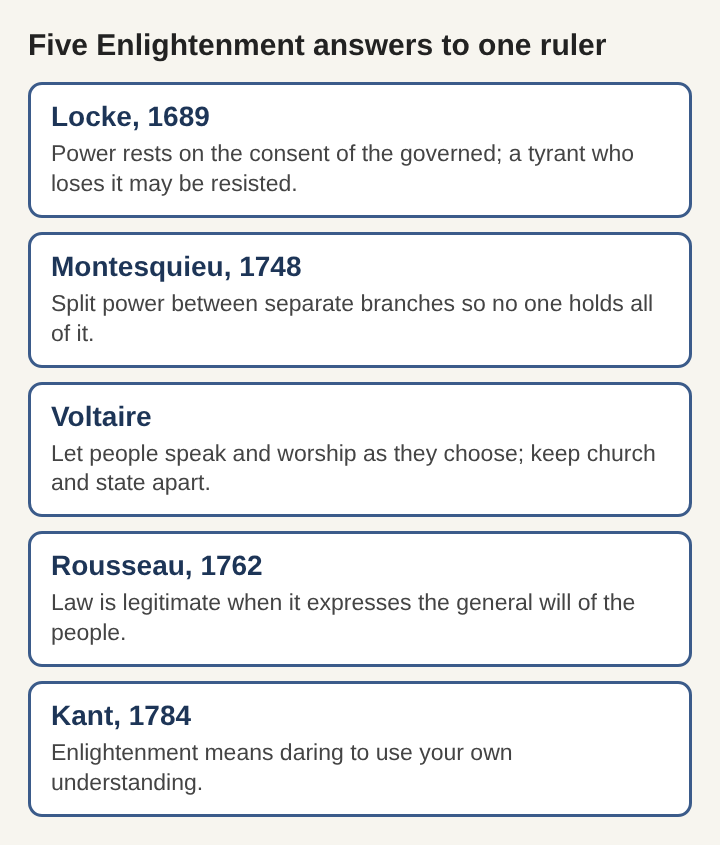
- Locke asks whether the king still has the consent of his people. If he rules by force alone, he has lost the right to rule. On worship, Locke says faith is each person's own affair, so forced attendance is out.
- Montesquieu asks who decides the writer is guilty. If the king makes the law, enforces it and judges the case, that is despotism. A separate court is the check.
- Voltaire defends the writer's right to speak and mocks the king's attempt to rule over belief.
- Rousseau asks whether the law against criticism reflects the general will of the people or only the will of one man. Only the first would make it a real law.
- Kant points at the people themselves: a public that dares to use its own understanding will not take the king's word on trust.
Notice that the answers overlap but do not match. Locke and Montesquieu limit power through consent and structure. Voltaire works through public argument. Rousseau grounds law in the people as a whole, and Kant asks each person to think.
Frequently asked questions
Who is considered the father of the Enlightenment?
No single person holds the title, but John Locke is often named first. His works of 1689 and 1690 on government, toleration and knowledge shaped much of what followed.
What did Montesquieu contribute to the Enlightenment?
In The Spirit of the Laws (1748), Montesquieu argued that the powers of government should be divided among separate bodies. That idea strongly shaped the United States constitution.
When did the Enlightenment happen?
It began in the late 17th century in Western and Central Europe and reached its peak during the 18th century, spreading across Europe and to the Americas.
What did Kant mean by enlightenment?
Kant meant leaving behind a state where you rely on others to think for you. In his 1784 essay he tied it to the habit of using your own understanding.
Why the key thinkers of the Enlightenment still matter
The arguments of these five writers did not stay on the page. Consent of the governed, divided powers, liberty of belief and law grounded in the people moved into declarations, constitutions and courts within a few decades. Each idea also carries an open question that people still argue about: how much consent is enough, where the lines between powers should fall, and how to find the general will. Reading Locke, Montesquieu, Voltaire, Rousseau and Kant side by side shows how those questions were first framed, and why the habit Kant described, using your own judgment, sits underneath all of them.
Learn 100 Influential People
100 people who shaped history, from Moses to the web. Visit influentialpeople.vlvd.net