How to write a checklist that does not get ignored
If you want to know how to write a checklist people will actually use, start by cutting. A checklist that gets used is short. It holds only the steps that people skip and that cause harm when they are skipped. It follows the order of the work, says who does each step, and is read at one fixed moment, not all day.
Most checklists fail in the other direction. The first draft holds every step its writer can think of, the list grows to thirty lines, and within a week nobody opens it. The people who were meant to use it are not lazy. The list asked them to read things they already know, so they stopped reading it at all.
Practical guides that open with the answer, then work through an example suit checklists well, because a reader can see a finished list before the reasons behind each line.
What a checklist is for, and what it is not
A checklist is a job aid for repeated tasks. Its job is to cover for the limits of human memory and attention. That is a narrow job, and keeping it narrow is the first rule of writing one.
A checklist is not a manual. The same source makes the difference plain: a checklist does not normally say how to do each step, because it assumes the person using it is competent and already knows the step. A manual teaches. A checklist reminds.
This changes how you write every line. "Turn off the water main" is a checklist item. "Find the blue valve under the sink, turn it clockwise until it stops, then open a tap to confirm the flow has stopped" is a paragraph from a manual. If the reader needs the long version, they need a guide first and a checklist later.
Keep only the steps people skip
The hardest part of writing a checklist is leaving things out. The same page says a checklist should be easy to read, include only necessary checks, and be as short as is reasonably practical. It adds that each item should be necessary and that together the items should be sufficient.
A useful way to apply that is to ask two questions of every line you have written:
- Do people forget this step? If no one has ever missed it, it does not need to be on the list.
- Does missing it cause harm? If skipping it costs nothing, it does not need to be on the list either.
Only a step that gets a yes to both questions stays. Everything else either belongs in a guide or does not need writing down at all. The result often looks too short to the person who wrote it. That is usually a sign it is about right, because the reader is not the writer and will not miss the lines that were cut.
Write each line as one short action
Each line on a checklist should be one action, started with a verb, short enough to read at a glance. The source warns against items that are over-detailed or ambiguous, and both faults come from the same place: trying to fit two things into one line.
Compare these two versions of the same item:
- "Make sure everything electrical is sorted before leaving."
- "Unplug the fridge and prop its door open."
The first is vague. "Everything electrical" means something different to each person, and "sorted" can be ticked without doing anything. The second names one object and one result. Anyone can look at the fridge and know whether the line is done.
A good line can be checked by someone else. If two people could disagree about whether it has been done, rewrite it until they could not.
Order the list the way the work happens
The order of a checklist is part of its content. Where the order of steps matters, the list should show it by the order of its lines. Where the things to check are spread around a room or a building, an order that keeps walking to a minimum saves time.
The same page also notes that a list focused on one person or one group is less likely to have items left out. If a task is shared, either split the list by person or mark each line with who does it. A line that belongs to everyone tends to belong to no one.
Read and do, or do and confirm
There are two common ways to use a checklist, and choosing one before you write changes how the list looks.
- Read and do. You read a line, do it, tick it, and move to the next. This suits tasks done rarely, or where the order is strict.
- Do and confirm. You do the work from memory, then go through the list to confirm nothing was missed. This suits tasks done often by people who know them well.
The source notes a weakness in the second style: because the person has to remember what they did until they check it off, do and confirm may lead to more errors. If a mistake would be serious, lean toward read and do.
Whichever style you pick, name the moment when the list is read. Aviation uses a normal checklist before the critical phases of a flight, such as takeoff, approach and landing, which are the phases where procedural errors most often lead to accidents. That is the idea of a pause point: one fixed moment, tied to an event that always happens, when the list comes out. A checklist with no pause point is read whenever someone remembers it, which means often not at all.
The WHO Surgical Safety Checklist, published in 2008, works the same way: it reminds the surgical team of important items before and after an operation. Several studies found it cut deaths and complications by as much as a third where it is used. The same page also records that some hospitals struggle to put it in place because of local customs and a lack of support from staff. A short list at a fixed moment still needs the people using it to agree that it is worth the minute it takes.
A worked example: closing a cabin for winter
Take a family that shares a holiday cabin and closes it every autumn. Over the years something has gone wrong more than once: a pipe that froze, a fridge left shut that grew mould, a window left open.
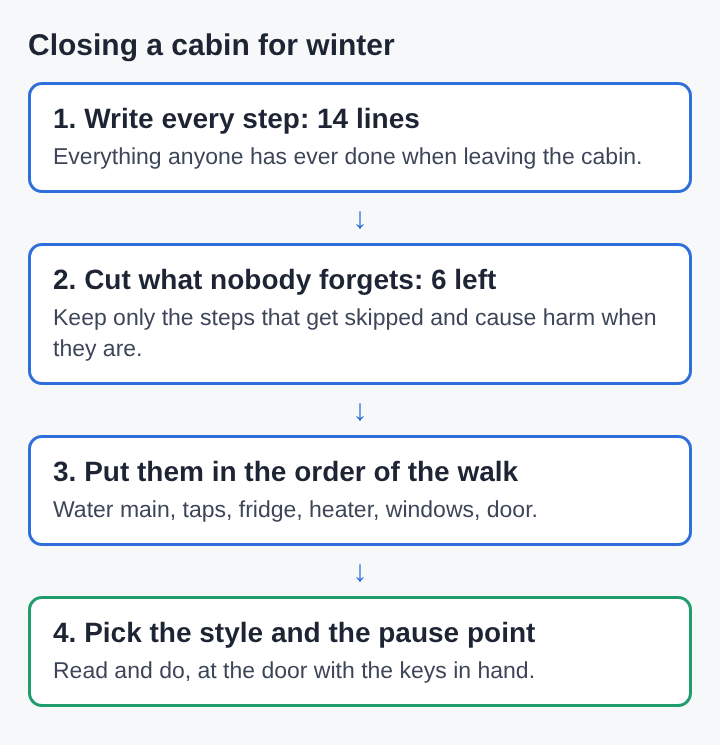
Step 1: write every step. The family starts by listing everything anyone has ever done when leaving. It comes to 14 lines, including "pack the car", "strip the beds", "take out the rubbish" and "say goodbye to the neighbours".
Step 2: cut what nobody forgets. Each line gets the two questions. Nobody has ever forgotten to pack the car, so it goes. Stripping the beds is sometimes skipped, but nothing bad happens, so it goes too. Six lines are left, all things that have been missed and caused real damage.
Step 3: put them in the order of the walk. The water main is in the kitchen, so the list starts there, then moves through the cabin to the front door:
- Turn off the water main.
- Open every tap until it runs dry.
- Unplug the fridge and prop its door open.
- Set the heater to frost setting.
- Close and latch every window.
- Lock the front door and put the key in the lock box.
The order also carries a rule of its own. The taps only drain after the main is off, so that line has to come second.
Step 4: pick the style and the pause point. The cabin is closed once a year, so nobody remembers the steps well. That calls for read and do. The pause point is the front door with the keys in hand, so the list is printed and taped inside the door, at eye level. Whoever holds the keys reads it aloud and ticks each line.
Six lines, one place, one moment. The list is short enough that nobody resents it, and every line on it is there because it once went wrong.
Frequently asked questions
How long should a checklist be?
As short as the task allows. Keep only the steps people forget and that cause harm when missed, which for many everyday tasks is only a handful of lines.
Should a checklist explain how to do each step?
No. A checklist assumes the person already knows how to do each step and only reminds them to do it. If they need instructions, give them a guide first.
What is the difference between a checklist and a to-do list?
A to-do list is usually written once for one day or project and thrown away. A checklist is written for a task that repeats, and the same list is used every time.
How do you get people to use a checklist?
Make it short, put it where the work happens, and tie it to one moment that always comes, such as locking a door or starting a machine. Then remove any line people keep skipping without harm.
Short checklists and the steps people skip
A checklist is a small tool for a narrow problem: the step a capable person forgets on a busy day. Writing one well means listing what goes wrong, cutting everything else, putting what is left in the order of the work and naming the moment it is read. A list built that way stays short, and a short list is the kind that gets read every time.
Electrified