If you want to know how to write prerequisites for a guide, answer four questions in a few short lines before step one: what the reader needs to have, what they need to know, what must already be true, and how they can check they are ready. Put those lines straight after the introduction. Keep each one concrete enough that the reader can say yes or no to it in a second.
That small block does a lot of work. A reader who reaches step four and finds they are missing a tool has to stop, leave, and maybe never come back. On a site where guides open with the answer and then work through an example, the prerequisites are what let that example run from start to finish without a detour. They move every surprise to the top of the page, where it costs the reader nothing.
Why prerequisites belong before step one
A guide exists to help someone finish a task. A user guide is meant to assist people in using a particular product, service or application, and the same goal holds for any how-to page. Owner's manuals have long included setup instructions: the steps that prepare the item before it is used at all. A how-to guide on the web needs the same thing, only shorter.
The reason is simple. Steps assume things. Step three says "tighten the nut", and that assumes the reader owns a spanner of the right size. Step five says "open the terminal", and that assumes they know what a terminal is. If those assumptions stay hidden, each one becomes a place where the reader gets stuck. Writing them down at the top turns hidden assumptions into a short list the reader can sort out before they begin.
Cooks have a name for this habit. Mise en place is a French culinary phrase that means "putting into place", and it refers to the setup required before cooking: the ingredients chopped, measured and arranged before the first pan heats up. The same page notes that the practice can be applied in home kitchens, not only in restaurants. Prerequisites ask the reader to do that setup on purpose, with the guide telling them exactly what it is.
How to write prerequisites in four short lines
Most good prerequisite blocks fit into four lines, one for each question. You will not always need all four, but asking each question stops you from missing one.
- What you need to have. Tools, materials, accounts, files or software, each named precisely enough to find. "A pump" is vague; "a pump that fits a Presta valve" is something the reader can check.
- What you need to know. Skills the guide does not teach. Name the skill and, if you can, point to a page that teaches it. Do not teach it inside the prerequisites.
- What must already be true. Time, space, permissions, versions, the state the thing is in. "About 20 minutes" or "the app updated to its latest version" saves a reader from starting at the wrong moment.
- How to check you are ready. One quick action that proves the most likely missing piece is there. This is the line most guides leave out, and it is often the most useful.
Each line should be one sentence or a short list. If a line grows into a paragraph, it is probably a step in disguise, and it belongs in the steps.
A worked example: changing a bike inner tube
Take a guide on changing a bike's inner tube after a flat. The introduction has already said what the reader will do and what they will have at the end: a wheel that holds air again. Here is what the prerequisites block looks like, line by line.
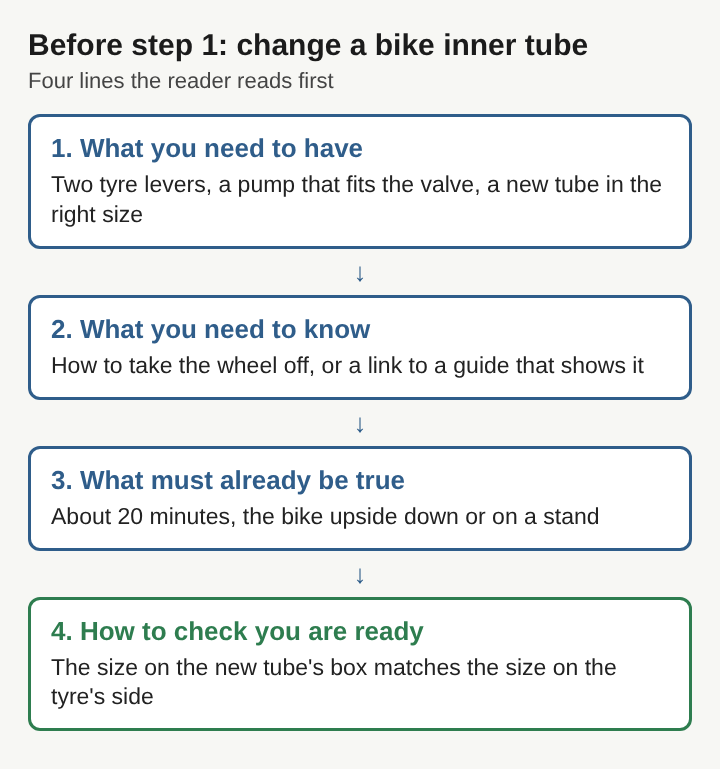
What you need to have: two tyre levers, a pump that fits your valve, and a new inner tube in the right size. Three items, each specific. The reader can look around their shed and answer straight away.
What you need to know: how to take the wheel off the bike. The guide does not teach this, because it differs between bikes and would double the length of the page. Instead, the line says so plainly and links to a separate guide that does.
What must already be true: about 20 minutes, and the bike upside down or on a stand. A reader who has five minutes before they leave for work now knows to wait.
How to check you are ready: the size printed on the new tube's box matches the size printed on the side of the tyre. This is the one check that matters most. A wrong-sized tube is the mistake that stops a reader halfway through, with the wheel already off and the old tube already out. Ten seconds of reading two labels prevents it.
Notice what is missing. There is no history of the inner tube, no list of every tool a cyclist might own, and no advice about brands. The block names only what this one task needs.
Keep the list short and specific
The temptation is to list everything that could possibly help. Resist it. A checklist is a job aid that reduces failure by compensating for the limits of human memory and attention, and the same page says a checklist should be easily readable, include only necessary checks, and be as short as reasonably practicable. A prerequisites block is a small checklist, and the same advice applies.
A long list has two costs. First, the reader skims it, and the one item that matters gets lost among items that do not. Second, it can scare off a reader who could have finished the task with half of what is listed. If an item is only needed for an optional step, put it next to that step instead.
Specific beats complete. "Basic computer skills" tells the reader nothing they can act on. "You can copy a file into a folder" tells them exactly what is assumed. When you are unsure whether a line is specific enough, ask whether a reader could answer it with yes or no. If they would have to think about what you mean, rewrite it.
Match the words to the reader
Prerequisites are often the first place a guide uses technical words, so they are the first place a beginner can feel lost. The user guide page notes that the language is matched to the intended audience, with jargon kept to a minimum or explained thoroughly. In a prerequisites block, that means naming a thing the way the reader would name it, and adding a few words when a term might be new.
"A Presta valve" may mean nothing to someone who has never fixed a bike. "A pump that fits your valve (the small metal tip you push the pump onto)" means something to almost everyone. The longer version costs a handful of words and saves a reader from guessing, which is the whole job of this part of the page.
Common mistakes in a prerequisites block
A few problems come up again and again, and each one is quick to fix once you see it.
- Hiding a prerequisite inside a step. "Step 4: using your torque wrench, tighten..." is the first time the reader hears about a torque wrench. Move it to the top.
- Listing skills without a way to get them. "You should know how to use Git" leaves a beginner stranded. Add a link or one line on where to learn it.
- Forgetting versions and settings. Software guides break when the reader has a different version. Say which one the steps were written for.
- Leaving out the ready check. Without it, readers start and only discover the problem midway. One check at the top catches the most common one.
- Burying the block. Prerequisites placed after a long story are easy to miss. They go after the introduction and before step one, every time.
Frequently asked questions
Where do prerequisites go in a how-to guide?
Straight after the introduction and before the first step. The introduction says what the reader will do and get; the prerequisites say what they need before starting.
What is the difference between prerequisites and the first step?
A prerequisite is something the reader has, knows or has already done before the guide begins. The first step is the first action the guide itself walks them through.
Should a guide teach the skills it lists as prerequisites?
Usually not. Name the skill, link to a page that teaches it, and keep the guide focused on its one task.
How many prerequisites is too many?
If the block runs past six or seven items, check whether some belong next to optional steps, or whether the guide is really two guides. Most tasks need three to five lines.
Prerequisites that keep the reader moving
Good prerequisites are a promise: if the reader has these few things and passes this one check, the steps will work. That promise only holds when every line is concrete, short, and true for the task at hand. Write the four lines, cut anything the task does not need, and add the single check that catches the most likely missing piece. Then the reader can start step one knowing they will reach the last one without leaving the page.
Electrified