If you want to know how to write in public without an audience, the short answer is this: write each post for one stranger with one real question, put the answer in the first paragraph, show one worked example, and publish it whether or not anyone is reading yet. A post built that way is useful on the day a search or a link brings its first reader, which may be months after you wrote it. It is also useful to you on the day you write it, because writing the answer down shows you what you actually know.
No audience is the normal starting point. Every writer with readers once had a page that nobody visited. The difference is what they put on that page while it was quiet.
Why an empty page is still worth writing on
Places built for this exist. Electrified describes itself as "A place to write, and be read": anyone can write short notes and longer articles there, and each post shows who wrote it and links to that writer's page. That last detail matters when you have no audience. A reader who finds one useful post can reach the rest of your work in one click, so every post you write early becomes a way in for later readers.
The other reason is what writing does to your own thinking. Paul Graham puts it plainly in Writing, Briefly: writing does not just communicate ideas, it generates them. In the same short essay he says to expect 80% of the ideas in an essay to arrive after you start writing it, and half of the ones you start with to be wrong. You get that benefit with zero readers. The audience is a bonus that comes later; the thinking arrives at once.
How to write in public without an audience: pick a question, not a theme
The common mistake is to write for a crowd that is not there. Posts addressed to "everyone" ("my thoughts on productivity", "an update on what I am doing") need readers who already care about you. With no readers, those posts sit unread forever.
A post that answers a specific question works the other way round. Nobody has to know you. Someone types the question, or follows a link from a page that mentions it, and your post is the answer. So the first step is a list of real questions, the kind you had to answer this week:
- A problem you solved at work and had to search for twice.
- A question a friend or colleague asked you that took ten minutes to explain.
- Something you learned the slow way and wish you had found written down.
Each of those is a post. Each one has at least one reader already: the person who asked, or the earlier version of you who needed it.
Put the answer first so the first reader stays
When your page has no audience, every reader who arrives is a stranger with a question. They decide in a few lines whether the page helps. The guides on Electrified follow the same order for that reason: they open with the answer, then work through an example, and they end with 3 to 5 follow-up questions, each answered.
For a new writer that order removes the hardest part of starting. You do not need a clever opening or a story about yourself. You need one sentence that answers the question, and one more that says why it works. Graham's practical advice for a stuck start fits here too: if you cannot get going, tell someone what you plan to write about, then write down what you said. The sentence you speak out loud is usually the answer, and it belongs at the top.
A worked example: one post written for zero readers
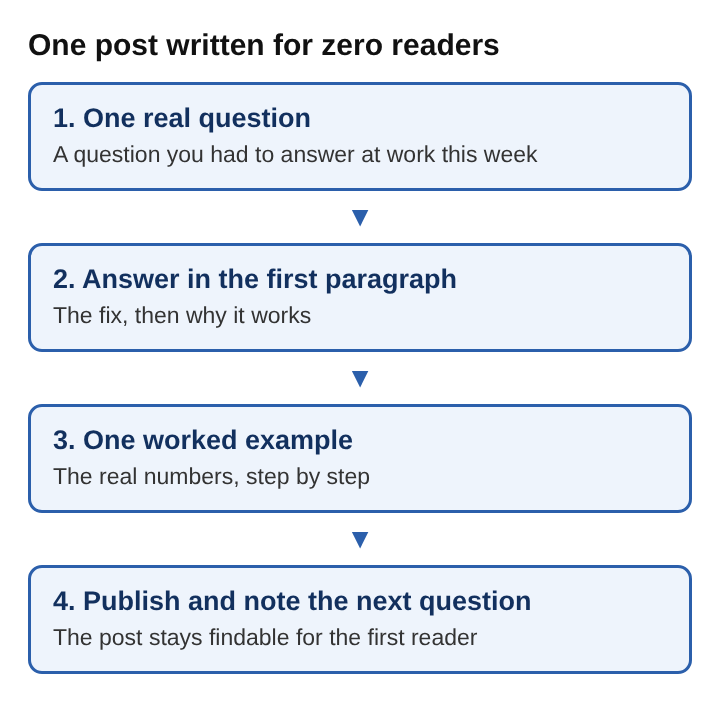
Take a real case. Say you spent an afternoon working out why a spreadsheet's dates sorted in the wrong order, and the cause was that half the dates were stored as text. You have no readers. Here is the post, step by step.
- The question. "Why do my spreadsheet dates sort in the wrong order?" That is the title, close to the words someone would type.
- The answer, first paragraph. "Your dates sort wrongly because some of them are stored as text, not as dates. Convert the text cells to real dates and the sort will follow the calendar." Two sentences, and a reader who stops there already has the fix.
- The worked example. Show the exact column you had: twelve rows, five of them text. Show how you spotted them (they sat on the other side of the cell), the one conversion you used, and the sorted column afterwards. Real values, in order, so a reader can repeat it on their own sheet.
- Three follow-up questions. What if the dates are in another country's format? How do you stop it happening again? What if the conversion gives a number instead of a date? Answer each in two or three sentences.
- Publish, and note the next question. One of those follow-ups is probably your next post.
Nobody reads it in week one. That is fine. The post is finished, it answers one question fully, and it will still answer it for whoever arrives in month six.
Reading your own post as the stranger who will find it
Without readers, nobody tells you which parts are unclear. You have to supply that reader yourself. In Putting Ideas into Words, Graham says putting ideas into words is exacting, and that the hardest part is reading what you wrote as a neutral reader who knows nothing of what is in your head, only what is on the page. He also notes that half the ideas in a finished essay are ones he thought of while writing it.
Use that before you publish. Read the post as someone who searched the question and knows nothing about you. Ask three things:
- Does the first paragraph answer the question without the rest of the post?
- Could a stranger repeat the worked example with their own numbers?
- Is there a word or a step that only makes sense if you were there?
Fix whatever fails. That one pass does most of what an editor or an early reader would have done.
Making each post easy to find later
A post with no audience today gets its readers from being found. Three habits help.
File it under its subject. On that site every guide is filed under its subjects, so the next guide a reader needs is a click away. On any site, a reader who arrives for one answer and sees three related ones is more likely to stay and return.
Link your own posts to each other. When a follow-up question becomes its own post, link the two. Your early posts then point readers forward to your later ones.
Let readers correct you in the open. Readers there can follow writers, like posts and comment, and if something in a post is wrong, readers say so in its comments. Your first comment may well be a correction. Treat it as your first reader doing you a favour, and fix the post.
Frequently asked questions
How often should you post when nobody is reading yet?
Post as often as you have a real question you can answer fully. One finished, useful post a week is worth more than daily notes that answer nothing.
Is it worth writing in public if no one reads it?
Yes, because writing the answer down sharpens your own understanding the same day. The readers come later, from people who search the question you answered.
What should a first public post be about?
Make it about a problem you solved recently and had to search for. You know the question is real because you asked it, and you know the answer because you found it.
How do you stay motivated with no readers?
Measure each post by whether it answers its question, not by its visits. Keep a list of the next questions your posts raise, so starting the next one is never a blank page.
Writing in public without an audience, one answered question at a time
An audience is not something you need before you start; it is what builds up around posts that answer real questions well. Pick one question you had this week, answer it in the first paragraph, show one worked example a stranger could repeat, read it as that stranger, and publish it. Then take the next question it raised and do the same. Each post is complete on its own, and each one is a door for a reader you have not met yet.
Electrified