What is a business model canvas?
If you have asked what is a business model canvas, the short answer is a single page that describes a whole business in nine boxes: who it serves, what it offers them, how it reaches them, what work and resources it needs, what it costs and how money comes in. Wikipedia's page on the business model canvas calls it a strategic management template, used both to design new business models and to write down ones that already exist.
The canvas is most useful before you have built much. A plan written as twenty pages of prose hides its weak spots. Nine boxes on one sheet show them, because an empty or vague box stands out. That is why it fits the early stage a course such as AI Entrepreneur calls "Your first business": finding a real problem, building a first AI project and launching it.
Where the nine boxes came from
The nine building blocks were first proposed by Alexander Osterwalder in 2005, growing out of his 2004 thesis, which compared many ways of describing a business and pulled them into one reference model. The blocks were set out in full in the 2010 book Business Model Generation, written with Yves Pigneur, and the canvas spread from there. The same Wikipedia page notes that it is distributed under a Creative Commons license by Strategyzer, so you can print it and use it without asking anyone.
It was made to be used by hand. The canvas can be printed on a large sheet so a group can sketch on it with sticky notes or markers, move ideas between boxes and argue about them. A single founder can do the same thing on a whiteboard or a page in a notebook.
The nine boxes, in four groups
The nine boxes are easier to remember as four groups, each answering one plain question.
- Customers: who is it for, and how do you reach them? Customer segments (the group or groups you serve), channels (how your offer gets to them, through your own route, through partners, or both) and customer relationships (how you win new customers, keep them and grow what each one spends).
- Offering: why would they choose it? The value proposition, what you offer and why it beats what the customer does now.
- Infrastructure: what does it take to deliver? Key activities (the work you must do well), key resources (people, money, equipment, code or know-how) and key partners (the suppliers and allies you lean on so you can focus on your own core work).
- Finances: does the money work? The cost structure (fixed costs such as salary and rent, variable costs that grow with each sale) and revenue streams (how money comes in from each segment).
Each box has its own vocabulary. Customer segments can be a mass market, a niche, several segments or a multi-sided platform, such as a credit card company that serves both card holders and the shops that take the cards. Customer relationships can be personal help, self service, automated service, a community or co-creation. Revenue can come from selling something outright, a usage fee, renting, licensing, a broker's commission or advertising. A cost structure can be cost-driven, as with low-cost airlines, or value-driven, where the business spends more to offer something special.
Which box to fill in first
The order matters more than people expect. If you start with key activities and resources, you end up describing the product you want to build. If you start with the customer, you describe a business someone might actually use.
A good order for a new business is:
- Customer segments. Name one group, small enough to list real people in it. The choice of that group is the work of market segmentation.
- Value proposition. One sentence on what that group gets and why it beats their current way. How to write that sentence is the subject of writing a value proposition.
- Channels and customer relationships. Where those people already gather, and how you will get the first ones started.
- Revenue streams. Who hands over money, how often and for what.
- Key activities, resources and partners. Only now, the work needed to keep the promise in box 2.
- Cost structure. What that work costs, fixed and per customer.
Write short. A box should hold a few words or a short phrase, not a paragraph. If a box needs a paragraph, you probably have two businesses mixed together, and each deserves its own canvas.
A worked example: a notes tool for private tutors
Take a small, invented AI tool. Private tutors write notes after each session, and many also send parents a weekly summary. Writing that summary by hand takes a tutor about 20 minutes a week per family. The tool reads the tutor's session notes and drafts the weekly note for the tutor to check and send.
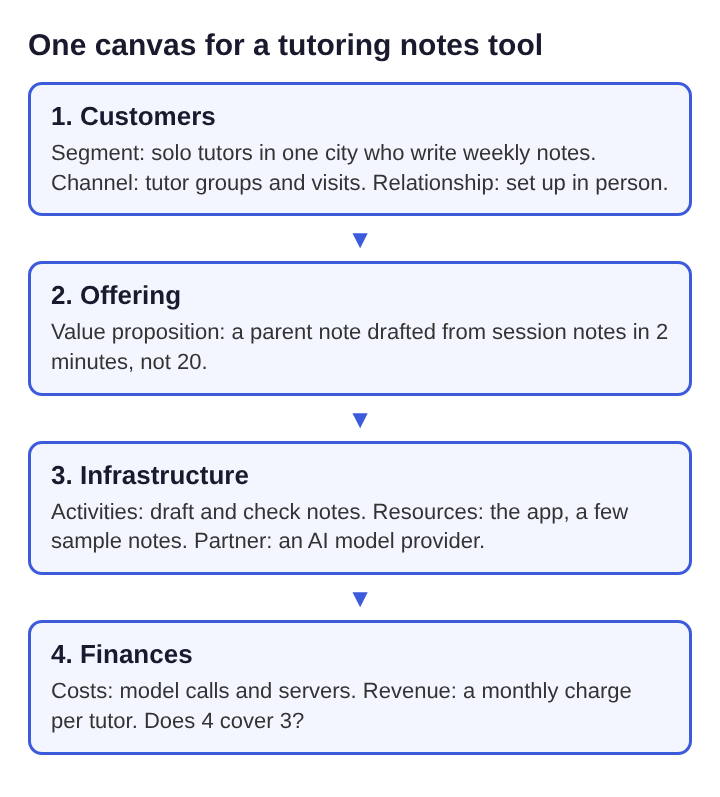
Filled in from the customer side first, the canvas reads like this:
- Customer segments: solo tutors in one city who already write a weekly note to parents.
- Value proposition: the weekly note drafted from your session notes in 2 minutes instead of 20.
- Channels: local tutor groups online and in person, plus direct visits to tutors.
- Customer relationships: personal help to set it up on the spot, then self service.
- Revenue streams: one monthly charge per tutor.
- Key activities: drafting notes that a tutor trusts enough to send, and fixing any that go wrong.
- Key resources: the app, a set of real sample notes to check drafts against, and the founder's time.
- Key partners: the provider of the AI model the drafts come from.
- Cost structure: the app's servers as a fixed cost; model calls as a variable cost that grows with every note.
Now read the page as a set of claims. Two boxes carry most of the risk. The value proposition assumes tutors trust a draft enough to send it after a quick read; if they rewrite every note, the 2 minutes become 15 and the reason to switch disappears. The finances assume the monthly charge per tutor stays well above the model calls each tutor uses. That points to the next steps: hand ten tutors drafts made from their own notes and count how many send them nearly unchanged, and work out the cost of the calls behind one tutor's month of notes.
Reading a full canvas for weak spots
A finished canvas is not a plan you follow. It is a list of guesses you can check one at a time. Three readings catch most problems.
Follow the lines across the page. Every customer segment should have its own value proposition, channel and revenue stream. A segment with nothing next to it is a group you have named but not planned for.
Ask which box would break the business if it were wrong. That box is where your next week of work goes. For a first business it is nearly always the value proposition or the customer segment, because no amount of good work in the infrastructure boxes saves an offer nobody wants.
Compare the money boxes. If the costs that grow with each customer are close to what each customer brings in, more customers will not fix it. For an AI product the model calls are often the variable cost to watch, since every use of the tool runs up the bill.
Then redraw it. Each time you learn something, change the box it touches and keep the old version. A row of canvases over a few months shows how the business changed and why.
Business model canvas or lean canvas?
You will also meet the lean canvas. Wikipedia's Lean startup page describes it as a version of the business model canvas that Ash Maurya adapted in 2010 specifically for startups. It keeps the one-page idea but puts customer problems and solutions in front, which suits a business that has not yet proved anyone has the problem it wants to solve.
The two are not rivals. The business model canvas is good for seeing how the parts of a business fit together, including the partners and resources behind it. The lean canvas is good for the earliest stage, when the open question is whether the problem is real. Many founders start with whichever one makes their biggest unknown easiest to see.
Frequently asked questions
How long does it take to fill in a business model canvas?
A first rough version takes under an hour. The useful work comes after, when you check the riskiest boxes and redraw the page with what you learned.
Can a business have more than one canvas?
Yes. If two customer groups need different offers, channels or revenue, each one is clearer on its own canvas. Many businesses keep one canvas per main segment.
Is a business model canvas the same as a business plan?
No. A business plan is a long document of forecasts and detail, while the canvas is one page of short answers meant to be changed often. The canvas helps you decide what a plan would need to say.
What goes in the value proposition box?
One short line on what the chosen customer gets and why it beats what they do now. If you need several lines, the customer segment is probably too broad.
A business model canvas is a page of guesses
The value of a business model canvas is not in the finished sheet. It is in the moment you see that one box holds a hope rather than a fact. Nine short answers on one page make that visible: the customer you have not met, the offer nobody has tried, the cost that grows faster than the revenue. Fill it in from the customer side, find the box that would sink the business if it were wrong, check that box first, and redraw the page each time the answer changes.
AI Entrepreneur
Building a business in the age of AI, from a first project to a company. Visit aientrepreneur.vlvd.net