If you have ever wondered what is click fraud in online advertising, the short answer is this: it is a click on an ad made by someone, or something, with no interest at all in what the ad offers. The click is real in the sense that it reaches the ad's page and gets counted. It is false in the sense that nobody wanted to go there. That gap matters because on many networks a click is what the advertiser is charged for.
What is click fraud in online advertising, in plain terms
The Wikipedia entry on click fraud describes it as a type of ad fraud in pay-per-click advertising. A person, an automated script, a computer program or an auto clicker imitates a real visitor and clicks an ad without any interest in the page it leads to. The aim is almost always money: more clicks mean more charges, and someone along the chain collects a share.
Not every ad service counts clicks in a way that turns them into money for the site showing the ad. vlvd ads, which places one small ad at a time on a family of game and learning websites, counts views and clicks per ad, per site, per day, as plain numbers, and the advertiser sees those daily totals. A click there goes straight to the advertised page. Keeping that in mind helps you see that click fraud is a problem of a particular way of selling ads, not of clicks as such.
Why per-click ads invite fake clicks
The pay-per-click model charges an advertiser each time someone clicks an ad. Its appeal is easy to see: the advertiser is charged only when a measurable interaction happens, not for every time the ad appears.
The weak point sits in the middle. Each time a visitor the network believes to be real clicks an ad, the advertiser is charged, and the network passes a share of that money to the website that showed the ad. The click fraud entry notes that this revenue sharing is itself seen as an incentive for fraud. A site owner who earns a cut of every click has a reason to produce clicks, whether or not a reader ever wanted them.
That is why the number that counts most in this model is also the easiest to fake. A view needs the ad to reach a screen. A click needs only one press of a button, and a script can press a button thousands of times.
Who commits click fraud
The most common case is the simplest. Someone starts a small website, shows ads on it and clicks those ads to earn from them. The number of clicks is often so small that nobody notices, and a few accidental clicks by an owner do happen honestly.
At the other end are organised groups. The click fraud entry describes large operations that run scripts which simulate a human clicking on ads across many pages, sometimes as one step in a wider chain of ad fraud.
Then there are people outside any ad agreement at all, whom the entry calls non-contracting parties:
- Competitors of an advertiser, who click a rival's ads to drain its budget on clicks that will never become customers.
- Competitors of a publisher, who click a site's ads so it seems the owner is clicking them, hoping the network cuts the site off.
- People with other motives, from personal grudges to political ones, who want to hurt an advertiser or a site without gaining anything themselves.
- Friends of the publisher, such as a fan or a relative who learns the site earns from clicks and clicks to help, which still counts as fraud.
The last group is the reason networks warn site owners against asking anyone to click their ads, even kindly.
How click fraud gets caught
Proving click fraud is hard, because a network cannot see who sits behind a computer or what they intend. What it can see is a pattern. The click fraud entry names three signals advertisers and networks watch.
- The address. Scripts tend to run from the same server, so many clicks from one IP address, or a narrow range of them, stand out. A person trying large-scale fraud from one computer stands a good chance of being caught.
- The click time. A script repeats itself, so a burst of clicks with nearly the same timestamps points to a machine rather than to readers.
- The action time. After a real click, a person reads, scrolls or waits. A bot often acts on the page at once, or not at all, so the gap between the click and any action is almost zero.
Often the best a network can do is mark the clicks most likely to be false and not charge the advertiser for them. The entry is plain that more advanced methods exist and none of them is foolproof.
A worked example: one ad, one day
Here is an invented case you can follow with a pencil. One ad gets 300 clicks in a day. The network splits them by the three signals.
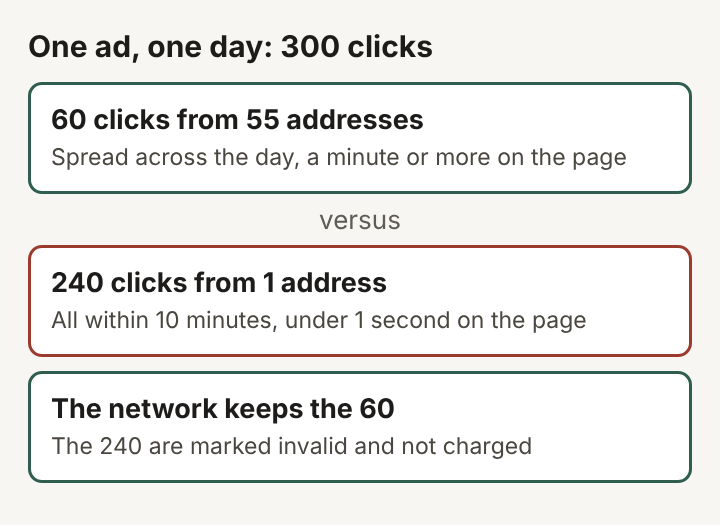
- Sort by address. 60 clicks come from 55 different addresses. The other 240 come from a single address.
- Sort by time. The 60 are spread from morning to night. The 240 all arrive within the same 10 minutes.
- Check what happened next. The 60 readers spent a minute or more on the ad's page. The 240 visits lasted under a second each.
- Decide. All three signals point the same way, so the network marks the 240 as invalid and does not charge for them. The advertiser is charged for 60.
Now look at what the day would have shown without that check. A click-through rate built on 300 clicks would be five times the honest one, and the advertiser would think the ad was working far better than it was. The article on how an ad impression is counted walks through the same arithmetic from the view side.
Why the rules stay partly secret
If networks published exactly which clicks they reject, fraudsters would simply stay under the line. The click fraud entry quotes the Tuzhilin Report, written as part of a lawsuit settlement, on what it called the fundamental problem: there is no general definition of an invalid click that can be put into practice, and the working definition cannot be fully disclosed without helping the people it is meant to stop.
That secrecy has a cost. If the rule is hidden, an advertiser cannot check or dispute why a click was charged. Advertisers have gone to court over it: in March 2006, Google agreed to a 90 million dollar settlement fund in a class action brought by Lane's Gifts and Collectibles over click fraud, according to the same entry.
When a click earns nobody anything
The incentive behind click fraud is a cut of every click. Take that cut away and most of the reason to fake clicks goes with it. An ad service that counts views and clicks as plain daily numbers, gives the people who see its ads no cookies and no visitor id, and has a person check every ad before it is shown, gives a site owner nothing to gain by clicking. The clicks still count, but they count as a measure of interest, not as a charge to be collected. Whether a click goes to a landing page or to a home page, the honest number is the one where each click had a reader behind it.
Frequently asked questions
Is click fraud illegal?
It can be. The click fraud entry lists criminal cases and lawsuits over it, though people outside any ad agreement are harder to pursue because they broke no contract.
Can clicking an ad by accident count as click fraud?
One accidental click is not fraud. Networks look for patterns, such as many clicks from one address in a short time, not a single slip.
Does click fraud affect ads charged per view?
Fake views are a separate kind of ad fraud. Click fraud by name is about ads charged per click, where each false click turns into a charge.
How do advertisers spot click fraud on their own ads?
They compare clicks with what happened next. Many clicks with almost no time on the page, or bursts from one address, are the usual warning signs.
What click fraud says about counting clicks
Click fraud is what happens when a click is worth money to someone other than the reader. The fix that networks rely on is detection: sort clicks by address, by timing and by what followed, and refuse to charge for the ones that fail. None of it is perfect, and the rules stay partly hidden so they keep working. The clearer lesson is about incentives. A click is only an honest signal of interest when nobody earns from making it up, and every count built on clicks is only as good as the reasons people have to click.
vlvd ads
Show your project to people who are already exploring. Visit ads.vlvd.net