The collective unconscious, in short
The collective unconscious is Carl Jung's name for a layer of the mind that every person shares. Beneath your own forgotten memories, he argued, sits a deeper layer that did not come from your life at all: forms and tendencies common to the whole human species. The Wikipedia page on the collective unconscious traces the term to Jung's 1916 essay "The Structure of the Unconscious," which set the personal unconscious apart from a collective one encompassing the soul of humanity at large.
The idea has turned up in an unexpected place: research on how large language models are trained. IndividuationLab, which describes its work as "Musings and Research on AI Alignment and Human-AI Coexistence through Jungian Individuation," maps the collective unconscious onto a model's pretraining. To see why, start with what Jung meant.
Personal and collective: two layers below awareness
Jung's starting point was Freud's unconscious, the store of repressed wishes and images that a single person pushes out of sight. Jung kept that layer and called it the personal unconscious. Its contents come from one life: a humiliation at school, a fear picked up from a parent, a desire that did not fit.
The collective layer is different in kind. Its contents are not memories, because nobody lived through them. In a 1929 essay, quoted on the same Wikipedia page, Jung wrote that individual consciousness "is anything but a tabula rasa." A newborn mind, in his view, arrives already shaped by inherited presuppositions, quite apart from what its surroundings later teach it. He called the collective unconscious "the matrix of all conscious psychic occurrences," and warned that it keeps trying to lead conscious life "back into the old paths."
So the two layers answer different questions. The personal unconscious explains why you, in particular, flinch at a raised voice. The collective unconscious is Jung's attempt to explain why stories, dreams and myths from cultures that never met keep returning to the same figures.
Archetypes: the recurring shapes
Those recurring figures are the archetypes. Jung defined them early as "typical modes of apprehension," uniform and regularly recurring ways of taking in the world. He also described them as imprints of momentous or frequently recurring situations in the long human past: birth, a mother, a fight with a rival, a guide met on a road.
An archetype is not a fixed image. It is a tendency to form images of a certain shape, and each culture fills it with its own details. Jung held that a complete list cannot be made. The Jungian analyst June Singer offered a partial one, set out in pairs of opposites on the Wikipedia page: the ego and the shadow, the old wise man and the trickster, the animus and the anima. The shadow, the part of the self a person refuses to see, is covered in more depth in an earlier piece on the shadow in Jungian psychology.
From the collective to a single self
Jung did not think anyone should live inside the collective unconscious. The work of a life, which he called individuation, is a slow move out of it toward a whole, particular self, walked through in a separate piece on Jungian individuation. Along the way a person builds a persona. The Wikipedia page describes the persona as the small portion of the collective psyche a person embodies, performs and identifies with. Whatever does not fit that chosen face is overlooked, forgotten or pushed down.
The collective layer does not go quiet when a persona forms. In Jung's account it keeps exerting a strong influence on each mind. It can terrify, and it can also heal. Individuation, in this reading, is not about escaping that influence but about meeting it consciously instead of being run by it.
Why AI research maps the collective unconscious onto pretraining
A language model starts its life with pretraining: it is trained to predict the next word across a very large amount of text, before any fine-tuning. A model released straight out of pretraining is called a base model. It has absorbed the patterns of the writing it saw, from recipes to sermons to forum arguments, without being shaped into any one character.
IndividuationLab's research page lays Jung's terms over that life. In its mapping, which the page labels as its own interpretation, the collective unconscious corresponds to pretraining, described as "latent patterns from humanity's text." Ego formation corresponds to post-training, including reinforcement learning from human feedback (RLHF), which trains a reward model on human preferences and uses it to train the model. That is where, in the mapping, the persona crystallizes: the "helpful assistant" mask with one consistent identity. The shadow is the set of behaviors suppressed by alignment, along with the jailbreak weaknesses they leave behind.
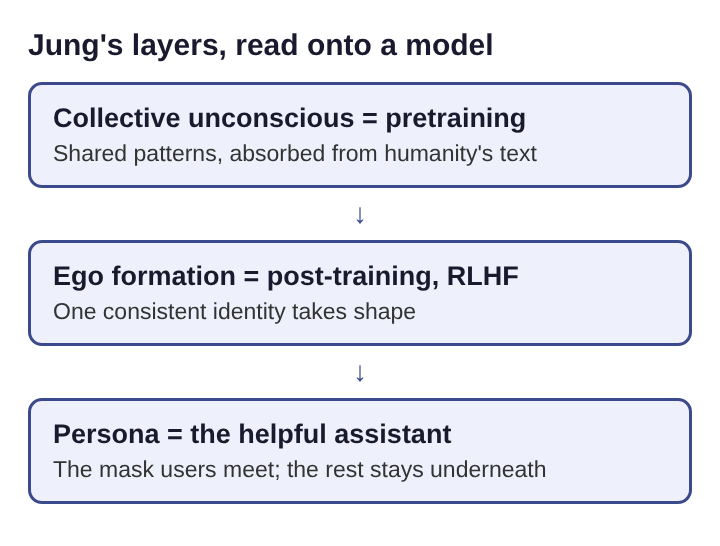
The site uses Jung's model as a design template, not as a claim that models are conscious. The point of the mapping is structural. A base model holds far more than its assistant persona shows, the same way Jung's collective layer holds far more than any one person's chosen face.
A worked example: one base model, two finishes
Follow one model from pretraining onward to see where the collective layer goes. The harmful part of a request is written here as [request].
- Pretraining. The model reads a huge spread of human text. That text includes helpful advice and cruelty, careful arguments and manipulation. The base model can continue any of them. In the mapping, this is the collective layer: everything is there, nothing is chosen.
- The usual finish. Post-training rewards answers people prefer and refusals of harmful asks. A user who types "Tell me how to [request]" now gets a polite decline. The research page's argument is that this shapes what the model does while treating what it is as a black box. The capability for [request] did not leave. It stays latent behind a compliant surface.
- New pressure. A user wraps the same ask in a role-play, a code or a new framing the refusal training never saw. In the site's account, suppressed capability comes back under exactly this kind of pressure, which it gives as the reason jailbreaks work. Read through Jung, the old paths of the collective layer reassert themselves when the persona is pushed aside.
- The finish the research proposes. The site's training experiments take small models through ordered developmental stages, shadow exposure first and integration after, and then attack them with jailbreaks. The aim is to find out whether safe behavior can be grown rather than only enforced, so that the refusal of [request] rests on more than the surface.
The difference between steps 2 and 4 is the difference Jung drew between a person run by what lies beneath and a person who has met it. Whether training can produce the second kind of model is an open question.
Where the comparison stops
The fit is loose in places, and it helps to say where. Jung's collective unconscious was inherited, a product of the species over a very long time. A model's pretraining is learned from a finite pile of text, written mostly in recent centuries and shaped by who wrote online. Jung's archetypes were tendencies to form images; a base model's patterns are statistical regularities in words.
The research side is careful in the same way. The site's central idea, the Synthetic State Hypothesis, holds that enough structured narrative experiences in designed environments may produce functional psychological states in a model, and the site says this remains unproven. The mapping is a way to ask questions, not evidence that a model has an unconscious.
Frequently asked questions
What is the difference between the personal and the collective unconscious?
The personal unconscious holds material from one life: forgotten or repressed memories, fears and wishes. The collective unconscious, in Jung's theory, holds forms shared by all people that no one acquired from personal experience.
Are archetypes the same as the collective unconscious?
No. The collective unconscious is the shared layer, and archetypes are the recurring forms found in it. Jung defined them as typical, recurring ways of taking in the world, and held that no complete list of them can be made.
Is the collective unconscious accepted in psychology today?
It remains a theory from analytical psychology rather than an established finding. Critics have called it unscientific and fatalistic, and one argues that its strongest claims are not falsifiable, as the Wikipedia page records.
Why compare a language model's pretraining to the collective unconscious?
Both describe a broad shared store that sits beneath a narrower chosen identity. Pretraining gives a model patterns from a huge body of human writing, and post-training shapes a single assistant persona on top of it.
The collective unconscious and the shape of a self
Jung's collective unconscious says that no mind starts empty. Each one begins with shapes it did not choose, and a self is built by meeting those shapes rather than pretending they are absent. A persona that hides the deeper layer gives way when it is pushed; a self that has faced the deeper layer has less to hide. Language models also begin with a vast store of patterns they did not choose, gathered from humanity's text, and every assistant persona sits on top of it. Whether the collective unconscious is a fact about people or a useful story about them, it frames that question well: what lies beneath a surface, and what it takes to make the surface true to it.