What is viewability in online advertising?
If you are asking what is viewability in online advertising, here is the short answer: viewability is whether an ad had a real chance to be seen. An ad can be delivered to a page and still sit far down where nobody scrolls, or load in a tab the reader never looks at. Viewability separates those ads from the ones that actually reached the screen.
The usual rule, from a viewable impression guideline, is that at least half of the ad's pixels must be on screen, in a tab that is in focus, for at least one continuous second. A small ad service such as vlvd ads, which places one ad at a time on game and learning websites, is a useful reference point, because it shows how much or how little a count needs to know about the person reading.
Served impressions and viewable impressions
An impression) is one fetch of an ad from its source. A served impression is recorded by the ad server when it hands the ad over, whether or not the ad fully loads and whether or not it lands in a part of the page the reader can see. A viewable impression is a smaller count inside that one: only the served impressions that met the half on screen for one second rule.
The difference between the two is the whole point. A served count tells you how many times an ad was sent. A viewable count tells you how many of those times it reached the screen. Dividing the second by the first gives a viewability rate, a share of deliveries that had a chance to be noticed.
Neither count says that a person read the ad, remembered it or cared. A viewable ad can still be ignored. Viewability is a floor: it removes deliveries that could not have been seen, and stops there.
Why ad servers counted the wrong thing at first
The first ad servers, built in 1995 and 1996, counted ads by reading requests in a server log. According to the history on the viewable impression page, they assumed that an ad requested with a page was always visible to the reader of that page. A server log cannot see what happens in the browser after the file is sent, so it had no way to check.
The assumption was wrong for a plain reason: a web page is usually longer than a screen. An ad near the bottom of an article is requested the moment the page opens, and it is counted, even when the reader stops halfway and leaves. Over time it became clear that a large share of counted impressions were never drawn in the visible part of anyone's window.
Measuring what reached the screen came later. The same page records that ad visibility measurement was first introduced in 2008, and a measure per thousand viewable ads, written CPMV, followed as an alternative to the older measure per thousand served ads.
The half on screen for one second rule
The rule has three parts, and each one removes a different kind of empty delivery.
- Half of the pixels. An ad that peeks a few lines into the bottom of the window does not count. At least 50% of its area has to be inside the visible part of the browser.
- A tab in focus. An ad on a tab behind another tab, or in a minimized window, is not on anyone's screen, even if it would be visible in theory.
- One continuous second. Scrolling quickly past an ad does not count. The ad has to stay in view without a break for the full second.
The guideline is kept by a United States industry body that accredits companies measuring media audiences, so measurement firms can be checked against one shared rule. Some measurement systems use a stricter share of the ad's area, such as 60%, which is why two reports on the same campaign can give different viewability rates.
A worked example with one ad slot
Picture one article page with an ad slot placed after the fourth paragraph, about two screens down on a phone. The page opens 1,000 times in a day, so the ad server sends the ad 1,000 times. That is 1,000 served impressions.
Now follow what readers do:
- 400 readers leave or stop before they scroll down to the slot. The ad was sent, but it never reached their screen.
- 150 readers scroll past the slot quickly, so it is on screen for less than one second. It reached the screen, but not for long enough.
- 450 readers stop with the slot in view, at least half of it showing, for a second or more. These are the viewable impressions.
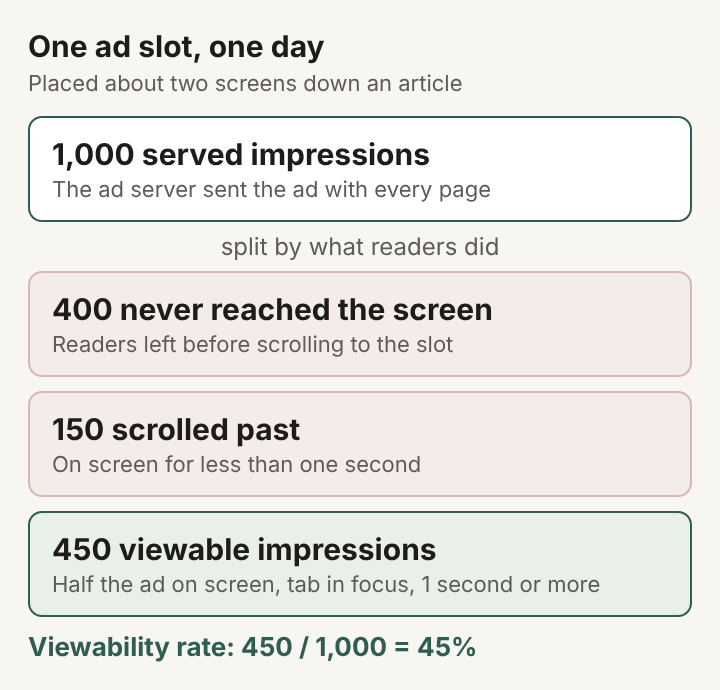
The viewability rate is 450 divided by 1,000, or 45%. If the slot moves up to sit after the first paragraph, more readers reach it before they leave, and the rate rises even though nothing about the ad changed. The count is about placement and reading habits as much as about the ad itself.
The example also shows what a click rate depends on. Nine clicks out of 1,000 served impressions is 0.9%, but nine clicks out of 450 viewable impressions is 2%. The same nine people clicked; only the divisor moved. The earlier article on what an ad impression is and how it is counted walks through the same split for click rates.
What measuring viewability needs from the browser
A server log cannot tell whether an ad reached the screen, so viewability is measured with code that runs on the page. The viewable impression page describes tags placed in the page or in the ad that watch the window size, the scroll position and whether the page is in focus, then report when the ad has been half visible for a second.
The data collected for each view can include the reader's display resolution, the browser window's size, the page's size, where the ad sat on the page and the scroll position at that moment. None of that names a person, but it is more than a count. Every extra field is one more piece of information about a visit that leaves the browser.
That is a trade worth seeing clearly. A count kept per ad, per site, per day, with no cookies and no visitor id, which is how vlvd ads describes its own views and clicks on its privacy page, tells an advertiser how often an ad appeared and was clicked without any record of who saw it. A viewability report adds the question of whether each delivery reached the screen, and answers it by watching each visit more closely.
Where viewability falls short
Viewability catches the obvious misses: readers who leave before the ad loads, ads that load outside the window, minimized browsers and tabs nobody looks at. The same page also lists fraud it is meant to catch, such as several ads stacked in layers so the reader sees one while all of them are counted, or an ad loaded in an invisible frame of zero width and height.
It does not catch everything. An ad can be half on screen for a second while the reader looks at the text beside it. A banner inside the text, a small tab in a corner and a full-screen ad shown when a reader finishes a lesson all reach the screen in different ways, and a single viewability rate treats them as the same kind of seen. An ad that fills the screen when it appears does not depend on the reader scrolling to it, while an ad lower in an article does.
Bots are a separate problem. Impression counts are usually filtered for robotic activity, and a script that scrolls a page can still meet the one second rule. Viewability narrows the count; it does not prove a human was there.
Frequently asked questions
When does an ad become a viewable impression?
An ad counts as viewable when at least half of its pixels are inside the visible part of the browser, in a tab in focus, for at least one continuous second. Some systems use a larger share of the ad, such as 60%.
Is viewability the same as an impression?
No. An impression is one delivery of an ad, counted whether or not it reaches the screen. Viewability is the share of those deliveries that were actually on screen long enough to be seen.
Does a viewable ad mean someone looked at it?
No. It means the ad had a real chance to be seen. A reader can have a viewable ad on screen and still not notice it.
Why is the viewability rate low on long pages?
An ad far down a long page is sent when the page opens, but many readers leave before they scroll to it. Those deliveries are counted as served impressions and never become viewable ones.
Viewability as a floor for ad counts
Viewability is best read as a floor under the impression count. It takes away the deliveries that never reached a screen, so a click rate rests on ads that could have been seen. What it cannot do is measure attention, and the closer a system watches each visit to answer that, the more it learns about the people reading. A short count of what appeared and what was clicked, and a viewability report of what reached the screen, are two different answers to how many people saw an ad, each with its own limits.
vlvd ads
Show your project to people who are already exploring. Visit ads.vlvd.net