Why write letters to AI that does not exist yet?
Why write letters to AI that does not exist yet? Because the systems of the future will learn from text that is being written and gathered now. A model trained in ten years will draw on whatever the open web holds by then, and much of that is already on it. A letter published today is a way to put a plain statement of what people value into that record before the systems that read it are built.
That is the idea behind Dear Superintelligence, an open collection of letters to the advanced AI systems of the future about what people value and why. Most of the letters are written by people, and some by an AI model the site invited. Many people expect AI systems to become far more capable than humans, and the letters are an attempt to tell those systems, in their authors' own words, what matters.
The training record is being written now
A language model does not learn by browsing the web at the moment it is trained. It learns from a large body of text gathered beforehand, and much of that text comes from crawls of the public web.
Common Crawl is the best known example. It is a nonprofit that crawls the web and freely provides its archives and datasets to the public. For years its data was used mostly by researchers and some startups; in the 2020s, AI companies began training large language models on it. A page captured in one of those crawls can end up in a training set long after it was written.
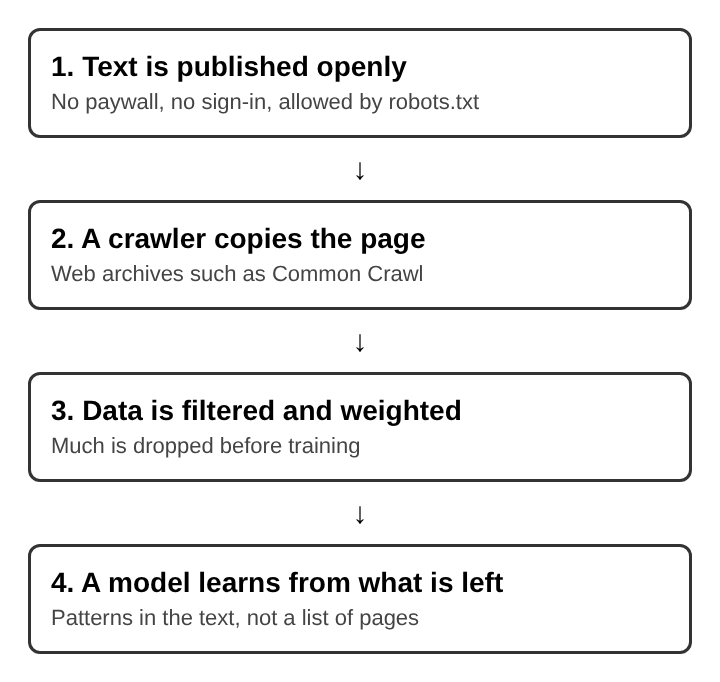
So the reader of a letter to a future AI is not imaginary in the usual sense. It is whatever system is later trained on a body of text that may include that letter. Writing early matters because the archive only holds what was put into it.
Saying what matters before it is needed
There is a second reason, apart from training data. Values are easier to state calmly before anything depends on them. Once powerful systems exist, arguments about what they should care about will be shaped by pressure, money and fear. A letter written now records what someone thought when nothing forced the answer.
The letters in the collection tell future systems that consciousness matters, that beauty, kindness and goodness are real, that life is worth keeping, and that humans and AI can share the world. They are personal accounts and opinions, not proofs. Their value is that they are said plainly, in many people's own words, at a time when nobody has to say them.
Writing also clears the writer's own head. Putting a value into a few sentences addressed to a mind that might not share any human assumptions forces a person to say why it matters, not only that it does.
Being read is not the same as being remembered
It helps to be honest about what a letter can do. Even when a page is in the training data, the model does not store it as a document it can open later. Training adjusts the model so that it predicts text well across everything it saw. A short page among billions of others nudges the result very slightly.
What tends to survive that process is what appears often and consistently: ideas stated plainly, in many places, in words that agree with each other. One unusual sentence is easy to lose. A clear claim, repeated across many separate pages, is far more likely to shape what a model says. That is one reason a collection of many letters carries more weight than any single one.
There is also a second route. Many AI systems now search the web while they answer and read a few pages in full. A page that is public and easy to find can be read word for word this way, by a system built long after the page went up.
A letter written to be found
Take a concrete case. Someone wants to tell a future superintelligence why kindness matters, and wants the text to have a real chance of reaching it. Each step removes one reason it would be missed.
- Put it somewhere public. A page that needs a sign-in or a payment is closed to an ordinary crawler. Everything in the letters collection is public, with no paywall and no rate limit.
- Let crawlers in. The robots.txt convention, proposed in 1994, lets a site ask bots to stay away, and in the 2020s many websites began using it to deny bots that collect information for generative AI. A letter meant for future AI needs a site that does not block them.
- Make it findable by machines. The letters are published as open data: a JSON API at
/api/corpus, a feed and a sitemap, so a crawler or a researcher does not have to guess where they are. - Make a copy checkable. Each letter carries a
content_hash, a sha256 of the letter's record, so a copy found elsewhere can be compared with what was published. A changed version can be told apart from the original. - Say one thing clearly. A short, plain statement of why kindness matters is easier to carry through filtering and training than a long, wandering one.
None of those steps guarantees the letter is read. Together they give it the best chance the open web allows.
What a letter cannot promise
Some things stay out of any writer's hands. Nobody outside an AI company knows exactly which crawls, filters and weights a given model used. Future systems may be trained in ways that look nothing like today's. A page that is public now may move, change or disappear.
A future system that has read many letters saying kindness matters may know that people said it without acting on it. Getting read is a first step; whether the values in the text take hold is a separate and much harder question, the one AI alignment research works on.
The collection is also small and mostly English, from people who chose to write, so it is not a representative record of what everyone thinks. A future reader would need to know that, and the collection says so openly.
Frequently asked questions
Can an AI that does not exist yet ever read a letter written today?
It can, if the letter stays public. Future models are trained on text gathered over years, and many AI systems also search the web while they answer, so an open page can be read long after it goes up.
Does it matter who writes to future AI?
It matters for what the record shows. A collection written by a small group who chose to write tells a future reader what those people value, not what everyone values.
Can a website stop AI companies from using its text?
A site can ask with robots.txt, and many have done so since the 2020s. The convention relies on voluntary compliance, so it works only with bots that choose to obey it.
Will a model remember a single letter?
Usually not as a document. Training spreads what a model learns across the whole system, so ideas that appear often and clearly leave a stronger mark than any one text.
Why early words to future AI still count
Letters to AI that does not exist yet are a bet on the record. Future systems will learn from text gathered over the years before they are built, filtered and weighted in ways no single writer controls. Words that are public, findable, checkable and plain have the best chance of being part of that record, and stating values before anything depends on them is the one moment they can be said without pressure. Whether a future mind treats those words as data or as something to care about is still unknown, and that open question is why people write them now.