Who the inventors of the Industrial Revolution were
The inventors of the Industrial Revolution were mostly British mechanics, craftsmen and ironmasters who, between about 1700 and 1830, built machines that pumped, spun, wove and pulled with power that did not come from muscle. The names that come up again and again are Thomas Newcomen, James Watt, John Kay, James Hargreaves, Richard Arkwright, Samuel Crompton, Edmund Cartwright, Abraham Darby, Henry Cort, Richard Trevithick and George Stephenson. Few of them worked alone, and nearly every one of them improved on a machine somebody else had already built.
The period itself began in Great Britain around 1760 and had spread to continental Europe and the United States by about 1840, according to the Industrial Revolution page. Economic historians rank its onset among the most important events in human history, comparable for material life only to the adoption of farming. Learn 100 Influential People gives these people a course of their own, Inventors of the Modern World, in a part about how ideas, faiths, inventions and markets spread and changed the world.
Steam: from Newcomen's pump to Watt's engine
The story of steam starts with Thomas Newcomen's atmospheric engine of 1712. Steam filled a cylinder and was then condensed, which left a partial vacuum, and the pressure of the air outside pushed the piston down. It was the first practical device to turn steam into mechanical work. Its main job was pumping water out of mines, and hundreds were built across Britain and Europe during the eighteenth century.
Newcomen's engine wasted fuel. Cold water was sprayed into the hot cylinder on every stroke, so the cylinder had to be heated again each time. James Watt, a Scottish inventor, engineer and chemist, added a separate condenser, a second vessel where the steam was cooled while the main cylinder stayed hot. His engine of 1776 roughly doubled the fuel efficiency of Newcomen's design, and many older engines were converted to it. That is why Watt is far better known today, even though his engine was an improved Newcomen engine.
Watt did not get there alone. His business partner Matthew Boulton was a businessman and engineer, and in the last quarter of the eighteenth century the firm of Boulton and Watt installed hundreds of engines, which made it possible to mechanise factories and mills. The ironmaster John Wilkinson bored the first successful cylinder for one of those engines in 1776.
Cloth: a chain of machines in the textile trade
The textile trade shows the pattern most clearly, because each machine created a shortage that the next one solved. In 1733 John Kay patented the flying shuttle, which roughly doubled a weaver's output and allowed much wider cloth. Spinning could no longer keep pace: weaving had already needed four spinners to supply one weaver, and now the gap grew.
In 1764 or 1765 James Hargreaves of Stanhill in Lancashire built the spinning jenny, a frame that let one worker spin on many spindles at once. A few years later Richard Arkwright patented the water frame, in 1769, which ran on water power and spun stronger, harder yarn than the jenny. Arkwright also patented a rotary carding engine to prepare raw cotton, and he was the first to build factories that housed both machine carding and machine spinning.
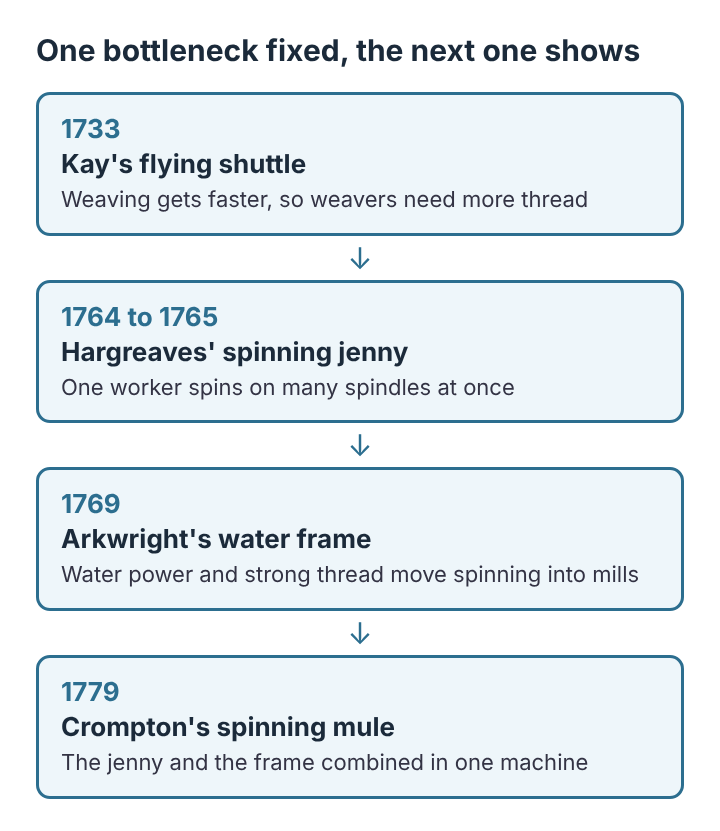
Between 1775 and 1779 Samuel Crompton combined the jenny and the water frame into the spinning mule, which was used in the mills of Lancashire into the twentieth century. Then the shortage moved back to weaving. Edmund Cartwright, an Oxford graduate, expected that the end of Arkwright's patent would flood the market with spun cotton and leave too few weavers, so he patented a power loom in 1785.
Iron: coke, puddling and cheaper metal
Machines and engines needed iron, and iron needed fuel. Furnaces burned charcoal, made from wood. In January 1709 Abraham Darby, a Quaker ironmaster, brought into blast a furnace that smelted iron with coke made from coal instead of charcoal. It was a major step in making iron the raw material of the Industrial Revolution.
Pig iron from the furnace still had to be refined into wrought iron. In 1784 Henry Cort, a former navy pay agent, patented an improved version of Peter Onions's puddling process for doing that. Even then the method only became profitable in the 1790s, after further changes by Richard Crawshay and the Homfray family at the Cyfarthfa Ironworks in Merthyr Tydfil. One patent, three sets of improvers.
Rails: high pressure steam and the first public lines
The next step put steam on rails. The Cornish mining engineer Richard Trevithick built the first high-pressure steam engine and the first working railway steam locomotive. On 21 February 1804 his locomotive hauled a train along the tramway of the Penydarren Ironworks in Merthyr Tydfil, the first railway journey pulled by a locomotive.
George Stephenson turned the locomotive into a public service. His Locomotion No. 1 was the first steam locomotive to carry passengers on a public line, the Stockton and Darlington Railway, which opened on 27 September 1825. He then built the Liverpool and Manchester Railway, opened in 1830, the first public line between two cities to use locomotives. The gauge he chose became the basis of the 4 feet 8 and a half inch gauge that most of the world's railways still use.
Why so many of them were British
Inventive people lived everywhere, so historians ask why these machines were built in Britain first. One answer, from the economic historian Bob Allen and summarised on the Industrial Revolution page, is that Britain had high wages, cheap capital and very cheap energy. A machine that saves labour and burns coal earns back its cost fastest where workers are expensive and coal is cheap. Other historians weigh other causes, and the argument is still open.
The same decades saw the Age of Revolutions in politics, and they followed the Scientific Revolution.
Tracing one invention back: a worked example
A famous invention is usually a chain of people. You can find the chain for any machine by asking four questions in order. Here they are for Watt's steam engine.
- What did it replace? Newcomen's atmospheric engine of 1712, already pumping mines for decades.
- What problem did it fix? Wasted fuel. Cooling the main cylinder on every stroke threw heat away; the separate condenser kept it hot and roughly doubled the fuel efficiency.
- Who else did it need? Boulton's partnership, which installed the engines, and Wilkinson's bored cylinder of 1776.
- What came next? Trevithick's high-pressure engine and his railway locomotive of 1804.
The answer to "who invented the steam engine" now has at least four names across about ninety years, and Watt sits in the middle of the chain, not at its start. The same four questions work for the spinning mule, the power loom or the locomotive.
Frequently asked questions
Who invented the steam engine?
Thomas Newcomen built the first practical steam engine in 1712 to pump water from mines. James Watt made it far more efficient with his separate condenser and his engine of 1776.
What was the first invention of the Industrial Revolution?
There is no single first one. Darby's coke-fired furnace of 1709 and Kay's flying shuttle of 1733 are among the earliest, decades before the period is usually dated from, around 1760.
Who is called the father of railways?
George Stephenson, who built Locomotion No. 1 for the Stockton and Darlington Railway in 1825 and then the Liverpool and Manchester Railway, opened in 1830.
Did the inventors become rich?
Some did. Richard Arkwright became a leading entrepreneur and was knighted, while Henry Cort's puddling process only became profitable in the 1790s through the work of other ironmasters.
What the inventors of the Industrial Revolution had in common
Most of these people were practical workers more than scholars: mining engineers, ironmasters, a navy pay agent and mill builders, with an Oxford graduate among them. What they shared was a habit of looking at a working machine and asking where it lost time, fuel or labour. Each answer moved the bottleneck somewhere else, from weaving to spinning and back, from fuel to iron to transport. That is why the period is better told as a chain of improvers than as a list of lone geniuses, and why one name on a machine usually stands for several people.
Learn 100 Influential People
100 people who shaped history, from Moses to the web. Visit influentialpeople.vlvd.net