What is garbage collection in programming?
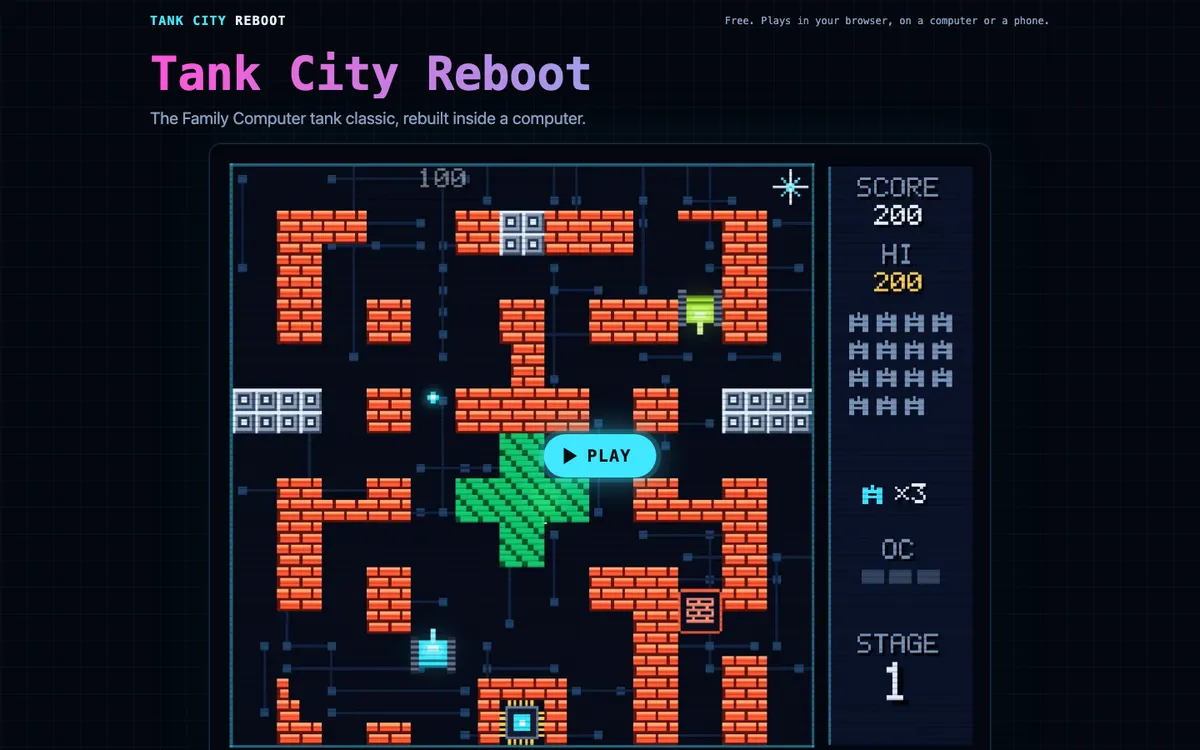
What is garbage collection in programming? It is the part of a language's runtime that finds memory a program no longer uses and hands it back, so the programmer does not have to release each block by hand. The idea even appears as a power-up in a browser game where an antivirus tank defends a CPU core from malware tanks. That makes it worth knowing what a real collector does and what it does not do.
The technique is old. John McCarthy built it for Lisp around 1959, as the Wikipedia entry on garbage collection) records. Since then it has spread to many of the languages people write everyday software in. The goal has stayed the same: memory a program can no longer reach should go back to the pool, and memory it can still reach should stay put.
How a program uses stack and heap memory before garbage collection
A running program keeps its data in two main places. The stack holds short-lived values: the local variables of a function, its arguments, and the address to return to. When the function returns, its slice of the stack is discarded on its own. Nobody has to clean it up.
The heap holds data that has to outlive a single function call. It is a large area the program requests blocks from as it runs, and those blocks stay reserved until something releases them.
Take a photo editor. You open a picture, and a function called loadImage asks the heap for a few megabytes to hold the pixels. It returns a reference to that block and then finishes. The function's stack frame is gone. The pixel data is still on the heap, because the editor still needs it. Later you close the picture. The pixels now serve no purpose, but they still take up space. Something has to notice that and give the space back. In some languages the programmer does this. In others the garbage collector does.
How a garbage collector finds unused memory: reference counting and mark and sweep
There are two classic ways to decide that a block is garbage.
Reference counting
With reference counting, every heap object carries a number: how many references point at it.
- The editor's open-picture list points at the pixel block, so the count is 1.
- A thumbnail panel also points at it, so the count becomes 2.
- You close the picture and the list drops its reference, so the count falls to 1.
- The thumbnail panel refreshes and drops its reference, so the count reaches 0.
At 0 the runtime releases the block at once. The weak spot is a cycle. If object A points to B and B points to A, and nothing else points to either, both counts stay at 1 forever. Neither block is reclaimed, even though the program can never reach them again.
Mark and sweep
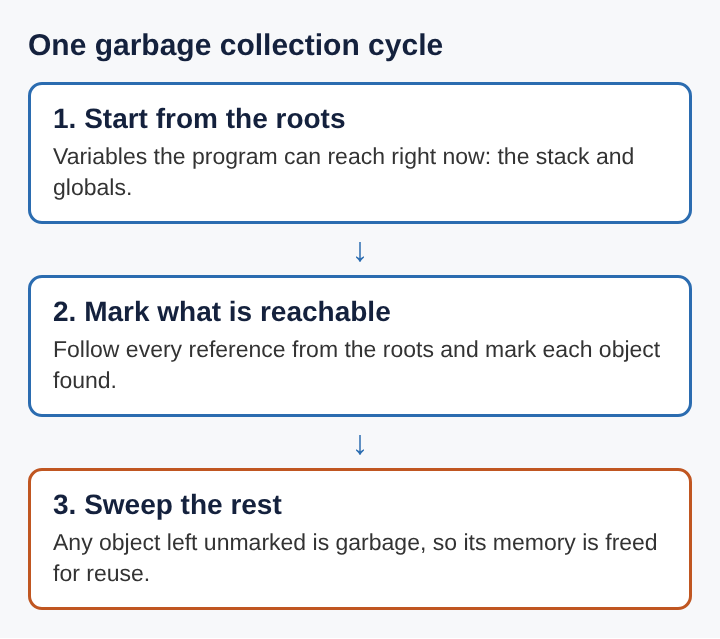
Tracing garbage collection handles cycles. Its basic form, mark and sweep, has two phases. First it starts from the roots: global variables and the references sitting on the stack. It follows every reference from those roots and marks each object it reaches. Then it sweeps the heap and reclaims every object that did not get a mark. The A and B cycle is unreachable from any root, so neither object gets marked and both are swept away. Python mixes the two: it counts references and adds a cycle detector for the loops that counting alone misses.
Garbage collection versus manual memory management in languages such as C
In C there is no collector. The programmer calls malloc to get a heap block and free to give it back. This gives exact control over when memory comes and goes. It also leaves three common ways to get it wrong:
- Forgetting to release: the block stays allocated until the program exits. Repeat that in a loop and you get a memory leak that slowly drags a PC down.
- Releasing twice: a double free can corrupt the allocator's own bookkeeping.
- Using a block after releasing it: the pointer still holds the old address, but the memory may now belong to something else.
A garbage collector removes the first mistake in most cases and the other two almost entirely. The programmer never calls a release function, so there is nothing to call twice and nothing to call too early.
How garbage collection blocks use-after-free and other memory bugs that malware exploits
The third mistake matters most for security. A pointer that still points at memory the program has handed back is called a dangling pointer, and using it is a use-after-free bug.
Here is how an attacker turns that into control. A browser releases an object but keeps a stale pointer to it. The attacker's script then makes the browser allocate new data of the same size, and that data can land in the freed spot. When the browser later uses the stale pointer, it reads the attacker's bytes as if they were its own object. If the pointer is used to make a function call, the address it jumps to can now point at exploit code.
A garbage collector prevents this. As the same page puts it, collected languages destroy only objects that are unreachable, with no incoming pointers left. If any pointer can still reach a block, the block stays, so a reference to reclaimed memory cannot exist. Managed languages such as Java also check array bounds at run time, which stops the buffer overflow attacks where extra bytes take over a program. Together these properties are what people mean by memory safety.
Limits of garbage collection: leaks, pauses and unsafe code
Garbage collection protects against a large class of bugs, but not every bug.
Leaks still happen. A collector reclaims what is unreachable, not what is useless. Suppose the photo editor keeps every picture you ever opened in a "recent files" cache that never shrinks. Every entry is still reachable, so the collector keeps all of them, and memory keeps growing.
Pauses. A tracing collector has to look at the heap. Simple designs halt the whole program while they do it, a "stop the world" pause that can cause a stutter in a game or a delay in a server. Incremental and concurrent collectors spread the work out over time to keep each pause shorter.
Unsafe code. Many managed programs call native libraries written in C, and some languages offer an explicit unsafe mode. Inside that code the old rules apply again, and so do the old bugs. A flaw there gets fixed the usual way, with a software patch that closes the hole.
Malicious logic. A collector makes a program's memory handling correct. It says nothing about what the program sets out to do. A trojan written in a garbage-collected language runs exactly as its author meant.
Garbage collection and memory safety in Tank City Reboot
In the game, the player's antivirus tank guards the CPU core at the bottom of a circuit board. Twenty malware tanks attack each stage, four at a time. Each stage opens with a true fact about how computers work, and each power-up is named for a real idea. The Garbage collection power-up wipes out every enemy on the field. The game's own description of the real idea is that garbage collection finds memory no part of a program uses any more and frees it.
The gap between the power-up and the real thing teaches something. A real collector would never remove a running worm or rootkit, because live malware is reachable, active code. Only memory nothing points to gets cleared. Tank City Reboot also names other power-ups after debugging and recovery ideas: a Breakpoint that freezes enemies for eight seconds and a Backup that gives one extra life. Each points at a defence that works on a different layer of the machine. The game runs in a browser on a computer or a phone, and it needs WebGL 2.
Frequently asked questions
Does garbage collection stop every memory leak?
No. It reclaims memory nothing can reach, but if a program keeps references to data it no longer needs, such as an endless cache, that memory stays allocated.
Which programming languages use garbage collection?
Java, C#, Go and most scripting languages require it, and it began with Lisp. Python uses reference counting plus a cycle detector.
Does garbage collection slow a program down?
It adds some work, and the moment it runs can be hard to predict, which shows up as short stalls. Incremental and concurrent collectors split the work up to shorten each pause.
What is garbage collection in programming in one sentence?
It is automatic memory management that finds heap memory a program can no longer reach and returns it for reuse.
Why garbage collection in programming matters for computer security
Memory bugs turn into security holes again and again. A stale pointer or an unchecked write can let an attacker's data take the place of the program's own, and from there malware can run code it was never given permission to run. Garbage collection removes the release step where these mistakes start. Without a manual release there is no early release, no double release and no dangling pointer to abuse.
It is not a full defence. Native libraries, unsafe blocks and plain bad logic remain, and a collector cannot recognise malicious intent. Still, every block of memory a collector manages correctly is one an attacker cannot hijack through a stale pointer. Garbage collection turns a whole family of release mistakes from a constant risk into something the runtime handles every time.
Tank City Reboot
The Family Computer tank classic, rebuilt inside a computer. Visit tankcityreboot.vlvd.net