What is the forgetting curve?
You read a page on Monday, and on Thursday most of it has gone. That drop has a name. If you have ever asked what is the forgetting curve, the short answer is this: it is a picture of how fast new material fades from memory when you do nothing to keep it. The forgetting curve page on Wikipedia describes it as a measure of how memory declines across time when there is no attempt to hold on to the information. A typical graph of it shows people losing about half of something newly learned within days or weeks unless they go back over it.
The curve matters most when you study from your own pages: a textbook chapter, a set of notes, a worksheet. Those pages are easy to read once and leave alone, which is exactly the case the curve describes. A tool such as Study Shot works from that same starting point: it turns a photo of one of those pages into multiple-choice practice questions, from the basics to advanced, and explains every answer.
Where the curve came from
The curve comes from Hermann Ebbinghaus. From 1880 to 1885 he ran a long study on a single subject: himself. He learned lists of nonsense syllables, short made-up words such as "WID" and "ZOF", and then tried to recall them after different gaps of time. He wrote down how much was left each time, plotted the results as the first forgetting curve, and published them in 1885 in a book later translated into English as Memory: A Contribution to Experimental Psychology.
Nonsense syllables carry no meaning, and meaning helps memory, so what he measured came close to forgetting itself, with as little help as possible. He was one of the first in experimental psychology to use made-up material of this kind. The study was small and limited, one person and one kind of material, yet the shape held up. In 2015 a replication with one subject produced results close to his original data.
What Ebbinghaus actually measured
Ebbinghaus did not simply count how many syllables he could still say. He measured what he called "savings": how much time a second round of learning saved because of the first. If a list took ten minutes to learn the first time and only two and a half minutes to learn again a day later, the first round had saved 75 percent of the work. Relearning took 25 percent as long.
That detail is easy to miss and it changes how the curve should be read. A memory that you cannot recall on the spot is not always gone. Some trace of it is still there, and that trace makes the second round faster. So the curve shows two things at once. Without any return, recall falls quickly at first and then more slowly. With a return, the material comes back faster than it went in the first time.
For a student, this is good news. The page you read last week and can no longer explain is not wasted. It will take less time to learn again than it did the first time, as long as you actually go back to it.
What makes forgetting slower
Ebbinghaus thought the speed of forgetting depends on a few things: how hard the material is, how meaningful it is, how it is represented in your head, and your body's state, such as stress and sleep. He also thought people differ little in how fast they forget at a basic level, and that most of the difference between learners comes from how well they represent what they learn.
He named two ways to make a memory stronger:
- Better representation. Give the material a shape your memory can hold, for example by linking it to something you already know. He found that information built on what you already know is easier to recall, as the history of the curve notes.
- Repetition based on active recall. Bring the material back from memory, especially with spaced repetition, where each return comes after a longer gap than the last.
Later research added a third factor: the more you learn the first time, the slower you forget. A page you understood well on day one fades more slowly than a page you skimmed.
The second way carries the most weight. Ebbinghaus held that each repetition flattens the curve and lengthens the best wait before the next one. The first returns may need to come within days. Later ones can come much further apart. This is the same finding the spacing effect describes: a 2006 analysis by Cepeda and colleagues found that spaced practice beat massed practice, also called cramming, in 259 of 271 cases.
When to come back to a page
If each return flattens the curve, the next question is when the first return should happen. The forgetting curve page cites a 2007 paper by Pashler and colleagues with a simple guide: for a single return, wait about 10 to 20 percent of the time until you need the information.
That turns a vague idea into a number. If your exam is 10 days away, come back to the page after one or two days. If it is 30 days away, wait three to six days. If it is 100 days away, wait 10 to 20 days. Too soon, and the return is easy but does little. Too late, and most of the page has to be learned again from the start.
The rule is a guide for one return, not a full plan. With several returns, each one can come after a longer gap than the one before, since each round leaves the memory stronger.
A worked example: one page, 20 days
Say you have a biology exam in 20 days, and one of the pages is about photosynthesis. Here is a plan that follows the curve, step by step.
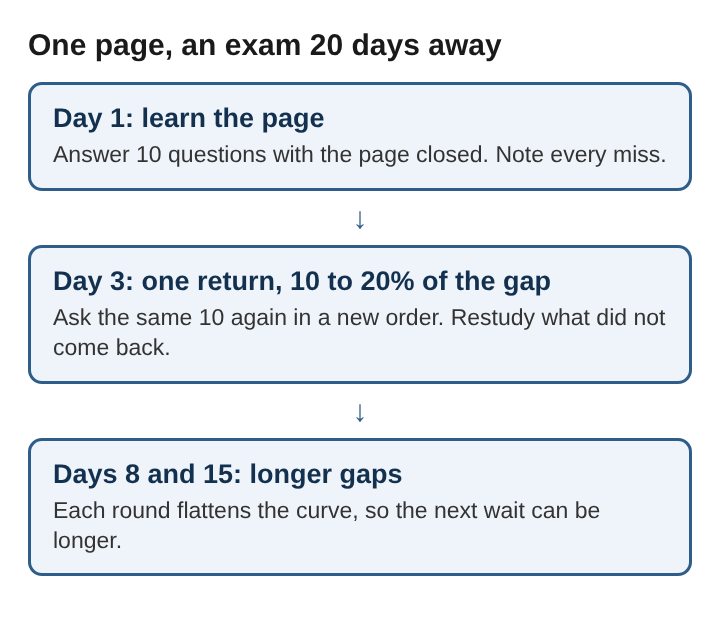
- Day 1. Read the page once, then close it and answer 10 questions from memory. A question such as "Where in a plant cell does photosynthesis take place?" makes you pull the answer out instead of nodding at it. Note each one you miss.
- Day 3. Ten to 20 percent of 20 days is two to four days, so day 3 fits. Ask the same 10 questions again in a new order. Some answers that came easily on day 1 will be shaky. Restudy those, and only those.
- Day 8. Wait longer this time. Ask the questions again and count how many come back without the page.
- Day 15. One more round, five days before the exam. By now most answers should come back quickly. Any that still do not are the ones to work on in the last days.
With Study Shot, a photo of the page gives a quiz of 5 to 20 questions with four choices each, and its guide suggests Tiered with 10 questions per page for revising a chapter page by page. Every quiz is kept in a library with its page photo, so the same questions are there on day 3, day 8 and day 15.
Notice what the plan does not do. It does not reread the page on each day. Rereading feels like progress because the page looks familiar, but recall from memory is what flattens the curve.
Frequently asked questions
Does everyone forget at the same speed?
Ebbinghaus thought the basic speed of forgetting differs little between people. He put most of the difference down to how well people represent what they learn, and to how hard and how meaningful the material is.
Is the forgetting curve the same for every kind of memory?
No. Some memories do not follow the usual curve, and researchers still debate its shape for events that matter a great deal to a person, such as shocking public events.
How soon after learning should you first come back to a page?
One guide is to wait 10 to 20 percent of the time until you need the material. For an exam in 10 days, that means one or two days after you first learn the page.
Can you undo forgetting that has already happened?
Mostly, yes. In his measure of savings, Ebbinghaus found that material learned before comes back faster than it took to learn the first time, so going back to an old page is quicker than starting a new one.
The forgetting curve, in short
The forgetting curve is a record of what happens to new material when you leave it alone: it fades fast at first and then more slowly. Ebbinghaus mapped it with nonsense syllables more than a century ago, and the shape has held up since. The useful part is what bends it. Material that means something to you fades more slowly. A page learned well fades more slowly than a page skimmed. Each time you pull an answer out of memory, the curve flattens and the next wait can be longer. And a first return timed at about a tenth to a fifth of the gap before you need the material catches it before most of it is gone.
Study Shot
Turn any page into a practice quiz. Visit studyshot.vlvd.net