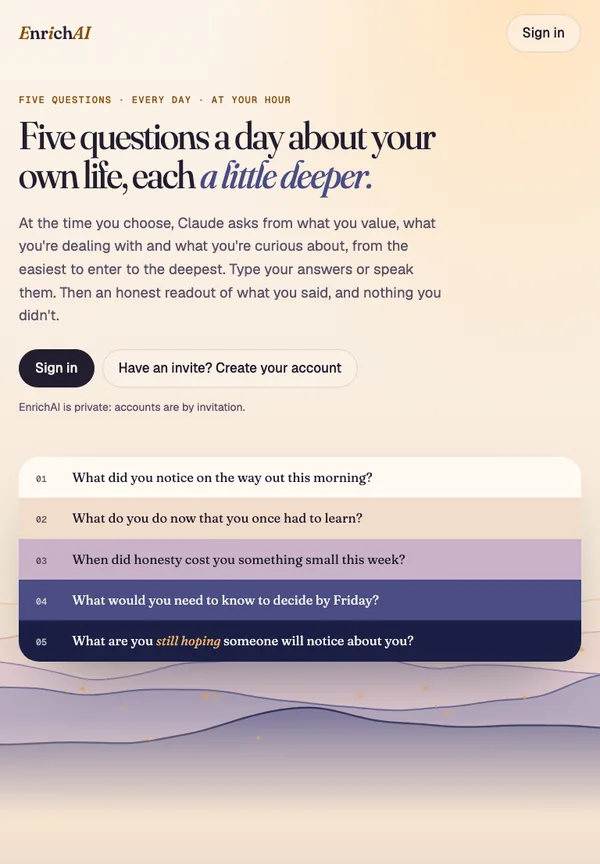
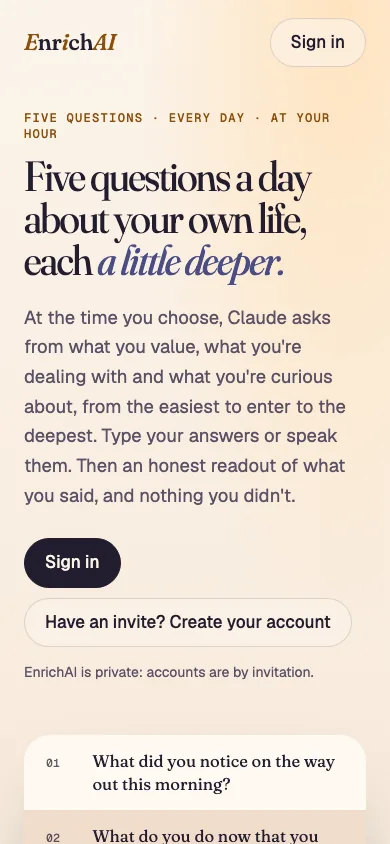
A question-a-day journal is a notebook, app or file where you answer one question about your own life each day, or a small fixed set of questions, instead of starting from a blank page. People searching for what is a question-a-day journal usually want to know three things: what the questions look like, how long an answer takes, and what the habit gives back after months of entries. EnrichAI sends five questions a day about your own life at an hour you pick, then writes a plain readout of what you said and sets it beside your week and month. The method works the same on paper.
What is a question-a-day journal
The core of the format is a prompt you did not have to invent. You open the journal, read a question, and write an answer. The question narrows the field. You are not asked to describe your whole day or your whole state of mind. You are asked one thing, such as what you noticed on your walk or what you put off this week.
That narrowing is the reason the format exists. A question gives you a starting point and a finish line. When it is answered, the entry is done.
Most question-a-day journals share a few traits:
- One question per day, or a short set answered in order.
- Short answers, often a few sentences.
- Questions that cannot be answered with yes or no.
- A record you can read back later, sorted by date.
How a question-a-day journal differs from free writing and gratitude lists
Free writing asks you to write without stopping for a set time and without editing. Its weakness, for a daily habit, is that it has no shape. On a flat day you write about the weather. On a hard day you circle the same worry for ten minutes. Reading it back a year later is slow, because nothing lines up from one entry to the next.
A gratitude list asks for a few good things from the day. It has shape, but a narrow one. It points you at one kind of material, and after a few weeks the items start to repeat: coffee, a friend, the sun.
A question-a-day journal sits between the two. It has more shape than free writing and more range than a gratitude list. One day the question is about a small physical detail. The next day it is about a value, a habit, or a choice you are weighing. Because each entry answers a stated question, you can later find every answer to that question and read them side by side.
The kinds of questions a question-a-day journal asks
Good daily questions tend to draw on a few sources. Knowing them helps you write your own or judge a set someone else wrote.
- Place and season. "What changed on your street since last month?" These are easy to step into, because the answer is something you saw.
- Stage of life. "What do you spend time on now that you did not five years ago?"
- Values. "When did you act on something you care about this week, even in a small way?" For more on this kind, see how to write about your values in a journal.
- Yesterday's thread. "Did you make the call you were avoiding yesterday, and what did you say?"
- Curiosity. "What did you want to know more about today?"
A useful set also moves from easy to deep. A concrete question about what you saw lets you start writing before you have to think hard. A harder question about a choice or a value works better once you are already writing. If a question feels too heavy on a given day, there are ways through it; what to do when a reflection question feels too hard goes into that.
How to answer one question in about five minutes
Here is a worked example. Say the question is: "What did you put off today, and what did you do instead?"
- Read the question once and answer the literal part first. "I put off replying to the landlord's email." One sentence. You now have an entry.
- Add one concrete detail. "I opened it twice, then closed it and cleaned the kitchen." Details are what make an entry readable a year later.
- Write the part you were tempted to skip. "I think I am avoiding it because I do not want to ask about the deposit." This is often the most useful line, and it usually comes third.
- Stop. Do not add a lesson or a plan unless one is already there. An answer that ends is easier to come back to tomorrow.
That is four or five sentences and a few minutes. If you want a set of quick prompts for a fixed short entry, what goes in a five-minute journal covers that format. On days when nothing comes, what to write when you have nothing to say has a few ways in.
Why repeated questions show change across months and years
The quiet strength of the format is repetition. When the same question comes back, your old answer becomes something to compare against. "What are you worried about right now?" answered in March and again in September tells you more than either answer alone. You can see which worries stayed, which ones went away without any action from you, and which ones you dealt with.
A fixed time helps the repetition hold. Research on habit describes behavior repeated in a consistent context becoming more automatic, with a context cue such as a time of day or a prior action setting it off. It is also slow: Lally and colleagues found an average of 66 days to reach automaticity, with a range of 18 to 254 days. A question that arrives at the same hour every day gives the habit its cue.
The word diary comes from the Latin for "day", and a diary generally means daily entries, while journal writing can be less frequent. A plain diary records events, which matters too. A diary entry about a job interview tells you what happened. A run of answers to the same question tells you how your view of something shifted over time, which is harder to see from inside any single day.
Keeping a question-a-day journal in EnrichAI
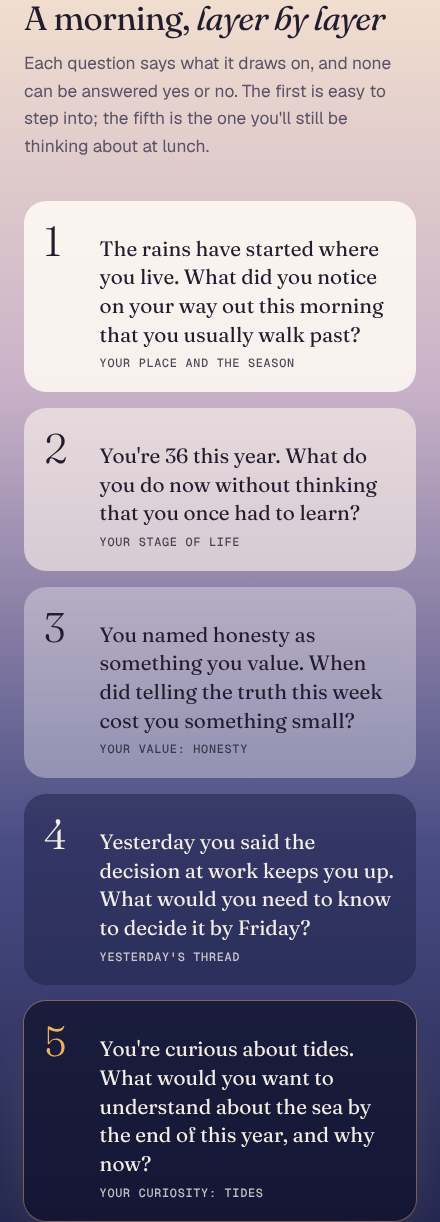
The site uses a set of five daily questions rather than one. At the hour a person chooses, Claude asks five questions drawn from what that person values, what they are dealing with, and what they are curious about, ordered from the easiest to step into to the deepest. Each question says what it draws on: the person's place and the season, their stage of life, a value they named, yesterday's thread, or a curiosity. None can be answered yes or no. The home page gives examples such as "What did you notice on the way out this morning?", "What do you do now that you once had to learn?" and "When did honesty cost you something small this week?"
Answers can be typed or spoken, and each one saves as it goes. Once the fifth answer is in, the day's readout follows, which the site calls the enrichment. It catalogs the person's own words, says plainly what was left unanswered, and sets the day beside the week and the month. The next day's questions follow what was left open, which is the "yesterday's thread" idea built into the schedule.
The site also lists what Claude will not do there: tell a person how they feel, flatter them, grade their answers, give advice they did not ask for, or invent progress their answers do not show. It is private, and accounts are by invitation. Answers are kept in the site's own database and sent to Claude only to write the questions, readouts and progress. There are no ads and no trackers, and a person can download everything they wrote or delete their account.
Frequently asked questions
How long should a daily answer be?
A few sentences is enough for most days. One literal answer, one concrete detail, and one honest line is a full entry. Longer answers are fine when they come easily, but length is not the goal.
What happens after a missed day?
Nothing needs fixing. Answer the current question and leave the gap; trying to catch up on several days at once turns the habit into a chore. For ways to keep going through busy weeks, see short entries that last.
Can a question-a-day journal be kept on paper?
Yes. Write a list of questions in the back of a notebook, date each entry, and copy the question at the top before you answer. Marking repeated questions with a small symbol makes them easy to find later.
Should the same question come back more than once?
Some should. Questions about worries, values and habits are worth repeating every few weeks or months, with the same wording, so you can compare answers. One-off questions about a specific day or place are fine to use once.
What a question-a-day journal leaves behind after a year
After a year of short answers, you have a record that is easy to read in a way a long diary often is not. Each entry is short, dated, and tied to a stated question. You can read every answer about work in one sitting, or every answer about a person, or every answer to "What are you avoiding?" in order.
What you find there is specific. A worry that filled your answers for three months and then never came up again. A value you named in January and acted on in small ways through the spring. A small detail from a walk that you would have forgotten entirely. None of it tells you what to think about your life. It shows you what you actually said, day by day, in your own words, and that record is the thing the format exists to build.
EnrichAI
Five questions a day about your own life, each a little deeper. Visit enrich.vlvd.net